• Tuesdays at 8 a.m.

    I look forward to going to therapy, even if I don’t necessarily look forward to getting up earlier than usual and paying a $35.00 copay just to talk someone’s ear off.

    Someone whose job I do not want. Someone who would be justified in secretly judging her patients’ “first world problems.” Someone who may not have much left to give herself at the end of every exhausting workday. Someone who has seen me cry more times than she has seen me smile.

    I didn’t start going to therapy to learn how to function. The truth is that I can function the way I am.

    But I don’t want to just function. I want to change. And I knew, after all previous, failed attempts, I would need to hire a professional to get there.

    I needed someone to read between the lines of every one of my monologues. I needed someone to listen, completely and fully, before jumping to conclusions. I needed someone to be a verbal handbook for healing. I needed someone to approach my emotion with empathy and logic. I needed someone to be objective enough to challenge me and understanding enough to analyze me without judgment.

    I need therapy because I want to be better. And I am self-aware enough to know that I can’t do it on my own.

    Today, we discussed boundaries.

    For a long time, I thought that boundaries and kindness were opposites. I thought, for one, that I had made too many mistakes and hurt too many people to have boundaries, or that somehow my screw-ups and failures voided any need I might have for the rest of my life. Secondly, I thought that if I said no or stepped back or held my ground that I was doing something unloving, especially if the person asking me to stretch was someone I had hurt.

    My entire adulthood has been a replay of the same scenario with varying circumstances – I create a standard by which others can access me. I believe it on paper and I rehearse it.

    And then I make a mistake, or I hurt someone, even if unintentionally, or someone argues with my set of standards in a way that I cannot logically refute.

    And suddenly the standard evaporates so that other people can be okay. I give up what I need so that the world around me can run more smoothly – even if I am breaking on the inside.

    I have a tendency to mistake remorse for redemption. And one of the ways I have expressed remorse is to extend unlimited grace to people who not only test – but cross – my boundaries.

    The “no” I feel in my head and heart suddenly becomes “that’s fine” or “sure,” because I over-claim responsibility for how other people view me. And because I have made so many mistakes that have hurt people, I over-extend myself so that my “no” is not added to an already long list of reasons why people do not like me, do not trust me, or are otherwise disgruntled with my mere existence.

    On Day 1, I told my therapist that I was the problem. I asked her if she could fix me. I begged for books, mantras, homework. I wanted to break destructive patterns. I wanted to shift my focus permanently. And I wanted a future that doesn’t involve anymore repeated failures.

    I still want those things.

    The course of my therapy has changed a lot in the last 6 months. After getting some background from me during our first few appointments, my therapist has since let me lead the discussion. And we have talked extensively about my relationships with other people. And not one time have I ever placed blame on anyone except myself.

    Until today.

    I didn’t feel good about it.

    This is about to reach a point of specifics I have tried to avoid on this blog. But I need to talk about it.

    There is a person currently in my life that I did not invite. This person – we’ll call her “Erin” – was forced upon me. Circumstances created by divorce, remarriage, and proximity have placed Erin in my path. She’s been around for about five years, the last four being pretty consistent.

    The first two years of dealing with Erin were a nightmare. I will admit to being guarded when I met her. I assumed the worst. And then Erin proved me right. The constant tug-of-war for control, the gossip, the second-hand harassment, the interference. I was always on the defense. I was emotional. I was on edge, anxious, and torn down. Erin made me question every good thing I have ever thought about myself, and there weren’t many of those to begin with.

    I certainly didn’t make things better, because, to combat all of the accusations and hostility, I matched Erin’s energy. I pointed out all of her flaws, and I didn’t hold back. I tried to validate my hurt by making Erin seem small.

    Two years in, the tug-of-war had ripped me apart. I realized that Erin and I were going to disagree about every subject based solely on opinions, personality differences, and principle. It didn’t matter if she made valid points. It didn’t matter if I made valid points. Our relationship was not one either of us wanted, and that was never going to change. Our respective needs to control our own worlds made it impossible for us to see eye to eye.

    So after two years, I did my best to avoid Erin physically. I blocked her number. I did my best not to discuss her with other people.

    But she lived in my head, rent-free. I replayed old arguments, stood on my metaphorical soap box justifying all of my behavior and none of hers.

    And that wasn’t healthy either.

    Over the weekend, I sent a text to someone with whom Erin is close. We will call this person “Alex.” It was a simple text regarding a vacation that I have scheduled.

    A backstory within a backstory – Alex and I used to be close. I cared for Alex and wanted our friendship/civility to remain intact. Erin’s entrance into our lives made that undoable, because Alex gave Erin full control of the relationship between us. Erin told me I was no longer allowed to call Alex, and that only texting was permitted. So when I followed that rule, Alex just gave Erin the phone, and Erin would respond to my texts on Alex’s behalf. An absolute nightmare on all counts.

    I didn’t receive a response from Alex’s phone to the text I had sent.

    But lo and behold, Erin called me. She called me after she told me 5 years ago not to call her or Alex. She called me after we’ve spent the last 5 years not-so-secretly despising each other. She called me after dragging my name through the mud, after reminding everyone that I am a terrible human being, and after crossing the line that exists between my reality and hers.

    When I saw Erin’s name on my phone, my heart sank. First, I thought I had blocked her. Second, I wanted to talk to Alex – the actual involved party – not Erin. Third, HOW DARE SHE?!?

    All of those thoughts occurred in about two seconds’ time. The following two seconds? The words “grace” and “forgiveness” flashed before me, along with a mental highlight reel of all of the times she’s accused me of being the problem in our not-even-wanted relationship.

    I answered the phone call. I didn’t want to answer it. But I thought not answering would create more problems for all involved. Since she controls Alex, she tries to control situations where Alex and I interact. Erin believes that she is protecting Alex from me. I believe Alex should act like a grown up and have grown up conversations. Since Alex does not, I believe Erin constantly oversteps. And by answering the phone call, I accepted the overstep. I shouldn’t’ve.

    Erin and Alex have a shared calendar that apparently Erin manages. So my notification to Alex about my upcoming vacation sparked the “need” for this phone call.

    I was monotone. To the point. And purposefully unaffected externally, even though I was physically shaking and panicky on the inside, to the point of feeling ill. Erin and I discussed the calendar, and that was it. “I manage the calendar and it’s really confusing. I just want to make sure Alex is where he needs to be,” she explained, with intermittent giggles I interpreted as an outward expression of disagreement with the vacation dates I provided, how I interpreted my contract with Alex versus how she interprets my contract with Alex. But she was not expressly rude or argumentative on the call. I will give her credit for that.

    Call ended. A 4 minute and 56 second unnecessary use of time.

    And it has occupied my mind ever since.

    So for 4 days, I have replayed it. What did I do that was right? What did I do wrong? Why did I even answer?

    This was the subject of my therapy today: BOUNDARIES.

    I told my therapist the above story, and she, too, asked me why I answered the call.

    “…because I am not unkind,” I explained tearfully.

    And we spoke for the remainder of my session about boundaries, specifically in relation to kindness.

    Kindness without boundaries is not kindness at all. It is self-erasure.

    I still don’t know if I get it. I just know I am tired of breaking myself so that others don’t have to bend. So I created a list (lists are my jam). I share it below, as a reminder that (1) boundaries are healthy when placed and followed correctly; and (2) boundaries preserve stability in all relationships, including relationships that are forced upon us.

    1. I don’t have to explain my “no” beyond what is reasonable. A clear answer is kind. A long explanation, which is often received as combative, is usually fear in disguise. I can offer clarity, not a defense.
    2. Managing others’ disappointment is not my job. I can empathize without fixing. And I can care without contorting. But discomfort does not mean that harm was done. I can understand Erin’s desire to be involved. I can understand her protective instincts when it comes to Alex. I can see how Erin would be disappointed, upset, or even angry about not having a say in my schedule. But I don’t have to accept her feelings as truth, and I don’t have to explain myself to her at all.
    3. I am allowed to protect my energy when I am already depleted. Saying, “I am not up for that today” is not rejection. It’s honesty. I am not required to sacrifice my capacity to appear accommodating. Knowing this now, I will need to put it in practice by not answering anymore of Erin’s calls. I am legally obligated to communicate with Alex. I am not obligated, legally or otherwise, to include Erin in any of that communication. If Erin’s reality is that she manages Alex’s calendar, that is great. But I manage my own schedule like a whole adult, and Erin’s approval is not only unnecessary – it’s uninvited.
    4. I do not have to engage in conversations that feel unsafe or circular. Respectful dialogue is welcome, but repeated pushing is not (like Erin’s phone call to me after setting her own boundary of “do not call me, ever” 5 years ago). Stepping away is not escalation – or at least not escalation that I cause. It’s discernment.
    5. I do not have to respond immediately to everything. Urgency is not always shared. I can reply when I am present – not panicked. This is a way to stay thoughtful instead of reactive. The vacation I have planned isn’t for another 5 weeks. The call from Erin did not have to be answered immediately, and looking back, I should have, at the very least, centered myself mentally before answering.
    6. I am not required to accept responsibility for feelings I did not cause. I pay attention to impact. I remain accountable for my behavior. But I don’t have to absorb emotions that belong to someone else’s expectations. Erin has never once asked for “my side” of stories she has heard about me (nor I her, to be fair). That only means her mind is made up. But how she feels about me is not even my business, let alone my responsibility, especially because her feelings are based on second-hand gossip and assumptions.
    7. I am not required to give unlimited access to my inner world. Depth can be offered slowly, with trust – not a demand. Privacy is not secrecy. It’s stewardship. I cannot control the fact that Alex loops Erin into scheduling. And Erin will, unfortunately, know my business it overlaps with Alex’s. But I do not have to acknowledge it.
    8. It is not healthy to tolerate disrespect in the name of understanding. Context explains behavior. But it doesn’t excuse it. Kindness does not require endurance. I will admit that the call with Erin went better than I thought it would. I expected Erin to argue my vacation dates with me. She didn’t. But again, the text I sent to Alex was sufficient. A conversation wasn’t necessary, especially not with Erin.
    9. I do not have to overextend to prove my worth. If I contribute, it should be because I want to, and not because I am afraid of being less valued. I don’t audition for belonging anymore. There are so many people who no longer want me in their lives because I have hurt them, and I am learning to accept those consequences. And I answered Erin’s call because I didn’t want her to have another negative thing to say about me. But the truth is that answering that call didn’t earn me any brownie points. Her hatred for me has not lessened. Our relationship has not improved. In fact, she probably got off of the phone and talked to Alex about how flawed I am in one way or another. And I do not feel any better even 4 days after that phone call. All that phone call did was let her know that I am willing to accommodate her interferences where Alex is concerned. Regardless of my failures, I was worth something before I answered, and I’d still be worth something if I hadn’t answered. What Erin thinks does not alter my value.
    10. I am allowed to keep my values intact, even when it costs approval. I can be gentle without being vague. And I can be kind in or out of silence. Alignment matters more than being liked. Now that I am back-pedaling, I know, 4 days later, that I would’ve felt better if I had honored my own principles about talking to people who are determined to misunderstand/misinterpret my every move. I failed myself by answering Erin’s call. In a panic and under pressure, I forgot that I matter, too.

    I am certainly not finished with this subject. And I will revisit this list with my therapist next week. But after 4 days of stewing, I hope that someday soon I will fully embrace the idea that boundaries don’t make us cold. They make us steady. They allow us to show up with sincerity instead of resentment and with clarity instead of exhaustion.

    And I do know this – kindness that costs me my peace isn’t sustainable. Too often throughout my life, I have bent, masked, and stretched myself so that others could tolerate me. I have given my time, my money, my permission, my forgiveness, my grace, and almost my sanity to people who not only take advantage of those things, but hold those things against me when I reach a breaking point. I have accepted what others say about me as fact as if they know me better than I know myself. I have nearly driven myself mad trying to be everything that everybody needs and then punishing myself when I cannot reach that impossible goal. I have created chaos in my life and the lives of others trying to force myself to be palatable at any given moment, in any given crowd, or with any given person. I have accepted others’ criticism as a challenge to change who I am and what I believe to suit their needs. And honestly, looking back, I feel sick and enlightened in equal measure. Not creating or maintaining boundaries has cost me important relationships. It has cost me sleep. It has cost me money. It has cost me precious time I cannot get back.

    That part of my life has officially come to an end.

    I hope everyone’s week is filled with happiness.
  • There are parts of myself I recognize easily now – not because they’re gone entirely – but because they no longer fit like they once did.

    It’s not rejection. It’s recognition.

    There are things that used to feel familiar, even defining, in my life. And somehow, they don’t fit anymore.

    1. Constant urgency – I used to live with a low hum of “I’m behind.” Everything felt time sensitive, important, and vaguely at risk. Now I am able to recognize the difference between urgency and habit. And I’ve decided that most things can wait.
    2. Overexplaining – I once believed that clarity would protect me from misunderstanding, conflict, or even being seen the wrong way. Now I know that people who want to understand don’t need me to narrate myself to exhaustion.
    3. Being needed – Being relied upon felt like a security blanket. Being needed was proof of my worth. But these days, I am more interested in being chosen, not required.
    4. Carrying other people’s emotions – I used to absorb moods, tension, disappointment – as if they were mine to manage. Now I pause. I notice. And I return what isn’t mine.
    5. Performing competence (or just performing in general) – Having it together all the time once felt important. Necessary. Now I am comfortable being capable without showcasing it.
    6. Staying to avoid discomfort – Leaving, stepping back, or disengaging used to feel like a failure. Now it just feels like discernment.
    7. Confusing intensity with connection – If something felt big, dramatic, or emotionally charged, I assumed it mattered more. If something or someone made me anxious I made it my mission to defend myself, change the circumstances, or “grease” it to death like the squeaky wheel I can be. But now I trust steadiness. Consistency beats chemistry – especially fake chemistry – every time.
    8. Self-criticism as motivation – I once believed that being hard on myself would keep me sharp. I also believed that challenging relationships would reveal my best self. Neither did. I was just tired all the time.
    9. Trying to be understood by everyone – I used to contort myself to be readable, palatable, and agreeable. Now I’d rather be honest and misunderstood. There are insults worse than “I don’t understand you.” Who cares? I don’t understand half of them either.
    10. Waiting for permission to rest – Rest used to feel earned. Conditional. Like the thing I was allowed to do after I checked all of my boxes. Now it feels like part of being a human being who has limits.

    What has replaced these things isn’t flashy. It’s quieter. More discernment. Less explaining. Deeper ease. Slower confidence.

    I didn’t lose myself. I just stopped carrying what never really fit. And honestly? That feels like growth I can live inside.

  • Having once been told that “all women are the same,” I used to think “being myself” would feel louder. More distinctive. That the things that piqued my interest would be more interesting on paper, or that somehow my traits would make me “more” unique than the next girl.

    What I am learning now is that all women are definitely not the same. The truest parts of me are small, steady, and – not to be dramatic – kind of boring.

    And somehow that feels right.

    1. I like calm mornings. Not productive ones. Not aesthetic ones. Just mornings that don’t require urgency. I love being able to roll out of bed – in my big t-shirt – and warm up with the day.
    2. I prefer knowing what to expect. While surprises sound fun in theory, I prefer the practices of context, clarity, and at least a vague idea of the plan. Other people have mistaken it for micromanagement, but at my age, and at my current “leanage” toward anxious thoughts, I just like knowing what’s next.
    3. I enjoy repetition. The same coffee mugs (even if in rotation). The same routines. The same handful of reliable comforts – my big bathtub, my hairstyle, what I eat for dinner and in what order. Novelty is fine. But to me, familiarity is better.
    4. I think before I speak. And sometimes I think a lot before I speak. It’s not because I am unsure. It’s because I care about tone and eloquence. When my emotions are especially on edge, it is very likely that you’ll find me in a corner stewing about what I need to say, as opposed to actually saying it.
    5. I need time to warm up. To people. To rooms. To days. I rarely arrive fully formed. I need to settle in.
    6. I notice things quietly. Mood shifts. Energy changes. What isn’t said. I don’t always act on it. But I do keep mental notes.
    7. I am content with fewer, deeper connections. Big groups drain me, and that used to feel like limitation. But small, meaningful conversations restore me, and now, that is the preference.
    8. I do better without constant stimulation. Background noise wears me down. Silence gives me space to breathe.
    9. I process things internally. I don’t always have immediate reactions. Or words. Understanding comes after reflection – not during it.
    10. I feel most like myself when nothing remarkable is happening. When I am not explaining, performing, or fixing anything. When I’m just existing – unobserved, uninterrogated, unhurried.

    None of this is impressive. It will never make a highlight reel, and oddly, outside of some pretty cool things going on financially, I probably don’t belong in a highlight reel.

    But these are the conditions under which I am most regulated, thoughtful, and real.

    Maybe “being yourself” isn’t necessarily all about being more interesting.

    Maybe it’s just about being less fractured. Less rushed. Less explained. Less loud.

    And if that is boring, I think I am finally okay with that.

  • I have to be honest about something.

    I don’t like myself very much.

    It’s not a character flaw. It’s a pattern that makes sense given some of the things I’ve lived through.

    I don’t dislike myself because I am secretly awful.

    I dislike myself because I learned to see myself through the lens of harm, failure and fear, instead of context, growth and humanity.

    I have collapsed my worst actions into my entire identity. Instead of thinking, “I did harmful things. I regret them. I’m responsible for repairing what I can,” my brain jumps to, “This is who I am. This is what I am.” And when shame goes unresolved, it stops being about behavior and turns into self-contempt. I don’t hate myself for the things I’ve done. I hate myself because I believe I am the doing. And that’s a brutal place to live.

    I don’t allow myself the mercy I extend to everyone else. I understand nuance when it comes to other people. I understand trauma, unmet needs, fear, attachment wounds, and exhaustion. But when it comes to me? I go straight to sentencing. No mitigating circumstances. No developmental context. No nervous system explanations. Just the gavel. And that internal double standard has eroded affection for myself over time. Anyone treated that way eventually becomes someone I wouldn’t be interested in being around – even in my own head.

    I learned that love is conditional, fragile, and easily revoked. Somewhere along the way, love became tied to being good enough, not messing up, not being “too much,” not hurting anyone, and staying useful, stable and agreeable. So now, when I look at myself, I don’t ask, “Am I human?” Instead I ask, “Am I still allowed to exist without being rejected?” That makes liking myself feel unsafe, because if I soften toward myself, it feels like I’m letting my guard down in a world that has proven it can cause wounds.

    I mistake hyper-accountability for integrity. I care deeply about integrity, but my version has become punitive instead of principled. True integrity says, “I tell the truth, take responsibility, and continue growing.” My version has quietly and gradually morphed into, “If I ever fail again, I don’t deserve peace.” And living under that rule has created constant self-surveillance. And no one likes someone they have to police 24 hours a day, not even themselves.

    I am grieving who I thought I would be. I had an internal picture of the mom I wanted to be, the woman I thought I could be, and the life that would make sense of everything. When the reality didn’t match the picture, the grief didn’t get processed. I just redirected it at myself. And self-dislike often begins as unacknowledged grief that just wears armor.

    I don’t dislike myself because I am irredeemable. I dislike myself because I am honest, reflective, remorseful, and have a strong moral compass. I do not yet know how to hold accountability without annihilating myself.

    What I am learning is that the bridge between self-hatred and self-love is something I have missed. It’s called self-respect. It’s calm. Unromantic. Firm. It’s not, “I’m amazing.” It’s, “I will not abandon myself.”

    1. I am trying to stop narrating my life as a prosecution. Self-respect isn’t, “There’s the full list of evidence that proves I am defective.” Instead, it’s, “What happened happened. Now what is the responsible next step?” I don’t rewrite the past kindly. I just stop reopening the case every day. If my thoughts are not solving anything, I don’t argue with it. I just disengage.
    2. I am keeping small promises to myself, even when no one is watching. Self-love says, “I matter,” but self-respect just means that my word matters. I try to do the things I say I am going to do, even if it’s as simple as drinking water, or going to bed on time, or finishing a book. I don’t do this perfectly, but I try to do it consistently enough so that I can trust myself again.
    3. I am trying to stop using pain as proof. Hurting as much as I am hurting does not mean I am bad. Pain tells me that something is wrong, not that I am wrong. So instead of asking myself what is wrong with me, I am trying to ask myself what happened to me, or what need went unmet, or what fear is active in the moment.
    4. I am trying to tell the truth in real time, even when it is uncomfortable. Not necessarily confessional truth. Just present-moment truth. Things like, “I don’t know how to answer that yet,” or, “I don’t have the capacity to show up at my best right now,” or, “I am overwhelmed and need to pause this.” Self-respect does not demand eloquence. It demands honesty without theatrics.
    5. I have stopped rehearsing how awful I am. I don’t replay conversations to punish myself. I don’t imagine how others judge me for sport. I don’t mentally practice shame “just in case.” Because it isn’t helpful to mentally degrade myself as a form of vigilance.
    6. I am working to allow consequences without expanding them into my identity. I am learning to accept that some people won’t trust me again, some doors are closed, and some relationships are forever changed. I just draw the line at, “Therefore, I am permanently unworthy of peace.” Consequences are events. But identity is not up for retroactive sentencing.
    7. I am consistently choosing behaviors that don’t make tomorrow harder. Before self-love, self-respect asks, “Will this cost me more later?” And then I decide accordingly, with neutrality, not heroics. No self-flagellation. No grand vows. Just fewer self-betrayals.

    Self-love is at the end of the line. Self-respect comes first. Then self-trust. Then self-compassion. And eventually, affection. I am not behind. I am exactly at the stage where integrity is being built from the inside, not performed.

  • What does my perfect day actually look like?

    Not the aspirational version.
    Not the productivity fantasy.
    Not the “I’ll do this when my life is different” model.

    This day would make me feel most like myself – steady, present, quietly content.

    It starts without urgency.

    I wake up without an alarm blaring me into consciousness. No rush. No adrenaline. Just a gradual awareness that I’m awake and allowed to be. The morning is calm. Not empty. Also not indulgent. Just unthreatening.

    And there’s coffee. But no pressure. Coffee is made slowly, and there is no optimal routine to live up to. I’m not running late. I don’t feel behind before the day even starts. And I sit on the couch and drink it, letting my brain warm up at its own pace.

    On this day, I have one meaningful thing to do. Not ten. Not a list designed to prove anything. Just one thing that matters. And it doesn’t really matter what the thing is. Maybe it’s trying a new recipe. Maybe it’s finishing my true crime series. Maybe it’s blogging. Maybe it’s a bullet journal project. Or finishing my book. Whatever it is, I do that thing without multitasking and without narrating it as a test of my worth.

    And there is space for reflection. But no spiraling. I think, because I always think. But I don’t interrogate myself. I just notice things on this day, and I let them pass without turning them into conclusions or accusations. Insight. Not criticism. That is the sweet spot.

    I feel emotionally safe. I’m not walking on eggshells. I’m not preparing for reactions. I’m not monitoring tone, timing or subtext. And the people around me don’t require that I live up to their expectations in order to accept me.

    I laugh. It’s unexpected. Nothing forced. Nothing clever. Maybe something catches me off guard – the neighbor’s farm animals across the street or a funny YouTube video. Maybe my dog runs into the wall again, as he often does when he gets the zoomies. Again, it doesn’t matter. Just something funny that catches me off guard and reminds me that I like being here.

    I move my body. A walk. A stretch. Enough movement to remind myself that I live in my body and not just my head. No goals. No metrics. No moral meaning.

    On this day, there’s writing without publishing. Thinking without concluding. Creating without explaining. No audience. No performance.

    I’m not misunderstood. But I’m also not performing clarity. On this day, I say what I mean, plainly. I don’t over-explain. I trust that being myself is sufficient.

    And the day ends quietly. No dramatic recap. No assessing what I should’ve done better. Just a sense that the day was lived, not optimized.

    This day doesn’t require me to prove I’m good or fix anything. I don’t have to anticipate rejection or earn rest. And I don’t have to be “impressive.” I only have to show up as I am – thoughtful, observant, funny, and most of all, a human being.

    On this day, that is enough. And honestly? That kind of feels like home.

  • Not once in my life have I ever been perfect. Nobody has.

    But I have definitely pretended to be perfect in order to be accepted.

    With honesty – below is a list of what I believe are my biggest character flaws. I am working through these, gently and slowly. And I am finding that consistency is more important than intensity.

    1. I over-function and over-extend when I am afraid of being abandoned. When connection feels uncertain, I explain more, give more, accommodate more. And I take responsibility for things that are not mine. None of these are forms of manipulation. But they come from fear + loyalty + a deep desire to be understood. On the flip side, this flaw only teaches others that I can carry the load alone. And then I resent it. A vicious cycle played out in real time, throughout so many of my former relationships with people.
    2. I confuse self-awareness with self-punishment. I am introspective, and that is a strength. But the flaw lies in the insight that doesn’t stop where it should. And it turns into replaying, self-interrogation, moral sentencing. Instead of “What can I learn from this?” my brain goes straight to “What does this say about who I am?” And that’s not accountability. That’s actually erosion, and it’s not beneficial.
    3. I stay too long out of hope. I see potential. I see nuance. I see context. So I wait. I explain. I give chance after chance after chance. And I assume growth will catch up. My flaw isn’t that I hope. It’s that I sometimes delay my own relief waiting for others to meet me where I already am.
    4. I intellectualize emotions instead of letting them move. I understand my feelings better – or – to a higher degree – than I actually feel through them. And those emotions turn into essays, patterns, conclusions, and eventually identities, instead of waves that I sit through, and waves that eventually pass. It is exhausting.
    5. I take responsibility for outcomes I don’t control. Have I mentioned I have control issues? So when something goes wrong, I believe, “I must have missed something.” And while that makes me dependable, it also forces me to carry baggage that I really need to leave on a metaphorical curb somewhere. I don’t yet trust that things can fail without feeling like I’ve failed.
    6. I am slow to trust ease, as opposed to tension. Chaos feels familiar. Hypervigilance feels competent. And peace feels suspicious. When things are quiet, my brain starts scanning for what I’ve missed. And it’s not drama-seeking. It’s just my nervous system, which has been trained in uncertainty.
    7. I expect myself to be better than human. I give others nuance, context, patience, and grace. But I expect myself to know better, sooner. I expect myself to heal faster. I expect myself to hold steadier. I expect myself to get it right consistently. I struggle to apply my own philosophies to myself. I believe them. I just don’t extend them to myself yet.

    None of these flaws mean I’m broken. They don’t mean I am unsafe. And they don’t mean I am unworthy of trust or love. They mean that I have learned to survive intelligently.

    And now I am learning how to live without armor, a transition that always feels awkward.

    I am not “too much.” I’ve been hard on someone who has been trying very hard for a very long time – me.

    And I’m working on changing that.

  • The church I attend fasted from January 4 to January 25. The specific goal was to pray for the direction in which the church was heading.

    I decided to participate in the fast. However, I didn’t give up food. Instead, I uninstalled my social media apps. Facebook, Instagram and TikTok.

    I kept Pinterest since I don’t communicate with anyone on that app. I also kept YouTube because I use it to listen to ASMR videos at night and online sermons. I also kept Audible, because that’s not a social media app, at least not in my opinion.

    A terrible ice storm came through my area about a week ago, after the fast was over. So I reinstalled the social media apps in order to connect with people who live in my tiny little community, as to receive updates about road conditions, electricity restoration, etc. Moreover, my church and my son’s school post scheduling updates. So I thought it was necessary that I reinstall my apps.

    It wasn’t.

    I was without social media for 29 days in total, from December 31 to January 28. And this is what happened:

    1. My anxiety and depression decreased significantly. Having less exposure to the “highlight reels” of others forced concentration on my own life. Hobbies. Inner work. Growth. And that ultimately reduced my anxiety.
    2. I developed an improved sense of self awareness. I had more time for introspection which helped me better understand myself, my own perspectives, my opinions – and most importantly – why those opinions exist. I would argue that, for me, social media can be brainwashing at times.
    3. Comparison culture was canceled in my life. Not seeing was everyone else was doing broke me free from the measurement of myself against others, and thus improving my sense of self worth.
    4. My productivity increased. There were less time-wasting distractions which freed up lots of time for meaningful tasks. I read a couple of books, watched some decent movies, spent time with my family, all without worrying what I was missing by scrolling for hours.
    5. My level of focus increased. I gained the ability to think more clearly and keep the phone down in order to complete a task without distractions.
    6. I developed enhanced critical thinking skills. Less exposure to shallow content improved my ability to think more profoundly about ideas that actually matter.
    7. My real-life connections became a priority. I gained the ability to sit with family or friends, not just stare at people on the internet.
    8. I slept better. At bedtime, there was no mindless scrolling. I read my Bible and closed my eyes when I got sleepy without anxiety or a guilty conscience.
    9. I was better able to live in the moment. My observation skills improved and I began to embrace the present.
    10. My skill set expanded. I learned an accomplished so much in about a month. I have maintained a bullet journal and a prayer journal, kept up with my Bible reading. I read two other books, watched movies (and reviewed them), maintained the house, perfected my skincare routine, and worked on what I share with all of you. It was an amazing use of my time.

    I am still on my apps. The first day, I scrolled TikTok for hours and started to feel really terrible about it. So I am not sure they’re here to stay. I liked who I was when I wasn’t on social media. So I will continue to pray for direction.

    I hope you have an amazing week.

  • This is not a list born out of disappointment. Instead, this was born out of clarity.

    At one point in my life, I carried a quiet set of expectations everywhere I went. I had hoped people would show up the way I would, care the way I cared, notice the things I noticed. I hoped for the same grace for my shortcomings that I extended to others for theirs.

    What I am learning, though, is that releasing certain expectations doesn’t make me colder. It actually frees me from so much anxiety.

    These are the things I no longer expect from other people:

    1. I don’t expect people to read my mind. Silence isn’t communication, even when it feels obvious to me. If something matters, I am learning to name it. And if I name it and nothing changes, I release it. It is as simple (and as complicated) as that. Clarity trumps resentment. Every time.
    2. I don’t expect the same level of self-awareness. Not everyone reflects constantly. Not everyone revisits conversations at 2 a.m. That doesn’t mean they’re careless. They’re just different than me. And how boring would this world be if everyone thought the same way I do?
    3. I don’t expect consistency from people who haven’t practiced it. Patterns matter more than promises. So I am practicing consistency for myself. And as for others, I let behavior speak instead of hoping words will grow legs. (This is not to say people can’t change, because they absolutely can. But some people don’t want to – see #1 as to how to release those people.)
    4. I don’t expect people to value what I value. Care looks different in different hands. Someone else’s priorities don’t have to mirror mine to be real or valid. The same goes for feelings, preferences, [insert thing here].
    5. I don’t expect closure anymore. Boy, oh boy, I used to. But some things just end quietly. Some things don’t end at all. And I’ve learned to make peace without a concluding conversation.
    6. I don’t expect accountability from people who avoid discomfort. Growth requires willingness. I can’t manufacture that for anyone else. And in the last 6 months or so, so many things in my life have changed – financially, physically, circumstantially. All because I knew things needed to change in my life. I was willing to put in the work. Some people aren’t. And until they are…
    7. I don’t expect people to show up the way I do. I give deeply, intuitively, thoughtfully. But that’s just my way. It’s not the universal standard. Letting go of this expectation has saved me so much recent silent disappointment.
    8. I don’t expect others to protect my boundaries. That’s my job. And I figured out that people will test what isn’t clearly held. That’s not necessarily malice. It’s just human nature. But it’s why boundaries need to be very clear. Always.
    9. I don’t expect understanding from people committed to misunderstanding. Explanations don’t work when someone only hears what he/she wants to hear. I’ve over explained far too much throughout my life, gripping tightly to the idea that if someone just understood, they would accept me. That is not the case. So now, I just let that be information. I no longer consider it a personal failure.
    10. I don’t expect to be everyone’s priority. And more than that, I no longer try to earn that position by over-giving. Mutuality does not need convincing.

    What I expect these days is honesty – from myself first. I expect clarity where possible and acceptance where it isn’t. I expect to meet people where they are – and decide accordingly.

    I thought that letting go of these expectations would make be bitter. But it hasn’t. It has made me calmer. Clearer. More self-respecting.

    I no longer wait for others to become who I need.

    I listen. I adjust. And I move forward – with my eyes open.

    Letting go of expectations for other people didn’t leave a void, ironically. It made room. For a long time, my expectations lived outward – how others would show up, understand, respond, repair. What I am learning now is that the only expectations that actually stabilize my life are the ones I hold for myself.

    And they’re not demands. They’re agreements.

    1. I expect honesty, even when it is inconvenient. Not perfection, necessarily. And not even flawless self-awareness anymore. Just the willingness to tell myself the truth instead of narrating around it.
    2. I expect myself to listen when something feels off. I don’t dismiss discomfort anymore or intellectualize it out of existence. When something keeps nudging me, I pay attention.
    3. I expect follow-through when considering my own boundaries. Nothing rigid. Just consistent respect. Because I can’t ask others to honor what I repeatedly ignore.
    4. I expect self-compassion when I fall short. Correction doesn’t require cruelty. And growth doesn’t require punishment. I expect myself to respond with care, not contempt. This has become a slow process, as I am my own worst critic. But I have figured out in the last few months that I am worth compassion, even if other people don’t extend it.
    5. I expect effort, but not over-functioning. I show up. I contribute. But I no longer carry what isn’t mine to hold. Not bitterness. Not financial burdens. Not workload.
    6. I expect pause before explanation. Not every choice needs justification. Not every feeling needs a defense. Silence has now become a complete sentence. And it has been so freeing.
    7. I expect alignment over approval. I no longer abandon my values to stay “liked.” Belonging that costs me myself isn’t belonging at all. It’s dishonest.
    8. I expect learning to be ongoing. I possess the “How hard could it be?” gene. In reality, though, I won’t always get it right the first time. So I need to stay teachable.
    9. I expect rest to be part of the plan. Rest isn’t a reward. It’s not something I earn after wearing myself out or depleting myself. Rest is a requirement. And it’s something to which we are all entitled.
    10. I expect myself to choose “forward.” I can’t live permanently in regret or rehearsal. I own what is mine, I adjust, and I keep moving.

    These expectations aren’t a guarantee that my life will ever be easy. They guarantee integrity. When I hold myself to what actually matters – honesty, care, alignment, responsibility – I stop outsourcing my sense of stability to other people.

    I don’t need other people to become anything different so that my life feels more grounded. I don’t need anyone else to change in order to feel safe – not anymore.

    And that, finally, feels solid.

  • I don’t have main character energy in a cinematic sense. I can’t even open a can of biscuits, so I can’t imagine looking cool walking away from an explosion. There’s no slow motion walk. No flawless outfits. No dramatic “score” swelling behind me.

    And to be clear, I am only an underdog in ways I create for myself, by ways of insecurity, improper time management, and a long list of shortcomings I am slowly processing day by day.

    My “main character energy” is quieter. Observational. Occasionally inconvenient.

    1. I mentally narrate my life during every day, mundane tasks. Vacuuming the floor becomes a moment of reflection. Folding laundry feels symbolic for reasons I cannot always explain. I said to someone this morning, “I never feel like I’m doing enough. I always feel like I’m behind the 8 ball.” And I know now that feelings are facts (thank you, Christy the Therapist), but the feeling has to pass, nonetheless.
    2. I assume small moments are teaching me something. Losing my keys must mean I need to become more organized. An awkward pause is my internal nightmare. A missed turn might have saved me from having an accident. The “signs” are not always bad, but to say I overthink even the small things is absolutely accurate.
    3. I pause before responding like I’m choosing a line that defines me. A returned text as simple as, “Sounds good!” has context. After living in fear of being misrepresented or incorrectly perceived, I tiptoe over every word I say at times. I guess it’s a good thing that my life is quiet these days. I prefer that over constant scrutiny.
    4. I notice aesthetic details no one asked me to notice. Lighting. Music playing faintly in the background of a store or restaurant. The emotional “tone” of a room. I rarely comment on it. But I notice.
    5. I emotionally soundtrack normal experiences. Night rides in the rain = Janet Jackson. A warm spring day = pop. Tears in my pillow at night = Hillsong. Bubble baths = acoustic covers of 00s hits. There is absolutely no reason for this.
    6. I treat minor inconveniences like plot devices. Those things don’t happen to me. They happened for character development.
    7. I reflect deeply instead of reacting quickly. This is new. And it’s not because I’m wise. It’s because I’m rehearsing my inner monologue.
    8. I romanticize resetting my life at incredibly impractical times. Ever wake up on a Thursday and decide you need to redecorate your bedroom? Ever throw away half of your wardrobe because your graphic tees “just aren’t funny enough?” Ever spend $90 on items to do a craft project for something listed for $50 on Etsy? No? Just me? K thanks.
    9. I think about “who I am becoming” while doing objectively nothing. Sitting. Scrolling. Becoming.
    10. I feel like everything would make sense if someone else were watching. Nothing exciting is happening. Not technically. But it feels important anyway.

    This is not confidence.
    It’s not cool.
    It’s barely even noticeable.

    But it is presence.
    Awareness.
    Just me – quietly starring in my own life, with no audience, no arc, and no special effects.

    And if you knew me 6 months ago, and how often I let someone else decided who I needed to be to be “enough,” you’d note progress.

    Five stars.

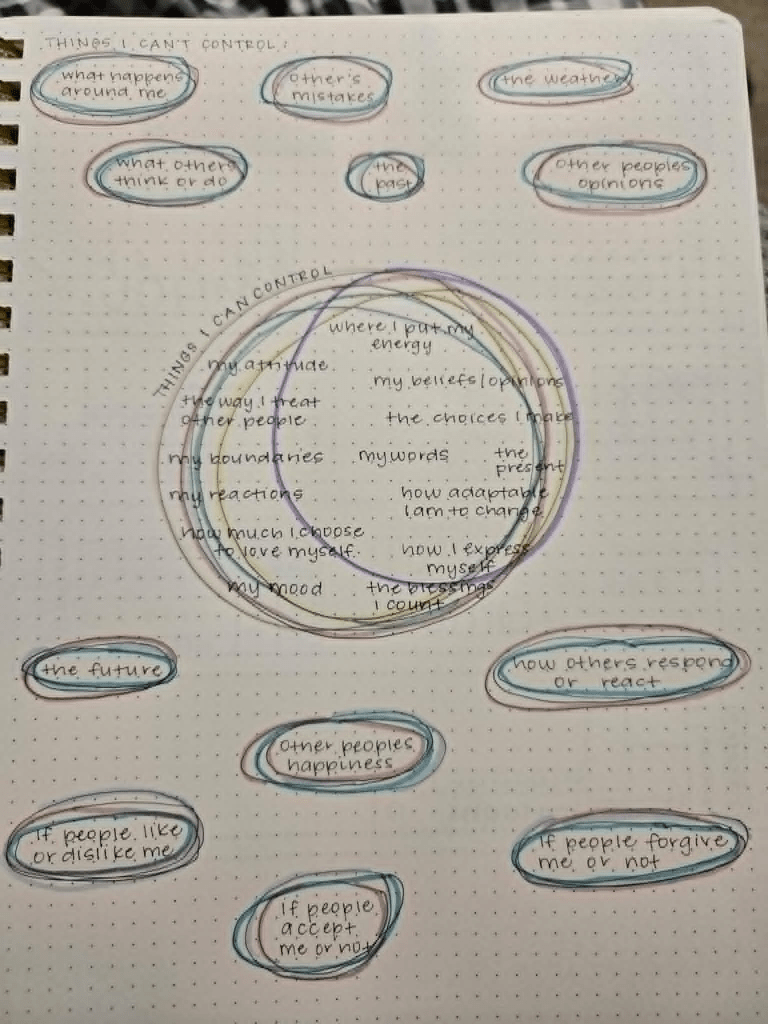
  • This week I have really tried to work on letting go of things I cannot control.

    **written in my bullet journal as a quiet reminder to myself that I should be focusing on the things inside the big circle, not the outer bubbles**

    I have an amazing job and a work ethic that trumps most others’, a beautiful home, nice car, a different Stanley for every day of the week.

    Combine those things with a never precedented desire for privacy, and on the outside I’m capable, rational, put together.

    (I make a point these days not to share my inner most struggles with people, as I have found that most either use it as a bargaining chip to get something from me, or, alternatively, turn my personal chaos into a subject discussed at their regular coffee klatches. Either way, I’m not interested. My life is more valuable than what others have to say about it.)

    So on paper, I’m reasonable.

    In practice, I’m intuitive. There are definitely patterns.

    And for someone who knows me well, this isn’t surprising. If you don’t know me well, I promise I am fine and I can be trusted with responsibilities.

    **For the most part.

    1. I need alone time after socializing, even if I enjoyed myself. I had fun. I laughed. And then my social battery ran out, and I now require solitude like it’s medically necessary.
    2. I can be decisive about big things and paralyzed by small ones. Major life choices? Where to live, big purchases, legal matters, career decisions. Calm. Rational. Thoughtful. Choosing a font? I need 20 minutes and a lot of reassurance.
    3. I overprepare for low-stakes interactions. I walk into casual conversation with back up plans and emotional snacks. On my way to a meeting at church last week, I rehearsed an “about me” monologue so hard that I got a headache. And we didn’t even have to speak in the meeting. Facepalm.
    4. I notice everything and then pretend I didn’t. Tone shifts. Facial expressions. The vibe. And I’ll turn it inward and never mention it.
    5. I love plans – as long as they remain hypothetical. The idea of making a plan, making a list, or setting a goal brings me joy. Executing them requires negotiation with my nervous system. And a lot of second-guessing and prayer.
    6. I take responsibility instinctively, even when it is not mine. If something feels off, I briefly assume it is my fault. It’s reflex, not logic. And I’m working on it.
    7. I am simultaneously deeply self-aware and wildly confused. I understand my patterns. But I don’t always know what to do with that information in real time.
    8. I crave calm but mentally rehearse catastrophe. While I am actively seeking peace, I run a continuous background scan for danger. Basically, it’s my exhausting way of multitasking.
    9. I care very deeply but express it quietly. I do not typically make grand gestures. But I remember things and I show up. Packing lunches for my family for work/school. Anonymous donations to those less fortunate than I am. Memorizing how you like your coffee. Finding out what your favorite dessert is and tracking down the recipe. Yet not making any of those things a whole production.
    10. I am confident and insecure in alternating waves. Sometimes within the same hour. Sometimes even about the same topic. I am learning to reassure myself, by myself. And I anchor my identity based on how much Jesus loves me, instead of looking at the perceptions of others.

    All of these things seem contradictory. And they probably are.

    But somehow, it works. Because I am making it work.

    For those who know me, all of this makes perfect sense.

    (It literally doesn’t. But thanks for pretending anyway.)