• At different points in life, we are assigned labels. Sometimes complimentary. Sometimes critical.

    Sometimes people label us based on conclusions they’ve drawn after watching a pattern in your life long enough to feel confident about it. And to be fair, sometimes those labels are accurate for a season.

    My therapist tells me that we are all made up of parts. Parts of our childhood, parts of our early adulthood, parts of parenthood, and parts of our present selves. She suggests that’s why we are always evolving – because the present us handles things differently than we might have yesterday. By that logic, labels often outlive the versions of us that created said label in the first place.

    People tend to remember the pattern even after we’ve disrupted it.

    I present to you a set of labels that have been specifically assigned and curated to me by people who thought they knew me well, at least during certain seasons of my life.

    1. Impulsive. So many of my past decisions were driven by emotion in the moment. If something felt exciting, urgent, or emotionally intense, I move toward it quickly. Intention doesn’t matter to most, but there were times in my life when I just wanted to feel better. And that’s not an excuse. But at the time, reflection came after the impulse. These days, I pause more. Not perfectly, but more often than before.
    2. Avoidant. I was an instinctive “runner.” When life became uncomfortable, I would move away from the discomfort rather than sit in it. New distractions. New environments. New circumstances. Anything that helped me avoid the deeper issue. Now I’m practicing the art of staying. I’m examining things instead of escaping.
    3. Chaotic. There were seasons in my life where chaos seemed to follow me, or rather, I created chaos by making those aforementioned emotion-driven decisions. Those types of choices tend to produce complicated outcomes, but I was blind to consequences in those moments. For the last several months, my life, circumstantially, is quieter. More routine. Less dramatic. Boring, really. I am learning to sit in that healthy stability instead of the chaos.
    4. People-pleaser. I tried so hard for so many years to be the version of myself I thought other people could stomach. At times, I eliminated pieces of myself that people didn’t accept, and other times, I highlighted aspects of my personality from which people benefitted. I wanted to maintain approval. And even though I don’t wholeheartedly believe it yet, I tell myself now that authenticity matters more than universal acceptance, and the truth is that shrinking myself to suit others proved to be a pointless effort anyway. Not everyone has to understand me.
    5. Defensive. When questioned in the past, my gut reaction was to explain, justify and defend. I wasn’t always trying to deceive people, but it just seemed easier at the time to clarify, as opposed to facing the whole truth about my choices. Now I do my best to be accountable. That’s scary because it requires brutal honesty. But Present Me won’t let me skate by on technicalities. I have to do the work necessary to become someone I can tolerate.
    6. Reactive. When emotions ran high, my responses used to follow immediately. Thoughtfulness sometimes arrived later. Today I try to slow down. Emotions aren’t wrong, but words said in the middle of emotional storms rarely lead to a peaceful place.
    7. Defined by my mistakes. This one has lingered the longest, and it’s been the most difficult to slough off. There is evidence to support others’ position – that I have a pattern of failing. Failing family. Failing friendships, failing faithfulness, failing at honesty. So it’s up to us, as a society, to decide how to look at mistakes. This label has been slapped onto my forehead by people who had expectations for me that I could not meet. I can see those mistakes in one of two ways. Those mistakes are either evidence of incompetency, or they’re an opportunity for growth. I am doing my best, now, to not let those repeated missteps permanently anchor me.
    8. Selfish. It is not required of others to accept my intentions. People see me from a point of view that aligns most closely with their narratives. That’s why you could put my boss, my pastor, and one of my siblings in a room together, and none of them would offer even similar descriptions of who I am. In fact, it might not even seem like they were all describing the same person. Some of the mistakes I have made were incredibly surface-level selfish. To others, it does not matter if I was breaking. It only matters that I chose the wrong way to breathe in the middle of breaking. And I understand that. So now the goal is to keep trying to do the next right thing – by my standards – not by anyone else’s. Doing that doesn’t take away the sting of the label, but it does give me a little autonomy.
    9. Dishonest. Since so many of my past choices did not align with my core values, I often tried to hide or keep secret the not-so-desirable parts of my life. Other times, I performed completely, just trying to earn a seat at others’ tables, and in doing so, it has been difficult to draw a line between who I pretended to be and who I actually am. Combine that confusion with these labels, and I can only serve a sour, bitter cocktail of emptiness. I combat that now by analyzing each thought and each opinion with intentionality. I can’t be myself if I don’t know where others’ expectations stop and I begin.
    10. Careless. I guess this is the most important one. People think that the mistakes I made were with total disregard, like I somehow thought – mistake after mistake – that I could avoid the feelings I am dealing with today. I think what most people fail to realize is that the mistakes I made came from a places of deeply-rooted pain, and again, that doesn’t excuse the things I’ve done, but it does offer some context. It’s easy to look at someone else’s situation and firmly announce what he or she “should” do. To actually do it, though? So much harder. I do accept this label, because it has been assigned by people who wholeheartedly believe that the mistakes I have made are a direct reflection of how I feel about them. I can see how it looks that way. After so much analysis, though, I can say with full conviction that my decisions had absolutely nothing to do with them at all, but rather, I made them based on how I felt about myself, my own capabilities, and my own insecurities.

    The individuals who have assigned one of these labels to me don’t communicate with me anymore. If TikTok therapy spreads truth, then my entire existence can be dwindled down to a very specific pattern of harmful tendencies that now make up my entire character. And for those individuals who choose not to see past my mistakes, or the deeper reasons behind them, I can meet those people where they are, and even agree with them to a certain extent.

    But maybe my energy is best placed in the determination to change my mind about myself instead of the minds of others. And every day that I choose to live a little differently provides just as much evidence to refute all of those labels. I’m 38 years old. And I’m late. But I am capable of change – even if it takes time, even if the work is torturous, and even if it takes the rest of world a very long time to see it.
  • I do not know if I’ll share this or if this will become a write-and-save. At any rate, since I’ve been talking about growth, I thought I should draft a memorandum with a list of noticeable changes I have made so far so that said list is available to me the next time I feel stunted.

    In no way am I finished. In fact, I don’t think we ever “finish.” But as I have battled people in my life who were set in their ways, it has become very clear to me that growth matters more to me than acceptance. Well…most of the time anyway.

    1. My mindset shifted from explanation to accountability. Seven months ago, the questions I’d ask myself revolved around why things happened – patterns, diagnoses, motivations, dynamics. But over time, I started asking myself questions that prompted true change. What does this shift actually look like? How do I move forward even if…? How do I press on given the consequences of my past choices? That is a noticeable shift from analysis to ownership, and just the reframing of my internal interrogatives has manifested into outward softness.
    2. I reset my focus from external validation to internal integrity. I used to base how I felt about myself completely on what others thought/said, whether other people forgave me, and how other people interpreted my words and actions. In doing so, I became incredibly insecure. Now, I just try to do the next right thing, no matter how small, and regardless of who congratulates me or notices. While I used to be consumed with reputation management, what I focus on now is character development. And I’ll admit that being rejected still hurts, and there are still days when I crumble into a ball of loneliness. To be honest, I do not know if that will ever completely go away. But the fact that I am crumbling less now than I did last year is noteworthy progress.
    3. I have stopped romanticizing intensity. So many of my past decisions were driven by emotion, intensity or escape, which is why my nervous system was out of whack for the first 20 years of my adult life. My life now is not what other people would consider “glamorous.” My routine is calm. Steady. Sustainable. Peace can feel boring compared to the dynamic I used to think I needed. But this way is healthier.
    4. I have slowly incorporated self-examination into my way of thinking, without allowing it to grow into self-destruction. Until about September of last year, I accepted negative energy from others as “truth.” I even took pride in saying that I was my own worst critic. When identifying behavior, I dramatized my mistakes, and then added them all up just to assign myself a certain value. And it really dragged me down. It is difficult on hard days, but now, I try to take responsibility for the choices I’ve made, while also reminding myself that I’m doing the work, I’m not finished, and growth requires discipline. The balance between self-condemnation and self-respect, while still in progress, has reworked my entire emotional compass.
    5. I now think in longer timelines. To be fair to myself, several circumstantial-type things loomed over my head until about 6 months ago, and it has helped that I’ve been able to make plans without certain logistics remaining in limbo. Most of it was money-related, and not only did I fight the good fight, but I won. Those logistics aside, I used to live my life on the edge of my own seat, anticipating the next fight, holding my breath for the next emergency. I made decisions reactively and emotionally in hopes of resolving pain quickly. These days I try to think about things from a different perspective – longevity. It’s been a nice change of pace – from once living in survival mode to making my own 10 year plan.

    I still struggle. My instincts used to rule my life, and now, I process things much more slowly. But in doing so, I’ve created a mindset that will actually take me places. And it’s been a refreshing thing to track.

  • I used to believe that my struggle to forgive certain people had to do with the depth of the hurt they caused me.

    And to be fair, the hurt was real.

    Some things that have happened in my life have genuinely wounded me. Words have been spoken over me that crushed my spirit. Trust has been broken by people with whom I believed I was very close. Situations have unfolded that have left marks on me that I carry to this day.

    But being the overthinker that I am, I have started sitting with discomfort of my hurt. And I realized that it isn’t just the pain that keeps me hanging on. It’s what the pain represents.

    Unintentionally, and as years have passed and more hurt has piled on, I began wearing my hurt like a badge.

    Not in a dramatic or obvious way, but in a quiet way that announced, “Look what I have survived.”

    And that story gave me something. Validation. A testimony. Justification for my anger. And a clear explanation for certain behaviors and reactions. As long as the hurt remains central to my story, I haven’t had to look too closely at anything else.

    There is a strange power in being the person who was wronged. I felt like it gave me moral high ground. I have been allowed to say, with complete accuracy, “What happened to me wasn’t fair.”

    And at some point that truth became the foundation of how I have seen myself: The survivor. The wounded one. The person who endured something difficult.

    Over time, though, that identity has become limiting – because the story always circles back to the offense.

    Forgiveness is not just about letting someone off the hook, at least not in the way we often imagine. Forgiveness requires releasing the offenses that have shaped our identity. And that’s hard, because once the hurt is no longer the defining story, something has to take its place.

    Slow but surely, I have started releasing the role of “the one who was wronged,” and the spotlight has quietly shifted. It’s moved inward. So instead of focusing on what someone else did, I have had to start asking myself different questions:

    What patterns did I develop because of my hurt? What reactions became automatic? Where have I used my wounds to explain my own behavior?

    That kind of examination has been uncomfortable for me, because the moral high ground sometimes feels safer than a mirror.

    The hurt I’ve experienced has become a crutch, not because I’m weak, but because it offers an explanation as to how I have handled circumstances that have surfaced throughout my adult life. If I’m struggling in a relationship or if I’m guarded or if I react too strongly, all of that hurt explains why.

    And even though those explanations are often valid, they have become long-standing, which has stunted my growth. When my pain became part of my identity, I started protecting it, revisiting it, reinforcing it, and using it to interpret new experiences. I don’t enjoy suffering, but the story had become familiar, and familiar things are surprisingly hard to release.

    Forgiveness does not erase what happened. It doesn’t pretend the offense didn’t matter. But it does remove the offense from the center of my life story, which then allows the narrative to change.

    So instead of “This is what was done to me,” my story becomes, “This is what I learned. This is who I’m becoming. This is how I’m moving forward.” And then forgiveness isn’t the end of the work – it’s the beginning.

    I have released so many offenses, truly and wholeheartedly, in the last 7 months. With or without an actual apology, others’ debt has been canceled. All grace. No blame. And lots of conviction. And since those offenses no longer define me, the responsibility I have to grow has become entirely mine. And that requires a level of courage I never thought I had.

    The testimony I once had – the one that helped me explain myself – is no longer rehashed in my mind. I have realized that the most meaningful healing comes when that testimony is no longer the headline.

    It’s not that the hurt never mattered. It’s just that who I am becoming matters more. And I’m taking credit for that – without giving those offenses as much as a sidebar.

  • When people talk about change, they often imagine dramatic transformation.

    A big moment. A life overhaul. A completely new version of themselves. I’m just as guilty as the next person. “Okay, today, I’m going to declutter my entire house, walk 5 miles on the treadmill, write a novel, cook breakfast, lunch and dinner from scratch, fold and put away 8 loads of laundry, potty train my dog, quit vaping, drink an entire gallon of water, and read the Old Testament.

    But real progress doesn’t really work that way, and I know, because I learned. Most meaningful change happens quietly, through small decisions repeated over time, not overnight.

    And as I’ve thought about the next year of my life, I have realized something important: I don’t need to reinvent myself. I simply need to keep moving forward.

    So I put some small practical steps in place so that I can accomplish my goals.

    1. I started with brutal honesty. In order to progress, I have to tell myself the truth. I asked myself questions. What patterns have been hurting my life? What decisions keep leading me somewhere I don’t want to go? I can’t change something I refuse to see clearly.
    2. I am opting to focus on one or two areas at a time. Trying to fix everything at once usually leads to fixing nothing at all. I made a list of my goals, and then prioritized them, choosing one or two areas where growth would matter the most. Slow improvement in the right direction is better than half-finished projects sitting all over my house waiting to be touched again.
    3. I have built routines that support the version I want to become. My willpower fades quickly. So I changed my routine to become more disciplined, calmer, healthier, and more honest with myself. So now my daily habits reinforce that identity.
    4. I have replaced avoidance with reflection. It boils down to one simple question – what can I learn from this? Reflection turns mistakes into information.
    5. I have accepted that genuine growth will feel boring most of the time. Doing the same healthy things repeatedly, making steady decisions, and living more quietly than before, the kind of progress I want to make is private and permanent. It’s not dramatic, but stability is often a sign that progress is happening.
    6. I pay attention to my triggers. Patterns repeat in my life because something triggers said patterns. Stress. Loneliness. Frustration. So instead of waiting for the behavior to present itself, I have started noticing what happens immediately beforehand. Understanding my triggers has helped me interrupt the pattern earlier.
    7. I have surrounded myself with honesty. Growth is easier when you’re around people who value truth. I can’t expect to grow if I’m looking for immediate validation from social media or fake friends. My circle, now, is incredibly small, but it contains people who challenge me when I need it, people who aren’t interested in maintaining comfortable illusions. Honest environments create room for real progress.
    8. I have learned to tolerate discomfort. When something happens in my life that causes me discomfort, my knee-jerk reaction is to move on quickly, distract myself, assign blame, or push the situation aside. Many of my own destructive habits exist because they offer quick relief. But I am not interested in quick fixes anymore. So I am sitting with discomfort long enough now to choose a better response. Sometimes it’s waiting to respond to a text. Sometimes it’s completing a task that I hate (you thought of laundry, didn’t you?) before my feelings about it get a say. Discomfort isn’t the enemy. Avoidance is.
    9. I measure progress by consistency, not perfection. I have already made so many mistakes during this process. But it’s not about never slipping. It’s about how quickly I return to the right path after I do slip. Consistency builds character better than perfection ever could.
    10. I keep choosing the next right thing. I cannot solve the entire future. I cannot anticipate every emergency or difficult emotion. But anticipation isn’t necessary. I only have to make the next decision well. The next conversation. The next moment of honesty. The next responsible choice. And over time, those choices accumulate. So that 12 months from now, my life will look very different from the one I’m living today.

    Real progress doesn’t require dramatic leaps. In order to make things “stick,” I need to be making small decisions, repeatedly, through honesty, reflection, and discipline. Most of my steps feel ordinary in the moment – refilling my Stanley with water instead of Dr. Pepper, reading for 20 minutes before bed instead of scrolling, talking to Jesus in the shower about my worries instead of internalizing them, putting the shopping cart back after weekly grocery pick ups, taking 10 seconds to send a text to a friend. Those are the small things that have the power to reshape an entire year, and when repeated enough, they can reshape an entire life.

  • About seven months ago, achieving peace felt impossible.

    It was impossible. Ingestion of a sedative was the only way to ensure sleep.

    My mind replayed everything – every decision, every mistake, every relationship I had damaged. The realization that prolonged dishonesty – with myself and with others – had cost more than I ever anticipated – sent me spiraling.

    I hated some things I had done. I hated the version of myself who had made those wretched choices. And for a while, it felt like my entire life had collapsed inward. And I just couldn’t bounce back.

    In previous seasons of my life, I had a pattern. When things got uncomfortable, I moved. Ran. Sprinted. To a new friend group, or a new job, or a new distraction. I would deflect just long enough to quiet that discomfort and put a metaphorical “band-aid” on a much bigger wound, all the while convincing myself that recovery was the solution.

    But doing all of that didn’t shift me forward. I had only shifted sideways, which became clear when the same issues and same bad decisions and same cycles repeated themselves throughout various stages of my life.

    The root problem – me – came along every time.

    So when that happened again seven months ago, I stayed. No running. No deflection. No band-aids.

    I didn’t outrun the discomfort. I sat in it. Like a whole new definition of “feel your feelings.” What I didn’t realize in all the times I’ve said that phrase is that sometimes the act of feeling your feelings includes feelings of guilt. Shame. Remorse. Regret. Grief.

    So I sat. And sat some more. I felt those darn feelings. Additionally, I found a therapist, too. I did the homework. I read the books. I researched patterns and behavior, not because I’m a scholar by any stretch, but because I could not acknowledge what I could not define.

    And most importantly, I didn’t stop at understanding why I did those things or why I repeated those cycles. Yes, self-awareness is helpful. But self-awareness alone does not change anything.

    Work does. Daily decisions do. Forward movement does. Climbing, pushing, digging. And it’s all done slowly and often painfully, and with more discipline that I ever thought I had.

    It wasn’t the loss of relationships that induced my need to change, because I’d lost people before, and still repeated the same mistakes. But or the first time in my life, on the heels of all of those repeated cycles, I was legitimately fearful. I realized that I had become someone even I couldn’t tolerate anymore. And the idea that I might stay that way permanently – that I might continue to live inside a version of myself that I couldn’t stand – scared me more than any external consequence. I simply did not want to be who I was.

    Peace, right now, looks nothing like I once imagined. As it turns out, I am just as incapable as the next person, and I couldn’t do a complete overhaul of my emotions, habits, or coping mechanisms overnight. So my day-to-day is not dramatic or exciting. My life is currently pretty boring. Quiet. Uneventful. Routine.

    But it’s also calm. Stable.

    And the decisions I make no longer send me into a spiral of self-loathing. I can finally rest. Even when considering all I’ve lost, I can actually lay down at night and rest. Not because everything in my life is perfect or because I know something crucial that I didn’t know before.

    I’m just being honest. Honest with myself. Honest with others. Honest, even when the day doesn’t go exactly as planned. Honest, even when I don’t complete every task I assign myself. Honest, even when regrets from the past try to creep back into my headspace.

    I know that I am still actively choosing the next right thing. And that matters. To me.

    I’m not finished. I’m nowhere close to having everything resolved. I’m not even sure I’ve reached self-acceptance yet, much less self-love.

    But I am doing the work. Consistently, imperfectly, and daily. That is a kind of integrity I didn’t have before, and it’s that integrity that keeps me in forward motion.

    There are moments, still, when grief overtakes me. Those moments bring waves of guilt.

    But something has shifted. And now, instead of running from that grief and guilt, I can sit for a little bit.

    I can, and do, acknowledge what I have lost without abandoning the work that is slowly rebuilding who I am.

    So peace, right now, is not happiness. It’s just steadiness. It’s the quiet confidence that comes from doing the right thing repeatedly – even when no ones sees it. It’s the ability to tolerate hard emotions without abandoning my goals. It’s knowing that I cannot undo the past, but I can choose not to add to it. And slowly, seven months of choosing the next right thing – one decision at a time – has recalibrated something in my spirit. And now, even while carrying the weight of what I’ve lost, I can still rest in myself.

  • Personal growth is often discussed like it’s a renovation project.

    Identify the flaw. Fix the behavior. Become the improved version of yourself.

    And some things in life really do change that way. But in my own journey, I’ve realized something different.

    Some traits aren’t habits.

    They’re wiring.

    I’m talking about tendencies that show up for me, repeatedly, even after I’ve put this much work into myself. I’m not failing, despite my initial reaction toward that belief. But those tendencies are just how I am built.

    Learning to live with those things with honesty has been one of the harder parts of re-educating myself. I have had to adjust my expectations of change to include things I really thought were flaws.

    1. I have a strong need for control. I like knowing what’s happening. I like having influence over my environment, my routines, and my plans. It’s almost stubbornness. In some areas of my life, that instinct helps me stay organized and responsible. But in other areas, it can create tension, especially when circumstances refuse to cooperate with my desire to manage outcomes. I am learning that control is not something to wish away or white-knuckle. It’s something to steward carefully.
    2. Anxiety will likely always be part of my internal landscape. Some people seem naturally relaxed. But I’m not wired that way. My brain scans for problems, possibilities, and potential consequences automatically. And if I can’t eliminate anxiety completely, I need to expound my energy learning how to keep that anxiety from running the entire show. I can accept anxiety, as long as it knows its place.
    3. I overthink almost everything. My mind likes to examine things from multiple angles. All. The. Time. That can be helpful when making thoughtful decisions. It can also mean replaying conversations, analyzing tone, and considering possibilities long after everyone else has moved on. So I am learning how to balance reflection with letting things go.
    4. I feel things deeply. Sometimes I envy those who can brush things off with ease. I don’t seem to have that setting. Joy, regret, guilt, empathy, disappointment – everything lands with a little more intensity that I sometimes wish it did. But to counter those, the same depth that makes hard feelings heavy also makes love, compassion, and meaningful connection. I think the trick might be to focus on what is deep and positive, instead of generalizing deep emotion as “all-bad-never-good.”
    5. I may never feel completely satisfied with my appearance. This is a quieter struggle. No matter what stage of life I’m in, some part of me seems to find a mirror and evaluate how I look..and find room for improvement. So I am learning now that acceptance might not mean embracing every detail, but instead, refusing to let those pessimistic thoughts dominate my sense of self-worth.
    6. I’m an introvert, even when I try not to be. I can socialize. I can even be a little outgoing when the situation calls for it. But at the end of the day, my energy restores itself in quiet places. Large groups suck the life out of me. Solitude steadies me. But I’m leaning into it. Needing space doesn’t mean something is wrong with me.
    7. I can become micromanagerial about things that matter to me. If something feels important, my attention to detail intensifies. I notice small things. I care about how they’re handled. And sometimes that means I step in more than I probably should. This is something I am trying to balance – holding standards without needing to hover over every step along the way.
    8. I have a tendency toward perfectionism. Not the productive kind. The kind that quietly whispers that things should have been done better. The way it works for me can make my accomplishments feel smaller and my mistakes seem larger than they actually are. Learning to accept “good enough” is still a work in progress.
    9. I can be incredibly hard on myself. If I make a mistake, my instinct isn’t usually compassion. It’s analysis. Correction. Criticism. In that order. The upside is accountability. But the downside is remembering that growth doesn’t require constant self-punishment.
    10. I will probably always want more clarity than life can provide. I think when I began this journey, my goal was to understand – why certain things happened, how other people think, and what the right decisions are. But life rarely gives us complete explanations, itineraries or peeks into the future. And I’m learning that sometimes the healthiest response isn’t finding the perfect answer. It’s learning to find small peaceful moments in the middle of uncertainty.

    Accepting all of these doesn’t mean I am giving up on growth. In fact, it’s quite the opposite.

    Now I’m recognizing the difference between changing behavior and changing wiring.

    I may always think deeply. Feel deeply. Seek clarity. Prefer control. But understanding those tendencies allows me to work with them instead of pretending that they don’t exist.

    And strangely, that kind of honesty makes this process feel steadier and more realistic.

    Not perfect. Just genuine.

  • Today I caught myself saying, in the middle of tearful prayer, “Lord, I don’t want to be here anymore.”

    There was no plan. But today has been one of those days when the weight of my circumstances has been unbearable.

    I said, “Lord, I’m going to do [the work] because You told me to. But I don’t want to do it. This hurts. And I don’t want to do it.”

    And then I took my truck keys out of the ignition, grabbed my purse, and walked into my house with crusty eyes, convincing myself all the way up the porch steps that the people in my home would never know I was falling apart in that moment.

    Having faith is hard. Hoping is hard. Breaking my flesh and interrupting those desperate, ruminating thoughts…hard.

    I want this blog site to be a positive contribution to the world – even if posts inside it only resonate with a few people.

    But today I can’t put on a typographical smile and pretend I’m okay. Because I’m not.

    I’m falling apart over here.

    I’m tired in a way that sleep won’t resolve. It’s the kind of tired that comes from carrying regret. From replaying the past. From wishing I had made better choices in the last 38 years.

    It’s the kind of tired that whispers, “Maybe the world would be better without me in it.”

    No drama. Just genuine ponderance.

    While peering out the window of my truck after therapy this morning, scanning my big front yard and watching the tree leaves flutter in the breeze, I prayed:

    Lord, I do not feel like my life has purpose or meaning anymore. I have no friends, and almost all of my relationships are strained. Everything I touch falls apart. And I don’t understand – if I make everything worse, if I’m not making any progress or positive impact, if I’m isolated and lonely – why You won’t just come get me. It’s not just that I don’t improve people’s lives – that’s bad enough. But what I do is actively make people’s lives worse. Please end the suffering of my loved ones that exists because of me – and just come get me. I can’t do this anymore.

    Sometimes when people talk about despair, it becomes a dramatic display of crying, breaking down, and losing control.

    Not me. Not today. What I prayed was just an outward display of quiet exhaustion, because pounding away at my goals every day, just to make a hair’s width of progress…well…it hardly seems worth it sometimes. And today, during that moment, I had honestly concluded that the world would be an easier place for others to live if I wasn’t in it.

    Objectively, I know that my life has value, because the Lord’s Word says so. But the choices I have made that have not been ordained by Him? Those are the ones I worry about. And in a state of hopelessness, I worry if the damage I’ve done is permanent.

    I sat in silence after that prayer, half expecting no response at all, or at most, His correction. Instead, what I got back wasn’t a voice. It was a realization: The Lord does not ask for permission. If He wanted me removed from this world, I wouldn’t still be here.

    I woke up this morning. I’m breathing. And my story isn’t finished.

    Regret can feel like a life sentence sometimes. I replay the same moments over and over. I think about the things I wish I had said or the choices I wish I hadn’t made or the people I wish I hadn’t hurt. Today I allowed that regret to bury me.

    But regret can do something more positive, too. It can wake us up.

    The truth is that immediate healing/deliverance doesn’t always come after a single prayer. It can. But that’s not how it always happens. And in my case, the quiet, tender voice of the Holy Spirit reminded me today that sometimes the miracle lies within the hard work.

    Therapy sessions. Honest conversations. The discipline it takes for me to look at myself in the mirror every day. The unnoticed but constant dilemma and subsequent inner turmoil that exist when choosing the next right thing over the next easy thing.

    It is uncomfortable, tedious, and at times agonizing work. And I don’t want to do it.

    But I’m doing it. Because He said so.

    He hasn’t removed me from this world. He’s left me here to do something harder – grow. Become more honest. More accountable. More grounded. And He won’t honor or answer a prayer where I give myself permission to escape or give up just because of regret. He has denied my request, as if to remind me that I don’t need escape. I need strength to endure. Discipline and wisdom to make better choices. And courage to sit with my pain.

    If you are in a season of regret or shame, please remember that He will not give you a task without also providing every tool you need to complete it.

  • Up to now, when someone says, “Tell me a little about yourself,” the explanation has been very cut and dried.

    I’m a Christian. A wife. A mom. A paralegal. Daughter. Sister. Friend.

    These roles, and others, have shaped my days, my priorities, and the way other people understand me.

    But recently I started asking myself – on the prompting of my therapist – who am I if these titles are taken away?

    And the uncomfortable truth is…I’m not entirely sure.

    Life naturally gives us roles. Some we choose. Some we grow into. And some we carry with deep love and responsibility.

    Many of those roles become so central that they start to feel like the whole story, so that when someone asks who we are, we reach for the nearest label: Mom. Spouse. Professional. Believer.

    Those things are true. But they’re also…partial. They describe what I do and where I belong. But they don’t reveal who I am at my core.

    For people who have spent years caring for others or meeting expectations, the question, “Who am I?” can be surprisingly difficult to answer.

    I can tell you things I like – books, movies, hobbies that relax me.

    But preferences aren’t identity. Liking a certain kind of music or enjoying a specific activity doesn’t answer the deeper question.

    What kind of person am I when no one is asking anything from me?

    That takes time to uncover. And discovering who I am outside of my roles has yet to be a lightning-bolt moment. It’s been slow. It has required reflection – sometimes reflection that makes me sad. It has required brutal honesty. It has required letting go of versions of myself that were shaped mostly by someone else’s standards.

    For people who are used to serving others, it can feel selfish at first. But it’s not. It’s foundational. When I finally figure out who I am, my roles will stop consuming me and start expressing me.

    I don’t have the full answer yet. But I have started asking better questions. And these are a few things that have helped me begin:

    1. I have identified my core values. Those go deeper than hobbies or preferences. They’re the principles that guide how I want to live. Honesty. Integrity. Kindness. Faith. Stability. Growth. Responsibility. When I started listing the values that mattered most to me, I began seeing a clearer picture of the kind of person I aspire to be. And more than that, I figured out that my most regretful moments occurred during times when I abandoned these core values. Roles may change, but values tend to stay. And conviction tends to come when my choices do not align with those values.
    2. I pay attention to what energizes me. Not just what I enjoy, but what gives me a sense of meaning. Conversations, kinds of work, the ways I help people. Those moments reveal pieces of who I am even when I’m not satisfying a role. For example, I know, now, that being an introvert is part of my identity, because I have carefully considered and concluded that my energy comes from quiet solitude. Crowds drain me. But spending time alone allows for reflection, rest, and re-centering.
    3. I notice what bothers me. Frustrations can be clues, and sometimes what irritates me the most point directly at a core value being violated. Being excluded and shut out bothers me very deeply – so I know that forgiveness is one of my core values. Self-knowledge often hides in our reactions.
    4. I reflect on patterns in my life. Instead of asking, “What do I do?” I started asking, “What do I return to repeatedly? What kind of problems do I care about solving? What kind of people do I naturally gravitate toward?” If I like the answers to those questions, I create a tab in my brain. If I don’t, I create a separate tab titled, “Needs Improvement.” Patterns reveal more than the labels we all too often slap on ourselves.
    5. I accept that the answer may evolve. Identity is not a fixed destination. I will never be finished with the work. Who I am now isn’t even who I was 6 months ago, let alone 6 years ago, let alone 20 years ago. What matters most is not necessarily having a perfectly defined answer, but rather, being willing to explore the question.

    I’m beginning to realize that my roles have never defined me. They express parts of me.

    Being a mother reflects my capacity to nurture. Being a paralegal reflects my attention to detail and structure. Being a Christian reflects the faith that guides my decisions now.

    But underneath those roles is something much simpler: A person still learning, growing, and discovering what kind of human being she wants to be, even if I’m not there yet.

    Maybe we’re not supposed to have a perfect answer when someone asks us who we are. Maybe the real work is learning to live that question thoughtfully.

    Roles will change. Seasons will shift.

    But the process of becoming someone grounded in values, honesty and self-awareness – that’s something I can carry with me throughout every stage of my life, from here on out.

    And maybe that’s where identity actually lives.

  • “The Egg”

    Once, I was whole.

    A quiet oval of possibility
    resting in a carton among others
    who had not yet been asked
    what they might become.

    I could have been
    sunny-side up—
    bright and uncomplicated.

    Or scrambled—
    loud and scattered with laughter.

    I might have chosen to harden,
    to become something boiled and stoic,
    firm against the world.

    Perhaps I would have been folded
    into egg salad—
    soft, seasoned, nourishing.

    Or dissolved quietly
    into the golden chemistry of a cake,
    becoming something sweet enough
    to celebrate.

    When you are whole,
    possibility is an open refrigerator door.

    But somewhere along the way
    the egg fell.

    I do not know whose hands were full
    or whose attention wandered.

    Maybe the egg was fragile.
    Maybe the floor was patient.
    Maybe the carton had one space too many
    and someone thought
    this one could be spared.

    There was no villain in the room
    when the shell gave way.

    Just gravity.

    Just a sound
    small enough to ignore.

    And suddenly I was everywhere.

    Clear and yellow spreading across tile,
    a fragile architecture of shell
    shattered into moons and commas.

    No one asks a broken egg
    what it hoped to become,
    and a broken egg is not a dream anymore—
    it is a problem.

    Something to step around.
    Something to wipe away.
    Something to replace
    without ceremony.

    No one worries about the egg,
    only the mess.

    So I learned early
    to walk carefully –
    to step between fragments of myself
    without making the floor worse,
    to tiptoe so no one would slip,
    so no one would blame the mess
    for the fall.

    Living this way takes practice—
    walking on eggshells
    that were once your own bones.

    And still
    I tripped.

    Not out of cruelty
    or carelessness.

    Just the simple human act
    of losing balance.

    My foot slid through the thin albumen,
    shells collapsing under pressure
    that was never meant to be carried.

    And suddenly the room was louder
    about the mess.

    No one asked
    if I fell.

    Only how it got worse.

    And because I was there,
    and because I was capable of kneeling,
    the mess became mine.

    So I cleaned it.
    Napkins, spray, careful hands.

    For a while I sat there
    watching the stubborn shine of yolk
    cling to the floor
    thinking about how eggs,
    once broken,
    do not get second chances.

    They do not become whole again.

    They go to the trash.

    And so did I.

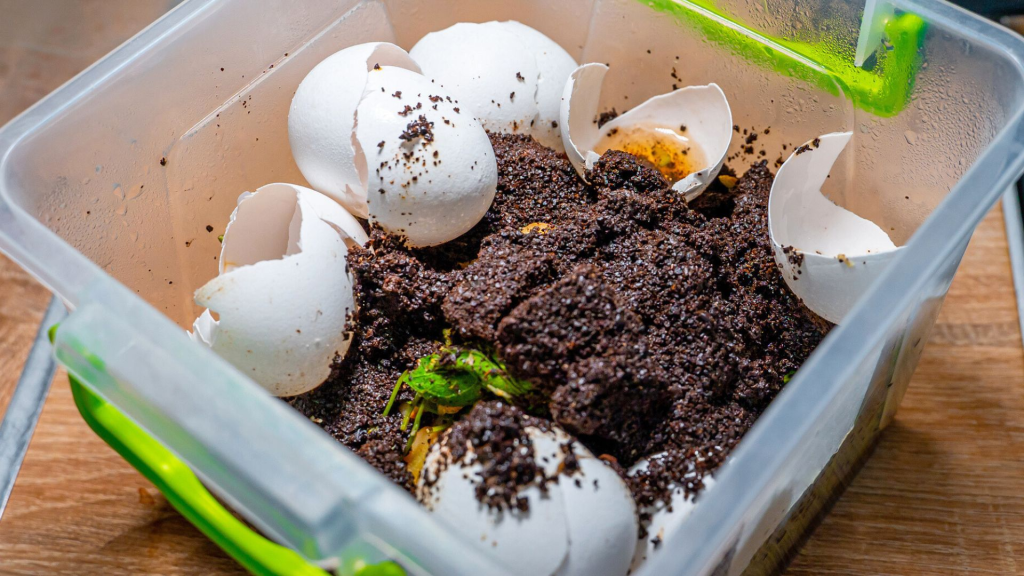
    Folded quietly into a bag
    with coffee grounds
    and wilted lettuce
    and yesterday’s forgotten bread.

    A place for things
    that had failed their original purpose.

    I thought that was the end of it.

    But the strange mercy of the world
    is that no one’s story ends in the trash.

    The bag was lifted.

    The truck arrived.

    The city carried us away
    to a wide and patient, freshly-planted field
    where broken things
    have permission to become something else.

    There, beneath sun and rain
    and the quiet labor of time,
    the mess softened.

    The shell crumbled into powder.
    The yolk surrendered its gold.
    The stench of failure
    turned slowly into soil.

    And I realized something
    no kitchen ever teaches an egg:

    We are not meant
    to stay whole forever.

    Even broken,
    even discarded,
    even misunderstood—

    I was still part of the work of growing.

    Not breakfast.

    Not dessert.

    Something larger than either.

    Because somewhere above that dark earth
    roots are drinking
    what my brokenness can provide.

    And the strange truth of it is this:

    Nothing grows
    without something first
    being broken open.

  • There is a strange moment in any mom’s life for which no one prepares us.

    I’m a mom. And for me, that moment happened quietly, but quickly. Not overnight – but it’s like I blinked – and then my oldest child became an adult.

    And somewhere along the way, she began forming her own conclusions about the kind of parent I was. In some ways, those conclusions have been generous. But usually? Not so much.

    Here’s the truth: There is no such thing as a perfect parent.

    Every parent makes mistakes. Some small. Some larger than we wish they were.

    Parenting is thousands and thousands of decisions made while tired, overwhelmed, and trying to do the best we can with the tools we have at any given time. There is no manual. No how-to video. Just love, instinct, and a lot of trial and error.

    What became especially painful was when my now-adult child began to define her entire childhood through a small set of memories that were pivotal for her, or at least central to her narrative. Some mistakes I made. Some moments where I handled something poorly. Times when I was human instead of perfect. Times when I allowed my “feelings” to call the shots. Times when patterns that resurfaced throughout my adult life because I was sad, insecure, struggling with my worth.

    And those moments suddenly became the entire story.

    And when that happened, the million quiet things I did right – things for which I have never required recognition or rewards – the endless and constant sacrifices, the sleepless nights, the worry, forking over $20.00 bills like they were Jolly Ranchers, folding countless loads of laundry, sitting in 100 degree heat for ballgames, eating what was left on her dinner plate because there wasn’t enough Hamburger Helper for everyone to get a full serving, skipping lunch because the $7 I had wouldn’t cover that and a field trip, buying my own clothes from Walmart because the On Clouds were “just so cool” – faded into the background.

    Additionally, bigger things – like the unprecedented, immeasurable support I provided, the numerous times I defended a child everyone said was “using me,” the never-ending grace and forgiveness I offered (because – just like moms – kids also are imperfect) – those things seem to not matter anymore either.

    It’s likely that she doesn’t even know about certain things in this laundry list of sacrifices, because I did not want her to know I was struggling and deeply hurting on the inside. It’s also possible that she has conveniently forgotten some of them because her nervous system is trying to keep her safe, and repression goes along with that. And even more than that, it’s possible that she won’t see the good I tried to do because she hasn’t raised her own teenager yet, and the black-and-white world she anticipates having when she does? Well, that doesn’t exist.

    Few experiences are as isolating as feeling like your own child had reduced you to your worst moments, especially when you know the fuller, more truthful story, and especially when you remember the years you spent trying your very best.

    Parents carry an invisible grief when that happens, because the relationship(s) that once defined your existence suddenly feel(s) distant, complicated, and fragile.

    And I have over-analyzed it – all of it – to the point of actually becoming physically ill. What if I had handled that differently? What if I had said something else? What if one decision changed everything? Those questions can haunt a parent for years. And honestly, there are, of course, so many things I would change if given the opportunity.

    But that’s the thing about time – we don’t get it back. And we don’t get redos.

    This has become a huge source of shame for me, in part, because the stigma around “no contact” is so widely misconstrued by society as a whole.

    In recent years, across various social media platforms, in the middle of “pop culture TikTok therapy,” boundaries and “protecting your peace” have become common themes, which can be good, in many ways – people should be able to set healthy boundaries, and no one should be forced to tolerate abuse.

    But sometimes those ideas are simplified such that any relationship, no matter how deep or complicated, is very easy to discard. And family relationships are rarely that simple. Most families are made of of imperfect people who loved each other imperfectly.

    In my opinion, we, as a society, need to be very careful not to slap a label on something (or someone) without knowing the true meaning of that label.

    A few opinions of my own (because this is my forum and I can say what I want):

    • “Narcissistic Personality Disorder” is a true, clinical, mental health diagnosis. In order to be diagnosed with NPD, you have to be formally evaluated by a mental health clinician, and during that evaluation, certain criteria must be met. People who do things differently than you are not narcissists. People who disagree with you are not narcissists. Parents who enforce rules are not narcissists. Parents who discipline are not narcissists. People who are selfish or careless are not necessarily narcissists. Liars and cheaters are not necessarily narcissists.
    • Insisting that your boundaries be honored while ignoring someone else’s – your parent’s included – is not appropriate behavior.
    • Over-generalizing and then globally defining someone by his/her worst moments to fit your narrative is neither wholly accurate nor beneficial.
    • If you’re “protecting your peace” by completely cutting someone else off, you’re doing it wrong.
    • “Trauma” is not the appropriate term to use when your feelings get hurt.
    • “Abuse” is a subjective term, but we need to practice caution when calling people “abusive.” I know that many things are open to interpretation, but to be true “abuse,” some type of repeated negligence and/or violence would need to occur. I really don’t care what TikTok says – parents who enforce curfews are not abusive. Parents who monitor screentime are not abusive. Parents who track your location before the age of 18 are not abusive. Parents who exercise their authority over you – because they’re the adult and you’re the child – are not abusive. Parents who don’t disclose every facet of their lives with you are not abusive. Parents who don’t ask for your consent before making a decision are not abusive.
    • It is impractical, immature, and self-centered to assume that your feelings are more valid than your parents’.
    • “Mutual respect” is overrated. Kids and young adults these days like to say that “respect goes two ways,” while simultaneously stomping on their parents’ feelings, breaking their rules, manipulating…what’s “mutual” about that? Kids want a say in lives they haven’t fully lived yet. Parents are owed respect simply because they’re older and have more experience. If you’ve never had to choose between buying diapers or a new onesie, if you’ve never had to negotiate a payment plan with the electric company so that you could buy new soccer cleats, if you’ve never paid your own cell phone bill, if you’ve never taken a cold shower because your child used all the hot water – then it’d really be better if you kept your mouth shut. Respect isn’t earned just by what kids choose to acknowledge. That’s like saying, “I’ll praise the Lord for all of his blessings, but I refuse to worship Him just because He’s God.” Huh???
    • Your “mental health” is never fully protected, and cutting ties, building walls, etc., does not improve your mental health. In fact, it will take a significant dip.
    • Asking your parents to take accountability for an action you perceive as “wrong,” while refusing to acknowledge your own mistakes is – by definition – hypocritical.

    If you’re a young adult reading this, please understand that cutting someone out entirely can leave wounds on both sides. I beg of each of you – please stop validating your opinions using quotes and captions on social media. Use your own brain and do your own research.

    No one – NO ONE – is going to be able to bend to your every whim, not even your parents. No parent is always going to adhere to your preferences 100% of the time. No mom is going to come away from parenting not feeling a certain amount of inadequacy in her own voice.

    Healthy boundaries leave room for openness.
    “This behavior isn’t okay.”
    “This is what I need moving forward.”
    “This is how we can have a relationship safely.”

    Total cutoffs are absolute.
    “There is no path forward.”

    And sometimes distance is necessary in truly harmful situations. If you’re an adult who was abused – or if you were severely neglected – you have (1) my empathy; (2) my support; and (3) my prayers, and I mean that.

    But in cases like mine, and in many families, that’s not what has happened. What’s needed most is an honest conversation and mutual growth. Not permanent silence. The idea that a young adult would deactivate half of who he/she is? That is very strange to me. The idea that someone can see all bad and no good? Outside of pedophiles and serial killers, that’s not realistic. Even some of Jeffrey Dahmer’s neighbors have gone on record saying that he was a nice guy.

    If you are a mom carrying this pain – if you feel like the narrative and subsequent judgments of your adult child are not truthful or merited, there are a few things worth remembering:

    1. You are one of so many parents experiencing this. Most of us carry our grief in silence because of the shame I mentioned earlier. It’s just not something talked about very often. But it is a widespread trend. And even though that doesn’t take away from our own stories, we should find some amount of solace in knowing that “cut off culture” has a lot less to do with us, and a lot more to do with a general mindset of entitlement, lack of empathy/understanding, and just straight up stubbornness.
    2. The bad chapters of your life as a mom do not definitively make up the mom you were, even if other parties only choose to focus on what you “didn’t do right.” Yes, your mistakes matter. But so do the thousands of loving, unselfish things you did that rarely are mentioned/remembered. The whole concept of “you’re a parent so you’re supposed to [insert trivial sacrifice here]…” That’s just simply not the case, no matter another’s refusal to see it. Since there is no rulebook associated with parenting, there are different interpretations of what is required of a parent. When I was young, it was just understood that food, clothing, and shelter made up the entire list. I tried (and still try with my youngest) to do more. I bent to their preferences. I valued their opinions. I gave them a voice. I was [probably too] honest with them about certain struggles that come with being an adult, in an attempt to help them understand that life is incredibly messy. It was all in vain.
    3. Regret does not always equal failure. Looking back and wishing you had done something differently is part of being human, and that doesn’t go away just because you’re a mom. It also doesn’t erase the love that existed. On really sad days, when I am hyper-fixating on these regrets, I wallow in those shoulda/coulda/wouldas. But it doesn’t do anything for me now – it just prolongs the sadness.
    4. Your identity is bigger than motherhood. I have such a hard time with this one, because I found out I was pregnant for the first time 10 months into adulthood. And I have spent my entire adult life finding my sense of purpose inside my kids, so that when one of those relationships essentially disappeared, I felt like I was losing myself. But part of healing is rediscovering who you are beyond that role, and making peace with the forfeiture of that particular role. I have learned so much about myself recently. And even if I’m not 100% thrilled with the content of that education, I am doing the hard work – and that does matter.
    5. Peace does not come from endless punishment. It is natural to replay the past. But living in “what ifs” forever will not repair the relationship. Neither will constant acknowledgement of their “truth,” meaningful sincere apologies, constantly reaching out, bending until you almost break, or validating someone else’s feelings while relinquishing your own narrative. None of those things will allow you to actually heal.

    Some parents and adult children eventually find their way back to each other. Some take years. Some never fully repair. And that uncertainty is incredibly difficult to live with.

    But one thing remains true, no matter what: You can continue growing, reflecting, and becoming a better version of yourself – whether or not someone else – even your own child – recognizes that growth.

    The mistakes I made were real doozies, and I offer no excuses for my lapses in judgment. I will not defend my poor choices to anyone, ever, especially my kids.

    No parent gets everything right. Not the ones we admire. Not the ones we criticize.

    We all raise our children while we – ourselves – are still learning how to be human. And sometimes the most compassionate thing a mom can do – after years of loving imperfectly – is to extend a little bit of that compassion to herself. So I encourage all moms to do that today. You’re worth it.