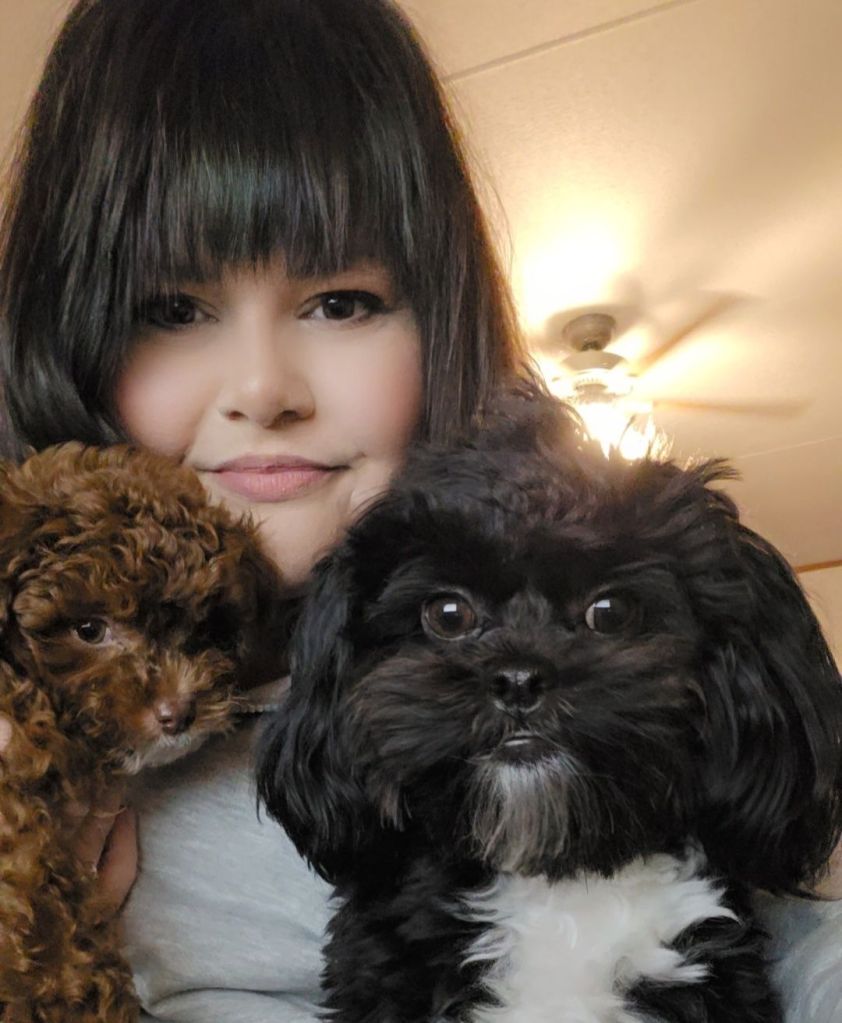
In the spirit of sharing not-so-vague things about myself, I offer photographs of the two entities in my life who force a routine – my dogs.
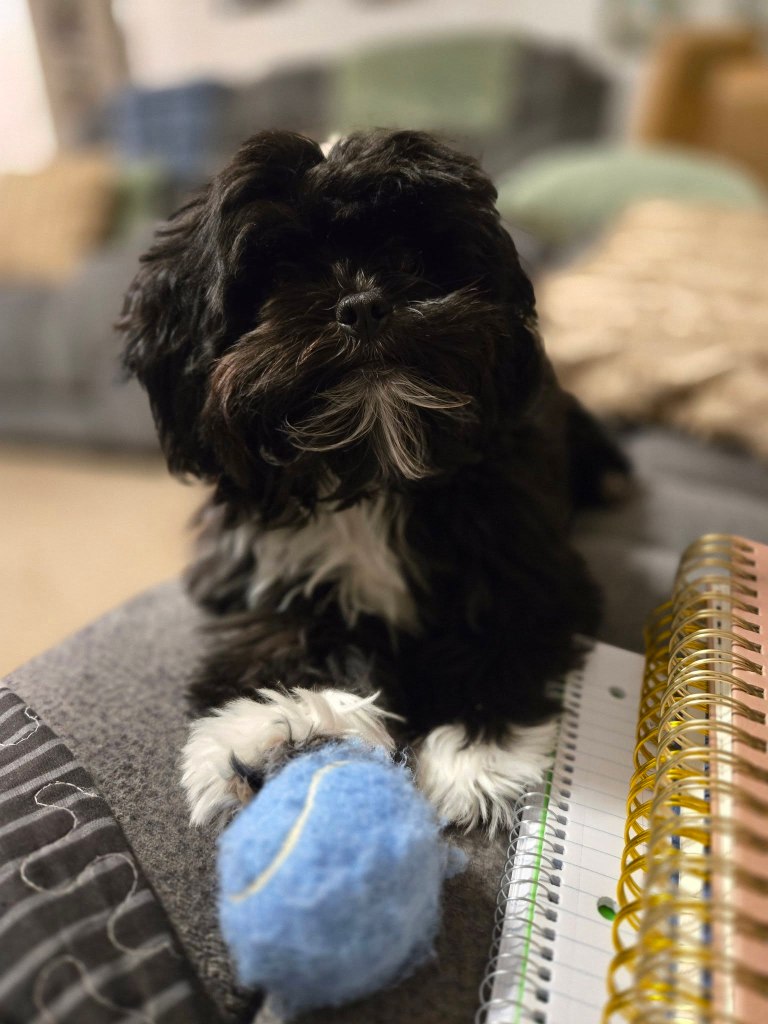
Ozmond Gatsby a/k/a Ozzy was born on July 19, 2025. He came to live with me in early September. He is 1/2 ShihTzu and 1/2 Toy Poodle – or – a “Shih-poo.” He has the squished nose and underbite of a ShihTzu and the curly hair of a Toy Poodle.
And he is so smart. Needy. Playful. Hyper. And handsome. He is not a fan of car rides or the groomer. But he loves treats and fetch and – for some odd reason – The Vampire Diaries. He’s Team Stephen.
Ozzy gave me permission to look at his ball, as long as I did not touch it.
As Ozzy grew, I realized that his breed (or the combination therein) is very sociable. ShihTzus and Toy Poodles function best with other dogs. My heart sort of hurt for him and I wondered if he was lonely…
…so I found Ozzy a baby brother.
Enter Bennett Grisham a/k/a Benny. He is also a Shih-poo, mixed a little differently. Benny’s dad is 100% Toy Poodle. Benny’s mom is 1/2 ShihTzu and 1/2 Toy Poodle. So I guess that makes Benny 1/4 ShihTzu and 3/4 Toy Poodle.
Benny was born on March 26, 2026, and he became part of our family in the middle of May. He has reddish brown, curly hair like a Toy Poodle. Green eyes, a pointier nose, and the anxiety of a squirrel caught in a bird feeder. He became attached to me immediately, and now, I cannot go pee without an audience.
Benny’s brain has not yet caught up with the length of his long legs, and he tends to lose his footing on occasion. He is still very young and tiny, weighing in at the vet last week at 2.8 pounds. We are currently working diligently on potty training. Benny loves Honey Nut Cheerios, sleeping directly on top of my head at night, and whining any time he cannot physically see me.
I sat on the couch with Benny his entire first weekend home, and I think that’s where the codependency started.
I remember imprinting on Ozzy immediately upon seeing his picture posted by his seller. I will also admit that I assumed Benny would act a lot like Ozzy, given their similarities in breed. So I was a little surprised to realize that I did not “feel” as attached to Benny from the start – or at least not in the way I was attached to Ozzy. I was also surprised to realize that Ozzy and Benny did not immediately bond, as I thought, for certain, Ozzy needed a playmate.
That has all changed, though. In two weeks, Benny has really come out of his anxious shell. He still cries when I leave the room, but he and Ozzy run after each other and pull each other’s ears and steal each other’s treats and toys. They no longer compete for parental attention. And their personalities are different enough that they each hold their own space in the house…and in the bed.
My co-workers. My secret keepers. My snuggle bugs.
The audacity to be this tiny and adorable…
The addition of Benny has doubled the dog treat bill, the groomer bill, the vet bill, and the doggy hotel bill. It has also decreased the amount of time between puppy pad changes, water bowl refills, and potty breaks.
But these two are a fun pair. And I sure do love ’em.
As a follow up to yesterday’s piece about focus, I feel led to discuss things on which I will not be focusing.
Energy is a funny thing. We don’t always realize how much of it we’re giving away until we’re exhausted. And for most of my life, I handed mine out carelessly…to overthinking, to conflict, to needing answers, to manipulating situations that would make me seem more in control. And then I’d end every day wondering why I felt emotionally drained all the time.
But protecting my energy isn’t selfish. Sometimes it is necessary. And part of growing, for me, has been learning what should (and subsequently, what should not) occupy the real estate in my headspace.
With focus comes sacrifice. It is not advantageous to spend all of my tossing and turning on things (and people) that ultimately will not help me become the person I want to be. And so I am dedicated to pulling my energy back with respect to the following:
The opinions of others. This one has been so hard. I have given enormous amounts of energy to the way I am perceived. I have tried to explain myself, correct misunderstandings, prove growth. And I do care about living with integrity, but I no longer believe that I can change enough for certain people to update their opinions. A painful realization, yes. But a freeing one.
The need to defend myself constantly. The people who do not possess the capacity to see me differently are the same people to whom I have caught myself clarifying everything. Every assumption. Every misunderstanding. Every version of my story I thought someone had wrong – or – alternatively – if wasn’t “wrong,” I wanted to clarify my reasoning. But all of that just keeps old narratives alive. Some things are better answered with silence and action.
Imaginary outcomes. I am self-defined as a “snowball effect” girly. My mind has always been great at creating worst case scenarios, and I suppose that’s a coping mechanism. Preparing for the worst means I won’t be disappointed. And so I pondered future arguments, emotional catastrophes, and inevitable judgment and/or rejection, all while rehearsing my part of conversations that hadn’t happened yet. I can’t dwell on any of that anymore. If it isn’t happening right now, I need to learn not to live in it.
Unresolved questions that have no immediate answer. To need resolution immediately is a curse. The challenge for me is to not seek clarity or closure. Some solutions need an oven, not a microwave. And obsessing over them doesn’t produce answers faster. It only causes anxiety.
Controlling other people. I like predictability and clarity and knowing where I stand. But no amount of effort, explanation, or emotional investment can control another person’s choices. None of that is mine to manage, and I am committed to the practice of releasing it.
Emotional bait. I notice everything. Avoidance. Comments. Stories spun to suit someone else’s agenda. I notice hypocrisy. I notice indirect digs in the things my “friends” and family post on social media…by people who have yet to address any of their qualms directly to me, ironically. But not every comment deserves a response. Not every tone shift deserves analysis. And not every trigger deserves reaction. The people who won’t confront me directly…who harshly judge my decisions…who ignore and avoid and leave…are the very same people for which I have bent over backwards without expecting anything in return – even support, apparently. Regardless of “feeling,” there are very few things in my life that are actually urgent. And like water off a duck’s back, there is power in not taking the bait.
Revisiting old shame. Shame still tries to pull at me. I am frequently tempted to mentally ruminate on old mistakes, to replay regret, to re-punish myself. And while reflection is healthy, shame isn’t productive. Accountability is necessary, but I’ve already accounted for my mistakes, and repeatedly opening old wounds only prolongs healing.
Proving my worth. I intentionally saved this one for last, because it is the most important to me. Validation earned through dishonesty isn’t a goal worth setting, let alone achieving. To stretch myself thin so that everyone approves. To be less-than-truthful about who I am at my core so that others find me digestible. To shrink into doormat form so that being taken for granted was normal. To consume breadcrumbs as if they would fill me. To manipulate people with a distorted sense of what I thought I deserved, never recognizing that it was a form of self-sabotage. To allow others to manipulate me…or blackmail me…into submission. I was trying to be enough. I was trying to be chosen. And I was doing it all the wrong way. Worth isn’t something that can be manufactured by change or even nit-picked reality or exhaustion. I am worthy because I’m a human being. I am worthy because the Lord calls me His. And validation from things and people in this world is superfluous in comparison to where I am headed.
Truth. Peace. Discipline. Consistency. Prayer. Routine. Growth. All of that is where my energy is placed now. It’s one of the most valuable things I have. And every time I give it to chaos, fear, overthinking, or shame, that leaves me with less time for what actually matters. In the warmest way possible, I give myself the gift of intention. And who knows? Maybe that alone will change everything.
Until recently, I thought that focus was measured by intensity.
Big plans. Big declarations. Big emotional surges of motivation that made me feel like I was changing everything overnight.
And I’ll admit that works for a little while. It can even be productive.
But as I stepped back from writing, journaling, and reading at the end of May, I realized that intensity is not the same thing as consistency, and that real focus isn’t as bold as I once assumed. So this month, after recovering from what I can only describe as burn out, I am determined to re-center my goals, routines, and mindset.
I will continue to do the next right thing. Not the dramatic thing. Not the impressive thing. Not the thing that gets noticed. Just the next right thing. Getting up. Going to work. Keeping my word. Following through. Taking care of my home. Doing the small things I say I will do.
I will not chase distraction. My former self once thought distraction = relief. If I felt uncomfortable, I looked for something – anything – to shift my attention so that I wasn’t thinking about my feelings. Validation. Fantasy. Overthinking. Chaos. Emotional noise. But none of it worked, as my feelings were waiting to be addressed when the chaos died down. So – with intention – I will resist the urge to escape myself. I will stay, even when it hurts.
I will conserve my energy. A lot of my burn out in May stemmed from offense. I found myself upset over things I could not control. And I realized this past week that I don’t possess the emotional bandwidth necessary to give everything access to me anymore. Not every thought deserves my attention. Not every problem deserves my panic. Not every misunderstanding deserves my explanation. With focus comes the ability to be selective. Does this actually matter? Does this deserve my energy? Will this move me forward? If the answer is no, I need to let it go…hard as that is sometimes.
I will implement repetition. To me, the least glamorous part of focus is the routine that comes with it, in part, I think, because it’s boring. Choosing the same healthy habits over and over again long after the emotional motivation fades. Prayer. Truthfulness. Self-awareness. Emotional regulation. Chores. Bills. Water. No fireworks. Nothing anyone would (or even should) notice. Just the unspoken process of keeping the promises I make to myself, and doing so on purpose.
I will think long-term. I used to make almost every decision based on immediate emotional relief. If something felt heavy, I wanted out. If something felt uncertain, I demanded reassurance. If something felt uncomfortable, I left. And as such, I am learning to practice the pause-and-pray method when it comes to making choices. I ask myself different questions. Will this choice still make sense next month? Next year? Will this build the life I say I want?
I will not be easy to distract. Not colder. Not detached. Not emotionless. Just less easily pulled off center. Less reactive. And more grounded in what actually matters.
Right now, I am not making time to consider perfection or proving myself or forcing outcomes. My priority lies in becoming someone I can trust. Someone honest, disciplined, accountable, emotionally steady, and present. That kind of focus isn’t always immediately rewarding. But it is genuine.
If you had asked me a year ago what focus looked like, I’d have told you something very different than how I’d describe it today.
It’s about peace.
Focus is no longer about doing everything. It’s about doing what matters – and doing it consistently enough to become changed by it.
As I continue to study God’s Word, I understand that what I once only recognized as non-fictional words on a page are – in reality – real life instructions for how we should be living our lives today. The Bible isn’t just a history book. It’s a handbook.
I finished Jeremiah and moved onto Ezekiel. I am not quite finished with it, but I’ll recap what I’ve studied so far.
Jeremiah and Ezekiel were both prophets, and both of these Books recall the same events – just from different perspectives. While Jeremiah delivered God’s messages from inside Judah/Jerusalem prior to and during the nation’s collapse, Ezekiel’s story is told to people who were already displaced in Babylon.
As a reader, I needed both. If I had only read Jeremiah, I’d have only understood the weight of warning. If I had only read Ezekiel, I’d have only understood the structure of judgment and hope. But together, I got a full, emotional, spiritual picture.
I don’t know if I should admit this, and perhaps someone more “woke” than me will correct me, but I don’t believe that everything that happens to us is God’s will. While we generally, as a society, subscribe to the idea of fate and that “all things happen for a reason,” that is only partially true, in my opinion. Some things happen because, as my dad says, “We ain’t got the sense God gave a goose.”
God gave His people free will, and they used it so haphazardly that poor leadership, pride, and idolatry broke down the very foundation upon which God had built them. God didn’t “want” two nations. It was not His “will” that His people divide into separate nations. He also didn’t want His people to worship other gods or be so selfish/prideful or stray so far from what they knew was truth.
But if God had forced Israel to remain unified after Solomon died…
If He had spared Judah from ruin after they had wandered…
If He had slapped wrists but kept the foundation of His people intact instead of allowing every consequence to play out fully…
…then restoration would not have been as meaningful.
Jeremiah revealed that God takes sin and its consequences seriously. But Ezekiel revealed that God is committed to restoration beyond what people deserve.
But here’s the clincher – transformation has to happen *before* restoration can happen. And because we are so hard-headed and set in our ways, our “truths,” our feelings, I think God knows that sometimes He has to let us do it wrong and fall apart before we reach a place so desperate that our foundations are completely destroyed. And that’s where He does His best work.
When my kids were little, if they misbehaved around their Mamaw, she would have them put their noses in a corner while she talked to them about respect, obedience, etc. And when they’d make comments to me about how silly that punishment was, I’d explain to them that the “corner” was the punishment, but the punishment wasn’t the only purpose of the corner. The corner (1) removed the kids from the setting of the behavior, so as to eliminate the temptation to continue that behavior; and (2) staring into a blank wall, with no distractions, no toys, no tv, gave the kids time to think and reflect on what they’d done wrong.
So God put Judah’s nose in the corner. He removed them from the place where the disobedience occurred. And He stripped them of everything so that all they had left was time to reflect and time to talk to Him. Exile was not just “punishment.” It was a place of reflection and work. God didn’t wait until Judah wasn’t broken anymore. God’s miracle was found while His people were still suffering. “I will gather you…I will cleanse you…I will give you a new heart…”
And He killed so many birds with that stone. Not only did He keep His covenant with His people, but He showed other nations who He was – the One, True God. And on top of that, the two nations were, once again, united as one (Ezekiel Chapter 37), as God had always intended. Every consequence…every fracture…rebuilt under one, stronger foundation, so that His people, after years of division and disobedience and wandering, were made completely whole.
As I have struggled to understand why I am in this particular season…as I have prayed to God for (and been actively denied) deliverance…and even as I have expressed anger/frustration toward Him for “allowing” the loneliness, the shame, the tears…the Holy Spirit has continued to (1) sit with me; (2) comfort me; and (3) speak the same message – “The miracle you seek lies inside the work you are doing.”
And it’s probably not just coincidence that I’ve been reading about how Judah – in all of its disobedience and wandering – had to do the same work…not the kind of work where they had to try harder or do more, but the kind of work that required a different mindset – total surrender, total commitment, and total obedience. And it was in that surrender, commitment and obedience that God restored them and gave them back even more than they lost.
The Book of Ezekiel has reminded me that putting metaphorical duct tape on our own destructive patterns will only work for so long. The Lord wants us to be transformed, from the inside out, and from the bottom up, in such a way that even other people will see Him in us. And in the same way Judah experienced God in the middle of consequence, true transformation happens when our foundations are broken.
By whatever means necessary, the Lord wants us to be whole, *especially* if we have specifically prayed for it like I have. And if making us whole requires Him to “put us in the corner” or to use a jackhammer on our foundations or to strip us of all tangible comforts, then that’s exactly what He’ll do – not because He wants us to hurt, but because doing all of those things puts us in a state of vulnerability necessary for transformation.
If you are in your transformation season – if you are lonely, if you are hurting, if you are in your feels, if you are learning and enduring – hang on. He didn’t abandon you. Restoration is coming.
I’m going down my self-made list of words that are generally used incorrectly these days.
Today’s vocabulary word: Self-care.
I think we’ve watered down its meaning. Somewhere along the way, self-care became synonymous with indulgence.
Bubble baths. Face masks. Mani / Pedis. Online shopping.
And there is absolutely nothing wrong with doing any of those things.
But honestly, most real self-care is less glamorous than that.
It’s not about indulgence. It’s about maintenance.
Not escape. Not avoidance.
Maintenance.
It’s taking care of yourself in ways that support stability – not just temporary comfort.
Sometimes self-care is just going to bed. Not staying up doom-scrolling. Not emotionally spiraling until 2 a.m. Just…sleeping. Recovering.
Sometimes it’s cleaning the kitchen. Not because a spotless house fixes your life, but because your environment affects your mind more than you realize. There is something regulating about caring for your space in the middle of internal chaos.
Sometimes it’s telling the truth. Not avoiding the issue. No numbing it. Not distracting yourself from it. Actually acknowledging that something is hurting you, that something is unhealthy, and that something needs to change. Honesty is self-care, too.
Sometimes self-care is discipline. Going to therapy, setting the boundary, sticking to the budget, taking the walk, logging off, not returning the text. Discipline, now, protects future peace.
Sometimes it’s not reacting, because not every emotion needs expression.
Sometimes it’s simply saying, “No.” Not because you’re selfish, but because constantly over-extending yourself creates resentment, burnout, and emotional instability. You cannot continuously abandon yourself and call it kindness.
Real self-care isn’t usually flashy. It’s repetitive. Quiet. Ordinary. And sometimes even inconvenient.
It’s not always about feeling good immediately. It’s about caring for yourself in a way that supports the life you actually want long-term.
Bubble baths are nice. Candles are nice. Little treats are nice. But genuinely caring for yourself is executed best by taking responsibility for your own life. That’s the kind of care that changes a person, slowly, from the inside out.
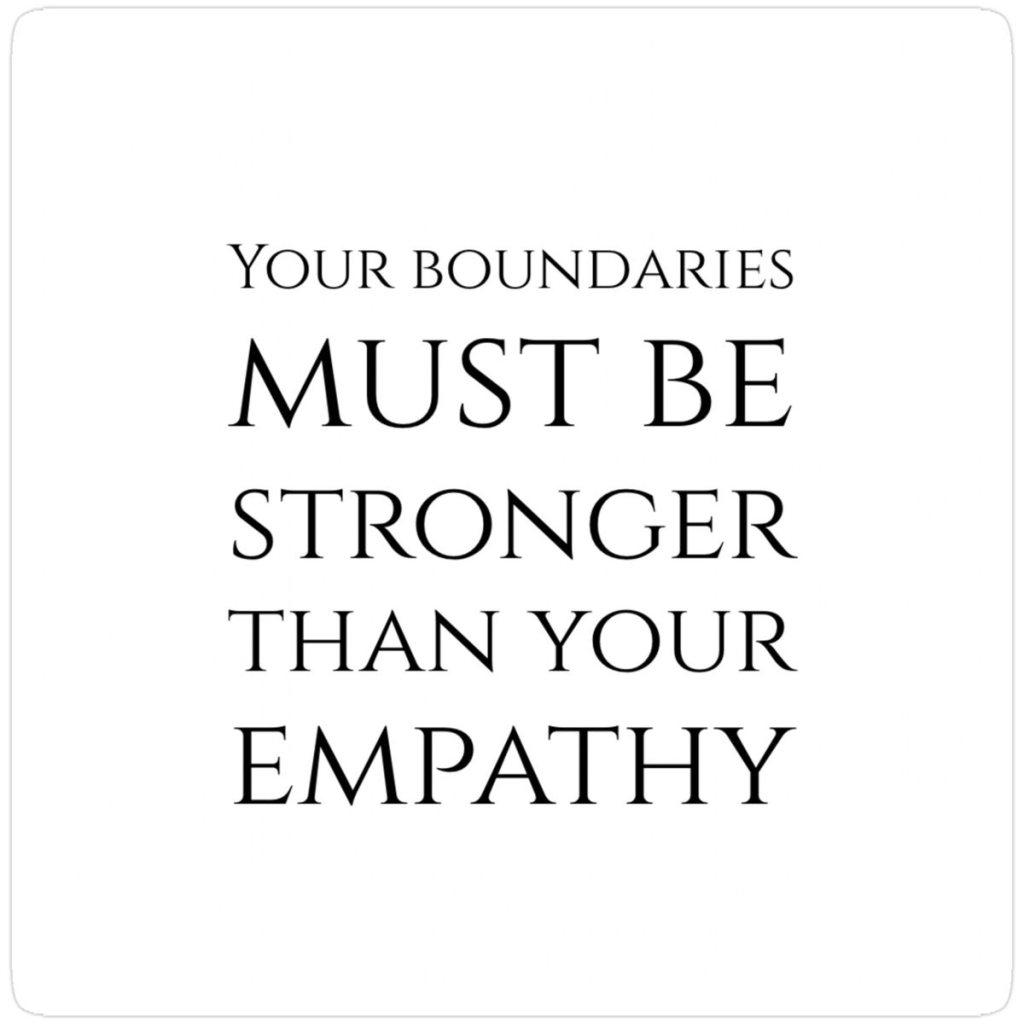
People talk about “boundaries” constantly these days.
“Set boundaries.” “Protect your peace.” “Cut people off.”
I can empathize with the heart behind those phrases, but I don’t think boundaries are always defined – or used – appropriately. That term has been oversimplified, like setting a boundary is magic.
In my experience, sometimes we can express a boundary clearly, and the situation remains exactly the same.
And that’s when being “woke” is no longer helpful.
First, what is a boundary? It’s not controlling another person. It’s not, “You must change.” It is, “This is what I will do in response.” Boundaries are about governing yourself, not managing someone else.
Second, how can we know when a boundary is necessary? The answer is different for everyone, so I’ll share a few of my own criteria:
Resentment is building constantly;
I feel repeatedly emotionally depleted;
I continue to abandon my own needs;
The same issue continues without resolution;
I start to react instead of staying grounded; or
I am tolerating what is actively harming my stability.
For me, a boundary becomes necessary when continuing “as-is” begins damaging my emotional health, integrity, or ability to function well.
Thirdly, boundaries are not punishments. The motive behind a healthy boundary is not revenge, or the silent treatment, or manipulation, or attempts to “teach someone a lesson.” A healthy boundary is clarity. It says, “I cannot continue engaging this way without consequence to my well-being.”
But the hardest part is when nothing changes. And it’s painful. I have only effectively set two healthy boundaries in my entire life. I communicated clearly, I explained calmly, I stated my needs honestly. And the other parties still didn’t change. They didn’t hear me. And they didn’t meet the need.
And to be honest, I think it was because I was the one setting the boundary. Had it been anyone else, the boundary would’ve been understood.
And that reality hurts.
But boundaries cannot force emotional immaturity or empathy or effort. And they can’t force someone to prioritize the same things that I prioritize. That’s just the difficult truth. Sometimes boundaries reveal more than just this issue. Sometimes they reveal the limits of the relationship itself.
When I set my very first boundary almost 10 months ago, the other person left. And when I set the second, my character was attacked – not to my face, but to people in my life, now, that I truly love.
So what do we do when the boundary changes nothing?
Answer: We stop waiting for the other person to create peace for us.
Instead, we begin deciding what we can realistically control now.
In Boundary Scenario Number 1, I couldn’t control the fact that I was left. And in Boundary Scenario Number 2, I couldn’t control the other person’s mouth.
But in each scenario, I can control my participation, my exposure, my expectations, my emotional investment, and my responses.
The hard truth is that sometimes circumstances stay the same. Sometimes the relationship doesn’t transform overnight. The coparenting doesn’t suddenly become easy. The other person doesn’t become who you hoped they would become.
And at that point, the work becomes internal.
I think TikTok-Pop-Culture Therapy tends to portray boundaries as exits.
But the healthiest boundaries are quieter than that.
Less contact. Different expectations. Less emotional chasing. More acceptance. More regulation.
Sometimes the boundary is, “I will no longer destroy my own peace trying to force this situation to become something it’s not.” And when we think about it that way, boundaries are less about controlling circumstances and more about remaining emotionally intact inside of difficult circumstances. That’s much harder, but much healthier.
Setting a boundary does not guarantee change. Sometimes it reveals change wasn’t in your control to begin with. And I know as much as anyone how discouraging that can be. But there is also something freeing about that. Because once I stopped trying to control everyone else, I had enough energy to take care of myself.
Emotional triggers are real. But I think the word is overused (or used entirely incorrectly), misunderstood, and weaponized.
Somewhere, at some point, society started treating triggers like permission. Permission to lash out. To avoid accountability. To demand that everyone else emotionally accommodate us at all times.
And I don’t agree with that.
There are absolutely things that emotionally affect me more deeply than they affect other people. And to be fair, almost everything affects me more deeply than others.
I’m an overthinker by nature. My impulses are rooted in emotion.
But the important thing to note is that my triggers may explain my emotional reaction, but they do not excuse my behavior. My triggers are ultimately my responsibility.
So on this journey to discover my identity, I have started tracking patterns in my own behaviors and reactions – not just what hurts me – but why – and then marking specific guidelines within each trigger, so that there is a plan to handle them – in a much healthier way – when they arise.
Feeling rejected or unchosen. This one probably hurts the deepest. Feeling left out, overlooked, emotionally replaced. In taps directly into old insecurities that quickly make me spiral, and I automatically and impulsively jump to questions like, “What is wrong with me?” and “What did I do to deserve this?” So now, I remind myself that someone else’s choice is not a measurement of my worth. And I no longer make impulsive decisions just to soothe the feeling of rejection.
Feeling misunderstood. I hate being misrepresented, especially when people reduce me to my mistakes, or one label, or one version of my story. And I used to obsess over correcting perceptions. But now I ask myself whether or not clarification will actually create peace. And the answer is usually, “No.” I can’t control how I’m perceived. And that still hurts, but there is a rational side of my brain – somewhere up there – that reminds me that not every misunderstanding requires a defense.
Loss of control. I like predictability. Clarity. Structure. When things feel uncertain, my anxiety rises quickly. But controlling other people or outcomes is an impossible task. So now I focus on regulating myself – through routine, through prayer, and through presence.
Feeling unappreciated after over-extending. There are two issues here, and the combination used to create resentment in me. If I gave a lot and didn’t feel acknowledged, I became emotional dynamite. So this is where I now question my motives. I pay closer attention to whether I’m giving freely or giving with unspoken expectations attached…because that distinction matters.
Criticism and judgment. Especially criticism that confirms my worst fears about myself. Those moments can still sting deeply. Presently, I try to separate conviction from shame. Sometimes criticism is useful, but sometimes it’s projection. Not every opinion deserves equal emotional authority.
Emotional distance. Silence, withdrawal, coldness. They poke insecurity in me. But I meant what I said – I don’t chase anymore – and that includes reassurance. Distance is still crushing, but now I sit in the discomfort, in an “exposure therapy” kind of way.
Feeling helpless. When I can’t fix something, solve something, or improve something immediately, I become overwhelmed. These days, I try to intentionally shift my focus to something that I can control. Sometimes the stain on the carpet. Sometimes how much water I drink. Sometimes how many chapters I read. Something that helps me appreciate autonomy.
Triggers are information. They’re not commands. They reveal wounds, fears, patterns…areas that still need healing. But they do not get to dictate how I behave.
I do not expect other people to babysit my emotions anymore. People are going to disagree, misunderstand, leave, criticize, and disappoint me. That’s life. And while kindness matters, emotional maturity requires learning how to regulate ourselves instead of demanding that the world constantly rearrange itself around our sensitivities.
I still get triggered. I still feel all of it. But instead of using those moments as excuses, I try to use them as invitations…to pause…to reflect…to respond differently than I once would’ve. Because growth doesn’t mean being emotionless. It’s just becoming responsible with your emotions.
I am honest about myself these days to recognize that, sometimes, I was the problem.
I wasn’t trying to be. But in the middle of chaos, there used to be this deep need/impulse to address everything. Every disagreement. Every accusation. Every misunderstanding. Every perceived slight.
If something bothered me, I reacted. If something hurt me, I confronted. If someone misunderstood me, I explained.
And I thought that made me strong. But looking back, I think a lot of it was just anxiety.
Not everything requires a response. That’s been hard for me to learn. Because when you’re emotional, sensitive, and deeply self-aware, everything “feels” important – every shift in tone, every indirect comment, every rumor. And if you’re not careful, you can spend your entire life emotionally responding to things that were never meant to have authority over you.
As I’ve slowly but surely increased my focus, I understand now that addressing everything creates more chaos, not less. Not every thought needs to be spoken. Not every offense needs confrontation. Not every misunderstanding needs clarification. Picking every battle keeps conflict alive longer than it was meant to live. Sometimes peace requires restraint.
There was a time that I thought silence was weakness. I had difficulty learning the differences between shrinkage and intentional unresponsiveness, because I know what it feels like to shrink, too.
I’m a strange raspberry.
Often times, the battles I fought were based upon principle, a need to be right, or, at its root, an overwhelming urge to justify my decisions.
On the other hand, when I was intimidated, or ashamed, or afraid, I ducked. I silenced my needs, I suppressed my feelings, I cried in private, and I made myself smaller so as not to inconvenience anyone else.
So while shrinking was a decision made out of fear of rejection or conflict or being “too much,” over-explaining and over-defending occurred when I felt harshly, outwardly criticized.
The obstacle still remains – learning the difference between suppressing myself and regulating myself. Between abandoning my voice and choosing peace intentionally.
The trick is rooted in one word: discernment.
Silence is not always weakness, and in fact, taking the high road – while it doesn’t have the same immediate effect as a quick verbal jab or a stabbing shift in blame – reveals a level of self-control I didn’t think I had. To take a step back and look at a situation and recognize, “This doesn’t deserve my energy.”
And that’s exactly what I try to do now. I’ve learned to ask different questions.
Will addressing this actually help? Will it create understanding or more noise? Am I responding from wisdom or emotion? Do I want peace or do I want the last word?
There is a motive behind every response. And when I learned to identify the motive, my responses – or lack thereof – evolved.
Some things don’t need to be fixed in real time. It’s easy to give into the urgency that is associated with discomfort. But some things settle on their own. Some misunderstandings fade. Some emotions calm down. And some answers reveal themselves with time. Not everything requires immediate intervention.
I do not subscribe to the majority view of “protecting my peace.” I don’t think most people even know what that really means. It’s not about cutting people off, blocking socials, and then posting quotes that suit your agenda or match your opinion. That’s not “protecting” anything. That’s justification. Protection does not necessarily mean “shut out everyone who disagrees with you.”
I protect my peace a little differently. Not by avoiding life. And not by shutting people out. I’m simply more selective about what I engage with emotionally.
I no longer feel obligated to defend myself constantly or explain every decision or respond to every opinion. Some things – some people – simply do not deserve access to my nervous system anymore.
I still believe in communication. I believe in healthy confrontation when necessary. And I am learning to set boundaries in a productive way. But I don’t confuse emotional urgency with wisdom anymore, because maturity is learning what actually deserves my attention. And sometimes growth looks less like speaking and more like being grounded enough, in myself, to walk away.
I don’t address everything anymore. Not because I don’t notice. Not because I don’t care. Not because I’m emotionally detached. But because peace – the right kind – has become more important to me than constant reaction. And it’s changed my life more than I initially anticipated.
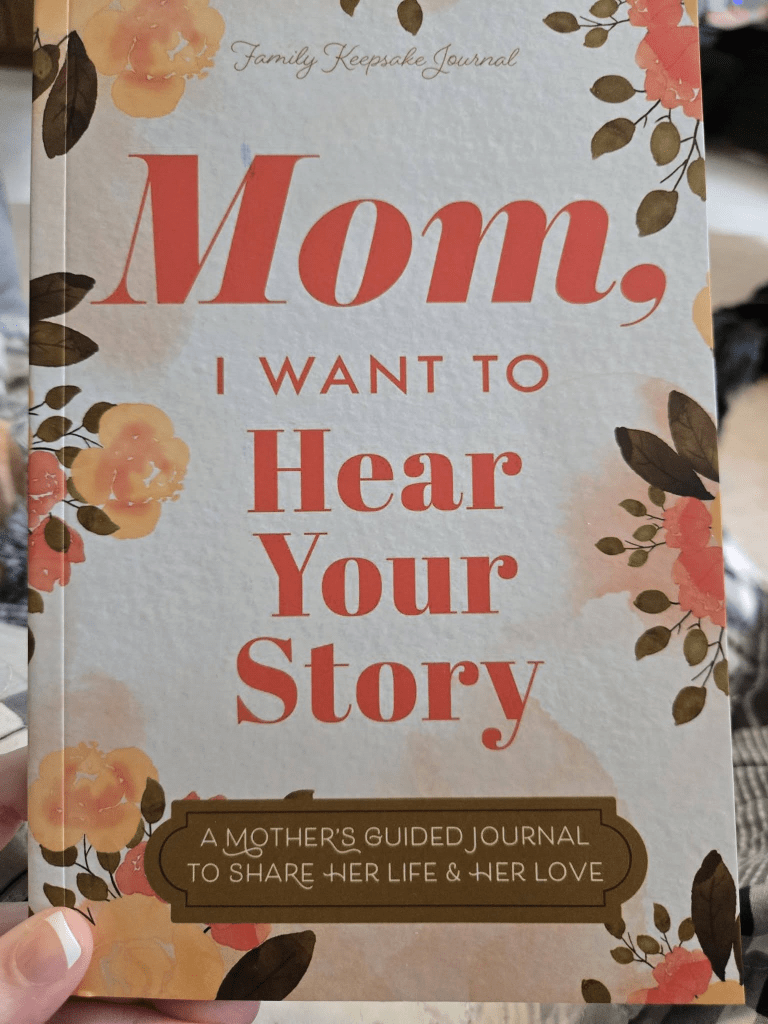
My son got a book for me for Mother’s Day called, “Mom, I want to hear your Story.”
He knows me well. I love “homework.”
I thought it would be a fun idea to blog some of the answers to the questions in the book, maybe as a way to reveal more about myself without having to come up with my own rhetoric.
What is your birthdate? July 10, 1987.
What was your name at birth? Megan LeAnne Smith.
Were you named after a relative or someone else of significance? I never could tell if my Daddy was joking, but he said that I was named after a little girl that my Gran (his mom) used to babysit. Whether or not that was true, my middle name is made up of two names – Lee, after my great grandmother on Mom’s side and my Uncle Dan on Daddy’s side – and Anne. Ann is my mom’s middle name.
In what city were you born? Somerset, Kentucky.
How old were you when you started walking? My baby book says I was 10 months.
How old were your parents when you were born? My dad was 21 (almost 22), and my mom was 19 (almost 20).
What notable events occurred in the year you were born? I know the stock market crashed in October of that year. Aretha Franklin was inducted into the Rock & Roll Hall of Fame – the first ever female to do so. And the world population reached 5 billion.
What song was at the top of the Billboard charts? “Alone” by Heart.
What were the prices of:
A loaf of bread – 55 cents.
A gallon of milk – $2.28.
A cup of coffee – at a diner or store, between 50 and 75 cents.
A dozen eggs – 65 cents.
A new home, on average – $92,000.00.
A stamp – 24 cents.
A new car – $10,300.00.
A gallon of gas – $1.00, on average.
A movie ticket – $3.42, again, on average.
What’s your favorite flavor of ice cream? Chocolate. Butter pecan is a close second.
How do you like your coffee? With just sweetened creamer.
If you could live anywhere in the world for a year with all expenses paid, where would you choose? A cabin in the mountains of Tennessee, away from everybody.
How do you like your eggs? Over medium – I like runny yolk but NOT runny white. Ewe.
What is your shoe size? Between a 7 and 8, depending on the shoe.
What superpower would you choose for yourself? Invisibility.
Do you have any allergies? Nope.
What is your biggest fear? Dying alone.
What would you order as your last meal? A filet, medium rare.
Have you ever broken a bone? I broke my ankle in 2016 by tripping over a microphone cord at a karaoke bar.
What is your favorite flower or plant? White lilies.
How would you describe yourself as a teenager? Sad. But I hid it well. Insecure. Smart-mouthed. A little lost. But also relatively popular and book smart.
How did you dress and style your hair during your teens? I spent the early 2000s in high school, so…low rise flare jeans, American Eagle shirts, Old Navy flip flops. I wore my hair down and curled and parted on the side.
Did you hang out with a group or just a few close friends? Are you still close with any of them? I think a lot of people knew me, or knew of me, in high school. My friend “group” consisted of about 4 people – Christina, Scott, Tate, and Kristin. I am friends with Christina and Scott on Facebook, but I haven’t seen or talked to Take or Kristin since high school.
Describe a typical Friday or Saturday night during your high school years. I was in marching band. So Friday nights in the fall were for football games, and Saturday nights in the fall were for marching competitions. If it wasn’t marching season, I spend those nights working. I didn’t really go out much – I wasn’t allowed. When I turned 16, Daddy let me “car date” one night a week, and that was usually on a Friday.
Did you have a curfew? On date nights, I had to be home by 10. Otherwise, I had to be home right after work, and the restaurant closed at 9.
What were your grades like? Always honor roll. It was expected.
Did you have a favorite subject and a least favorite? I enjoyed English and history. I loathed biology and calculus.
I’ll stop there. I may do more of these as I complete pages in the book.
And that’s not the version of a holiday that most people post about. You know, the pictures that contain flowers and brunch and smiles and gratitude.
Don’t get me wrong – I put on the happy face and took some of those, too.
But there’s another version of this day that doesn’t make the highlight reels. Because it’s not glamorous or happy. In this version, moms sit with their thoughts longer than we want. And we realize that everything we’ve lost is also emphasized on this holiday.
I spent most of last weekend sitting on the couch, crying. I didn’t feel proud or accomplished. I thougth about all the things I wish I could change. All the things I should’ve done differently. I didn’t feel like celebrating. I was reflecting. And reflection can hurt.
There was about half a day when I thought, “It might be easier if I just wasn’t here.”
I didn’t want to feel the way that I felt. The regret. The loneliness. The distance. The heaviness. It was a lot to sit in.
But I promised myself, under deep conviction, that I wouldn’t run from discomfort.
So I stayed. It hurt. But at least it was honest.
Sometimes motherhood isn’t what we imagine. It doesn’t look like closeness or celebration. Sometimes we just show up quietly, love from a distance, and hold space for things we can’t fix.
And that version deserves acknowledgement, too.
But even in the middle of those emotions, I know that nothing is permanent. The sadness, while intense, shifts eventually. And the fact that I feel so deeply means I still care deeply.
I put on a smile and went to church with my boys. I cried during the service. I took pictures afterwards. My family went to lunch. And I didn’t fall apart, even though I didn’t “feel” much like honoring myself.
But maybe the fact that I got through it without following through on those thoughts that tried to convince me to disappear is progress in some way. To sit in grief is brave. And to not allow that grief to ruin a day that can be made good for other people is even braver.





 Raspberry Iced M