As Americans, we tend to celebrate independence as something unquestionably good.
Freedom. Strength. Self-sufficiency. The ability to stand on our own.
And those things have their place.
But I have also learned that personal independence comes with a price. Especially when it is learned and not necessarily chosen.
I didn’t become independent overnight. I became independent one disappointment at a time. One unanswered need. One problem I had to solve by myself. One lesson that whispered, “Figure it out.” Over time, I stopped expecting rescue. I stopped expecting people to notice. And I stopped asking for help. I simply learned to carry my own weight. And eventually, it became who I was.
There are parts of it for which I am genuinely grateful. I am resilient. I don’t panic when things are collapsing around me. I have learned to adapt. To work. To think outside of the box. To keep going even when I don’t feel like it. I am resourceful, capable, reliable. When something needs to get done, I am the one who figures it out.
Those are gifts.
But every strength has a shadow.
The same independence that has made me capable has also made me unreachable. When you’ve spent years convincing yourself that you don’t have anyone in your corner, you tend to accept love in more practical ways, as if “help” is so rare that you find more value in it than affection.
The Lord never asked me to do life alone. Strength is admirable, but isolation isn’t. Even Jesus surrounded Himself with people and accepted help. He shared meals. He asked His friends to pray with Him. And if the Son of God didn’t choose isolation, I am not sure why I sometimes believe I have to.
Independence is a wonderful servant but a terrible master. Eventually, it starts to convince you that needing people is failure. Or that there is something fundamentally wrong with you if people don’t offer to help. Or that people who cast me with all of the responsibility of solving a problem have somehow decided that I only exist to make their lives easier.
And that’s not love at all.
I will probably always be an independent person. It’s part of my story. It’s part of how I have survived.
But I am realizing that there is a difference between being capable and believing I have to do everything alone.
On this Independence Day, I am personally grateful for the resilience I’ve built. But I am equally grateful that God is teaching me that strength is not measured solely by what I can carry. Sometimes it’s measured by what I choose to intentionally set aside. Because there is freedom in independence, but there is also freedom in the realization that I don’t have to do it all.
I am going to be sharing something today that is exceptionally private.
To me.
And once you finish reading this, you’re going to think, “Seriously? THAT is private?“
The answer is a resounding “yes.”
I guess it wasn’t long after my daughter left home that I took a hard look at my life and realized that the way I was living it wasn’t working for me. I was losing people that were important to me. I wasn’t as engaged in any area of my life as I wanted to be. I felt like I existed – mostly out of spite – but I felt like I was just turning in anxious circles, jumping from one act of disappointment to another. I didn’t feel like a good wife. I didn’t feel like a good mom. I did all I could to escape my own mind, and that meant I couldn’t stay in one place – or commit to one thing – for too long.
The first four months – I would say from September to December – were spent trying to understand why my brain worked the way it did. I sat in shame. I cried myself to sleep most nights. I prayed terrible things, like, “Lord, please just take me.” I enrolled in therapy so that a professional could guide me as I tried to comprehend how I became the person that I was.
Around Christmas of last year, I realized that – while understanding is an important part of healing – it doesn’t amount to much if there is no action behind that understanding. In fact, understanding why I did some of the things I did – why I thought the things I thought – ended up just being something I could potentially use to excuse or justify my lack of healing.
And I didn’t want to make anymore excuses. I didn’t want to just “appear” changed, like many times before. I wanted to actually change.
In my opinion, that starts on the inside. So I made two different commitments to myself. One, that I would sit in my emotions and process them as they presented themselves. I wouldn’t run. Like a weird form of exposure therapy, I wanted the scary feelings and the negative thoughts to not be so scary anymore. And two, that I would devote my time to the cause. I would track my progress in a way that was meaningful, so that on bad days, I could look back and remind myself of how far I’ve come, what worked and what didn’t work. And with that promise came the logistical aspect of organizing my life. After running for so long, I needed to re-order my steps, implement a routine, and keep my lists in one spot so that I could return to them anytime I needed.
I’m a doodler. I love to color, draw (simple things – I am no artist), write, and plan.
So I started a bullet journal on January 1, 2026. I planned each page with intention, and six months in, I’m seeing some pretty interesting things.
So this post is…well…pictures of some of the pages of my journal. I have not shared this journal or its contents with anyone before – not even my husband.
So we’ll start at the very beginning of the book…
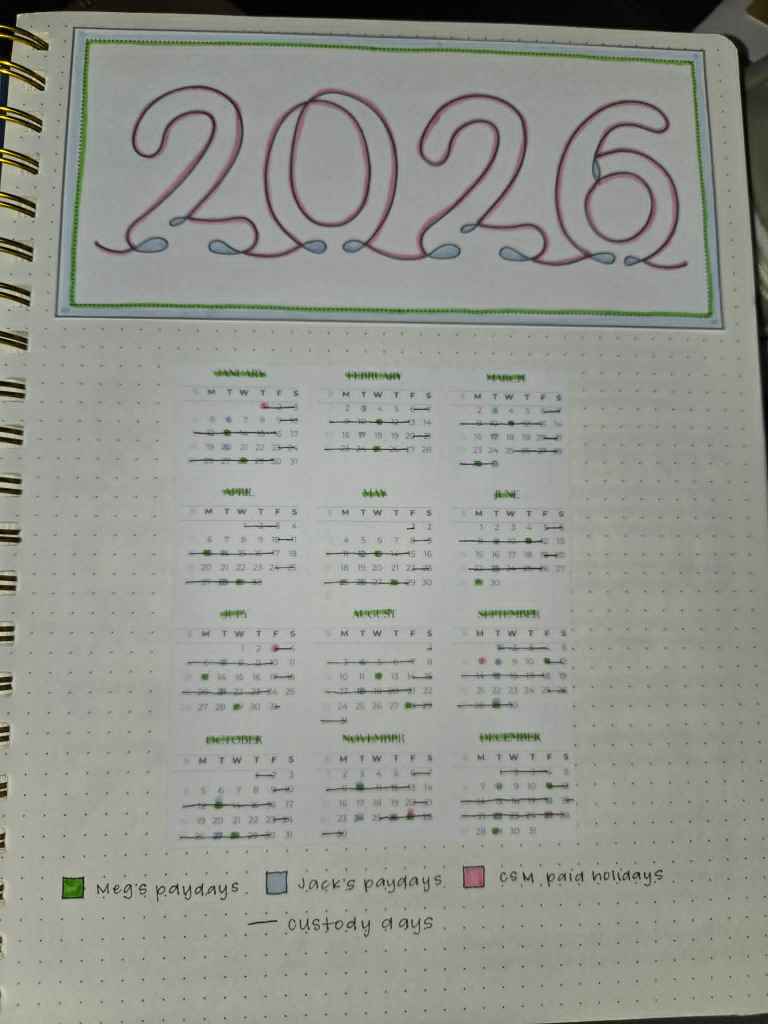
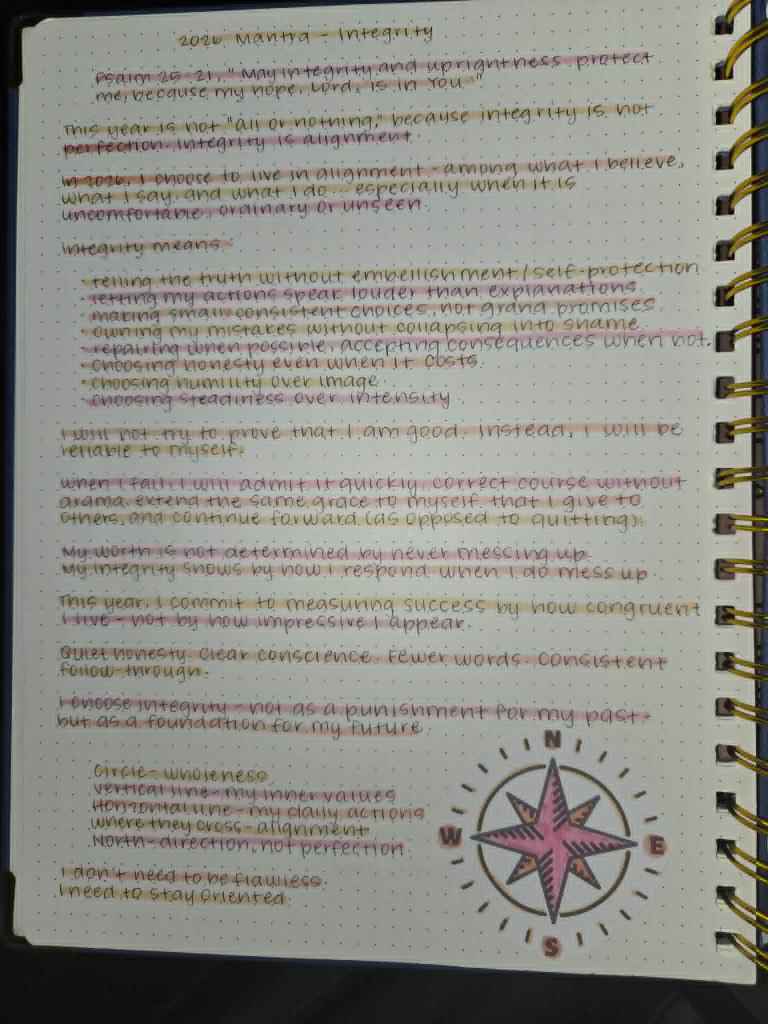
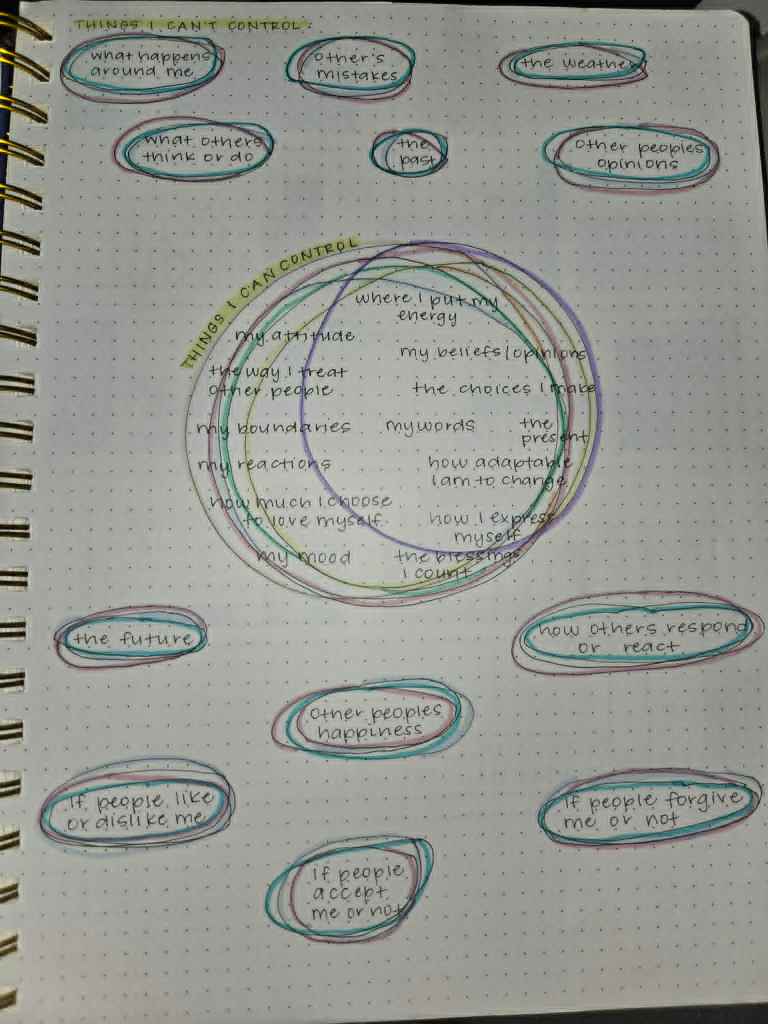
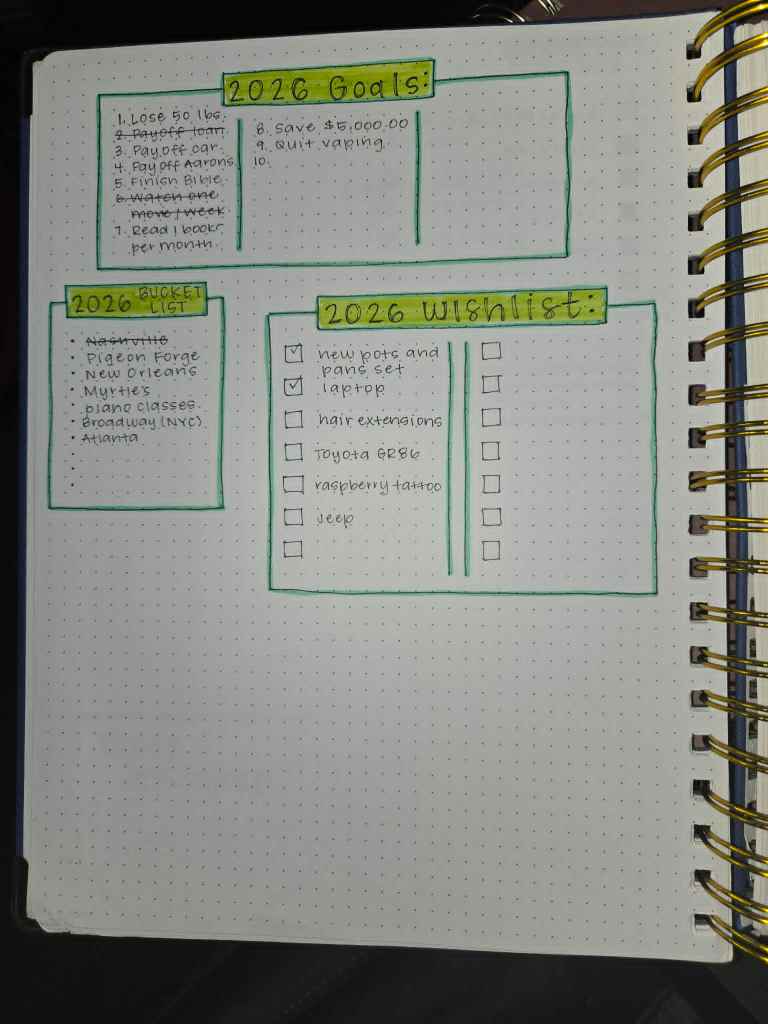
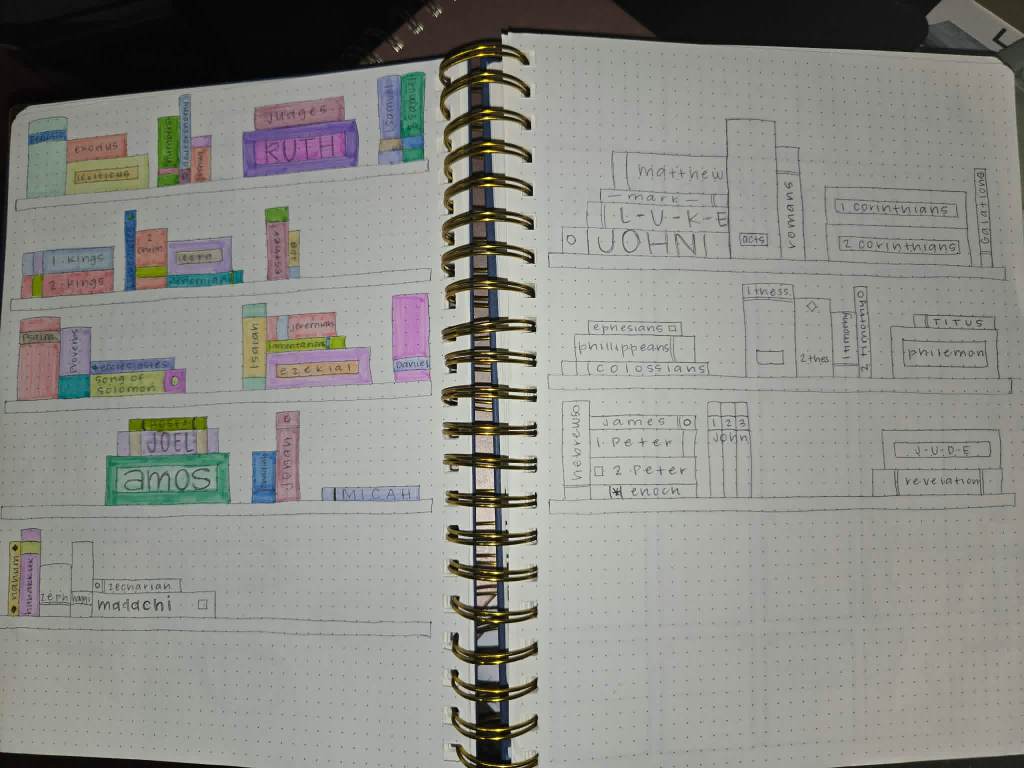
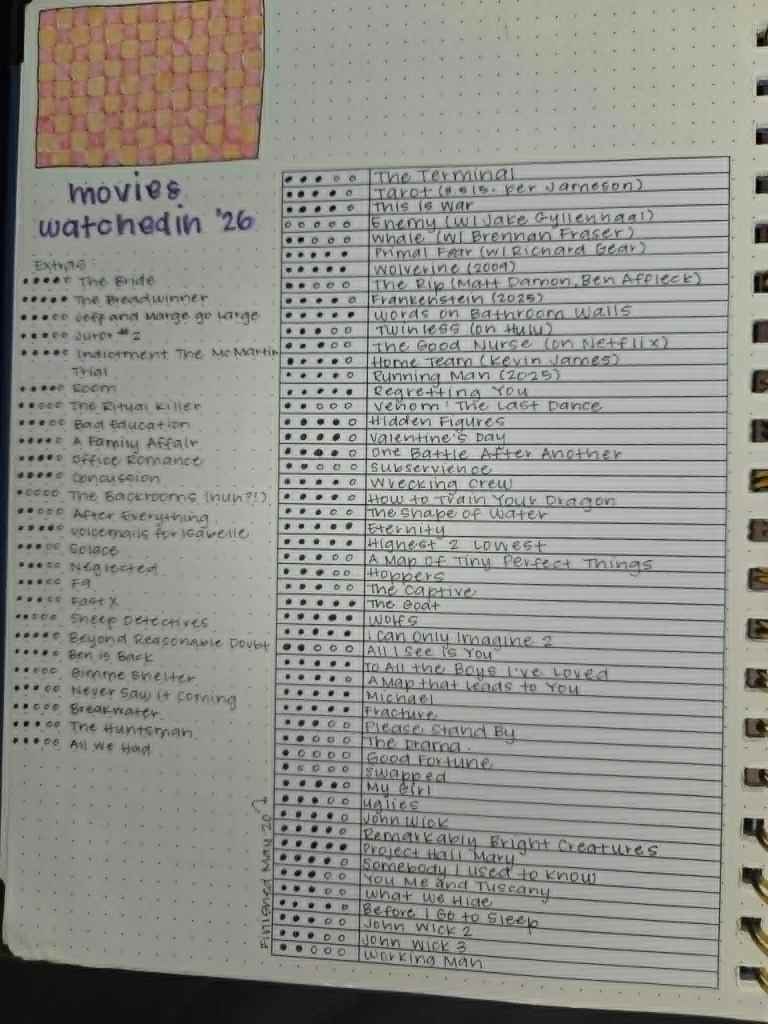
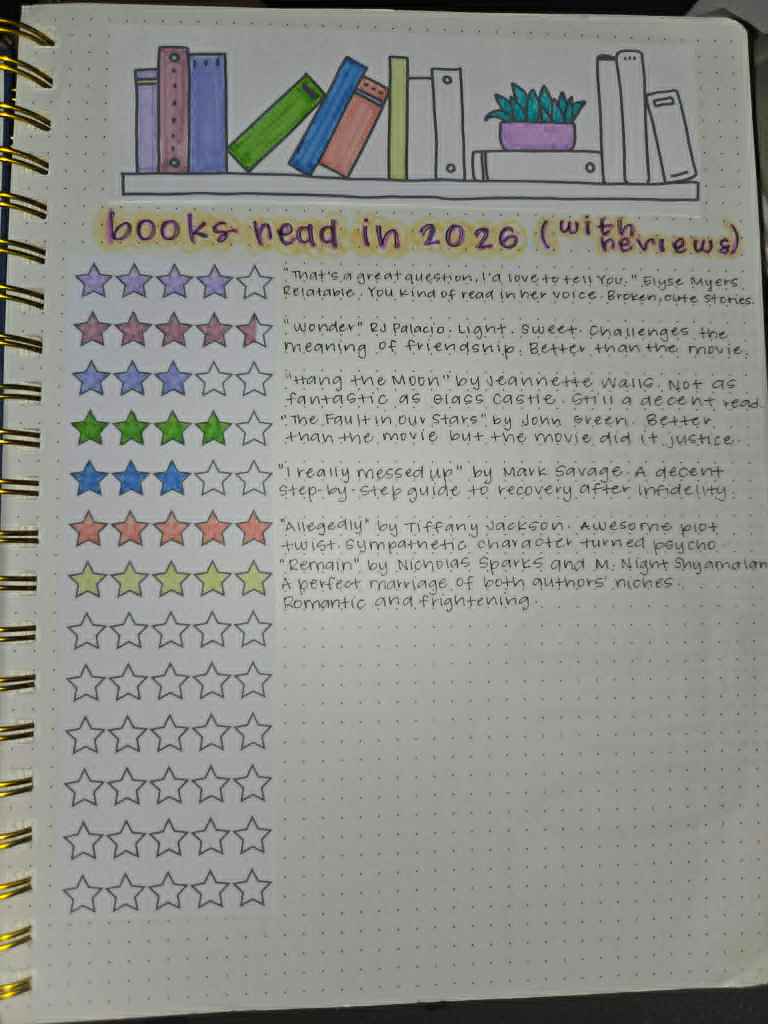
This is the very first page. It’s an overview of the entire year, complete with a key at the bottom. I wanted a place to go to be able to look at all 12 months at one time, for the purpose of planning things in advance.This is the second page. The theme word for 2026, I decided, was “integrity.” Having lived my life for so long from a place of reaction/emotion, even if that meant that I had to abandon a core value to obtain emotional relief, I wanted to create a page dedicated to my “why” for 2026. This is that page.This page is reinforcement for me. I have, in the past, tried to control things that were never mine to control – even if it meant I had to be manipulative or dishonest. So I created this chart, and I refer to it anytime a decision needs to be made, or anytime I start to embrace the accusations/assumptions of other people.These are my goals for the year, as well as my bucket list and wish list for 2026. Some of these items have changed (for example – I decided against hair extensions and am trying to grow my real hair out instead), but there are open blocks where I can add goals/wishes as I decide them. In fact, my husband and I are going to Atlanta this next weekend, so I’ll be crossing that one off very soon.I pledged to read the entire Bible this year, so when I finish a book, I color it in.I wanted to watch one new movie a week, and as you can see, I have already exceeded that goal.I set out to read one new book a month, and I am halfway there – so I’m on track to meet that goal.
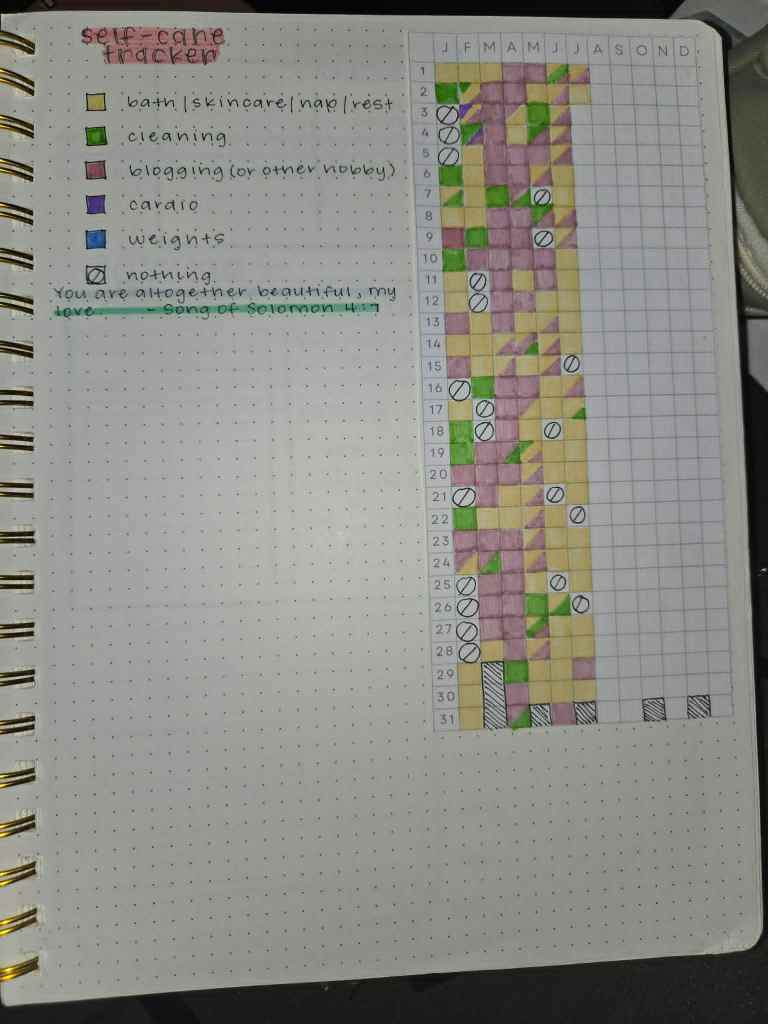
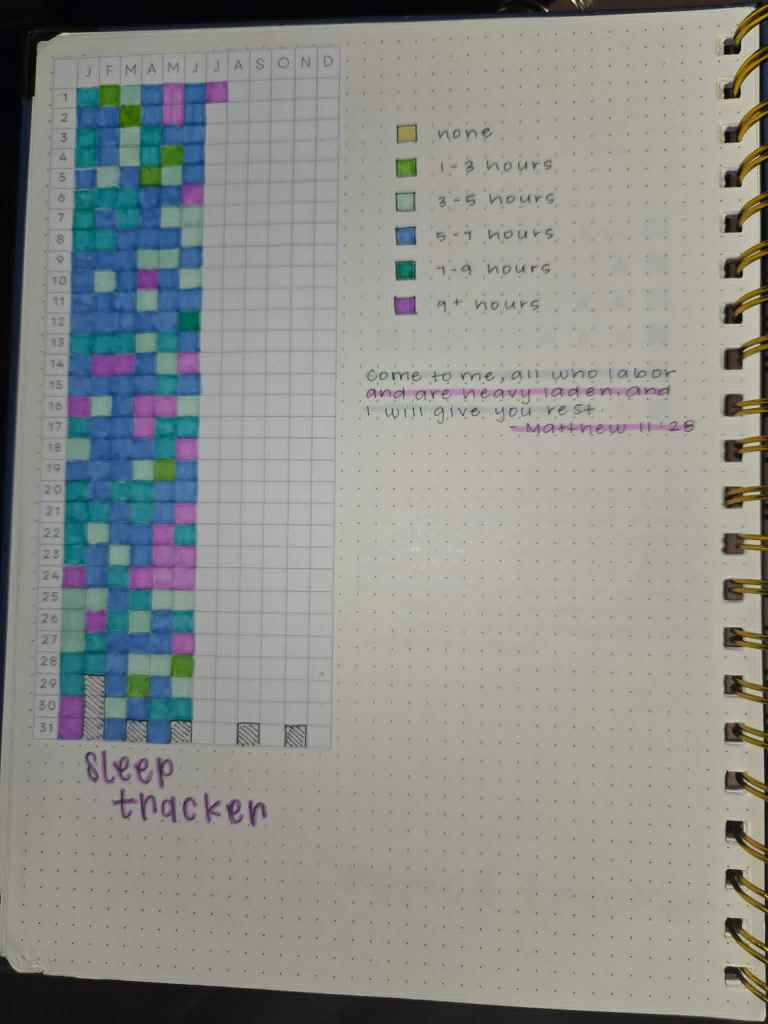
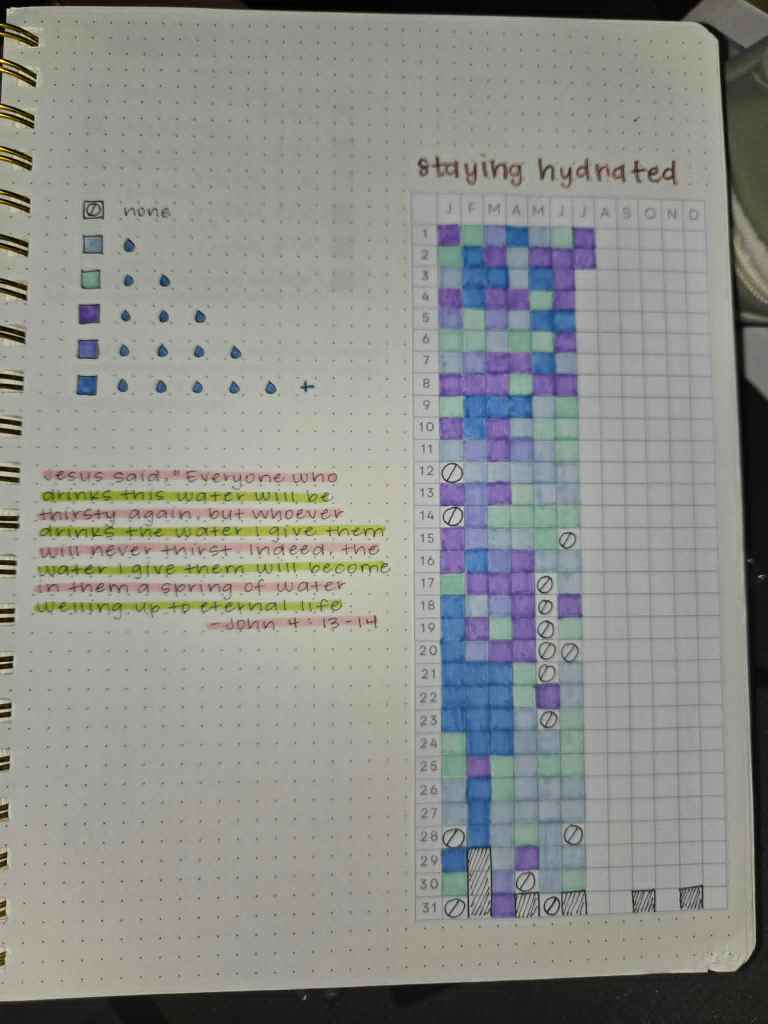
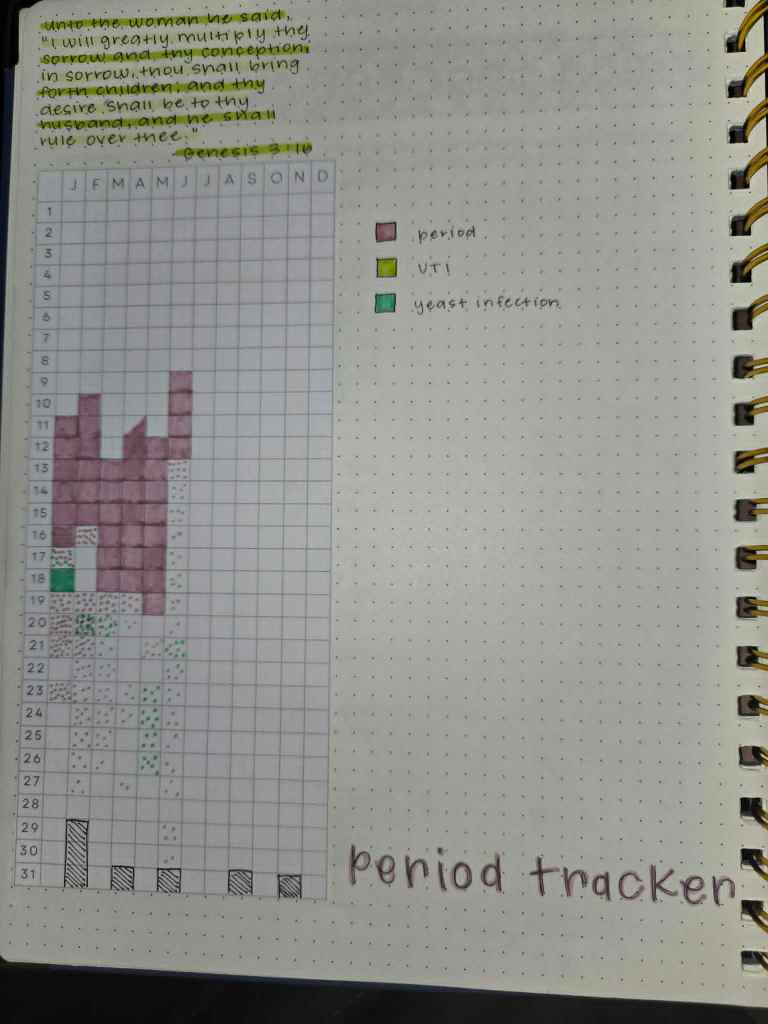
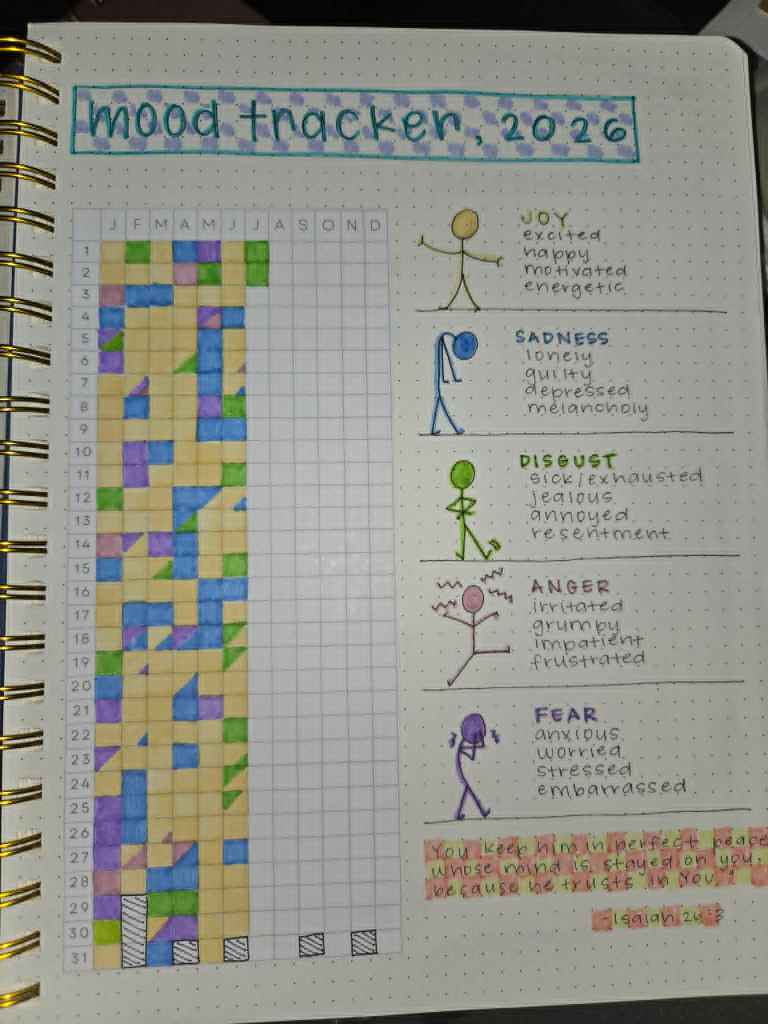
The below photos show my “trackers.” Every day, I use the corresponding key to track my mood and habits. The year is halfway completed. It’s sort of neat to look back and see all the color variations, and these trackers are what keep me motivated to touch my journal every day.
Now for the months…
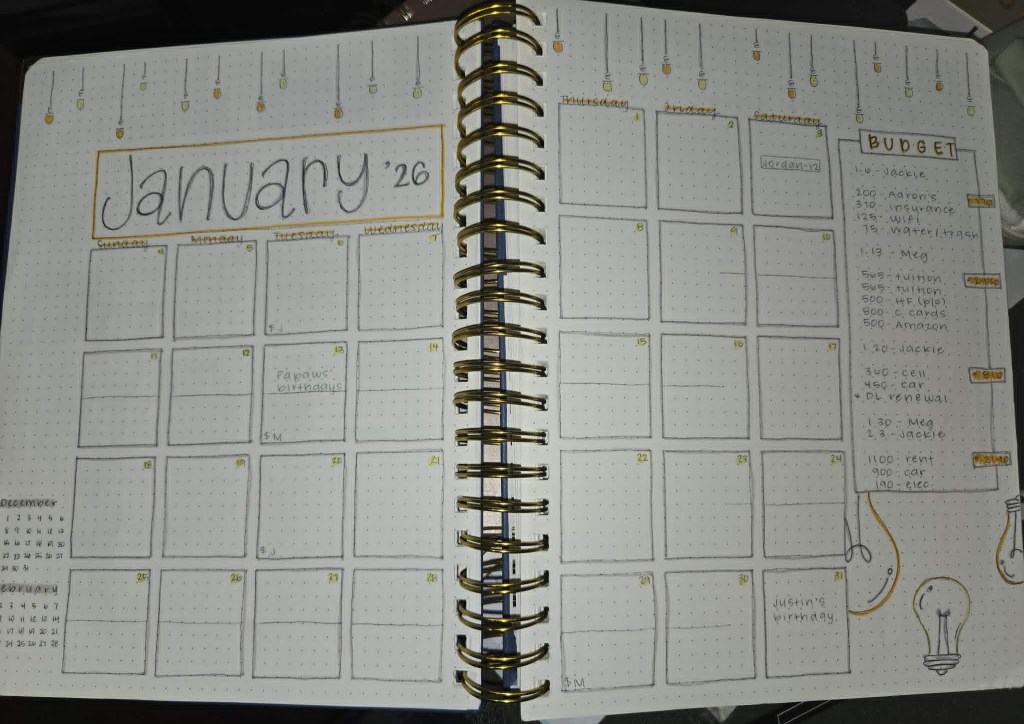
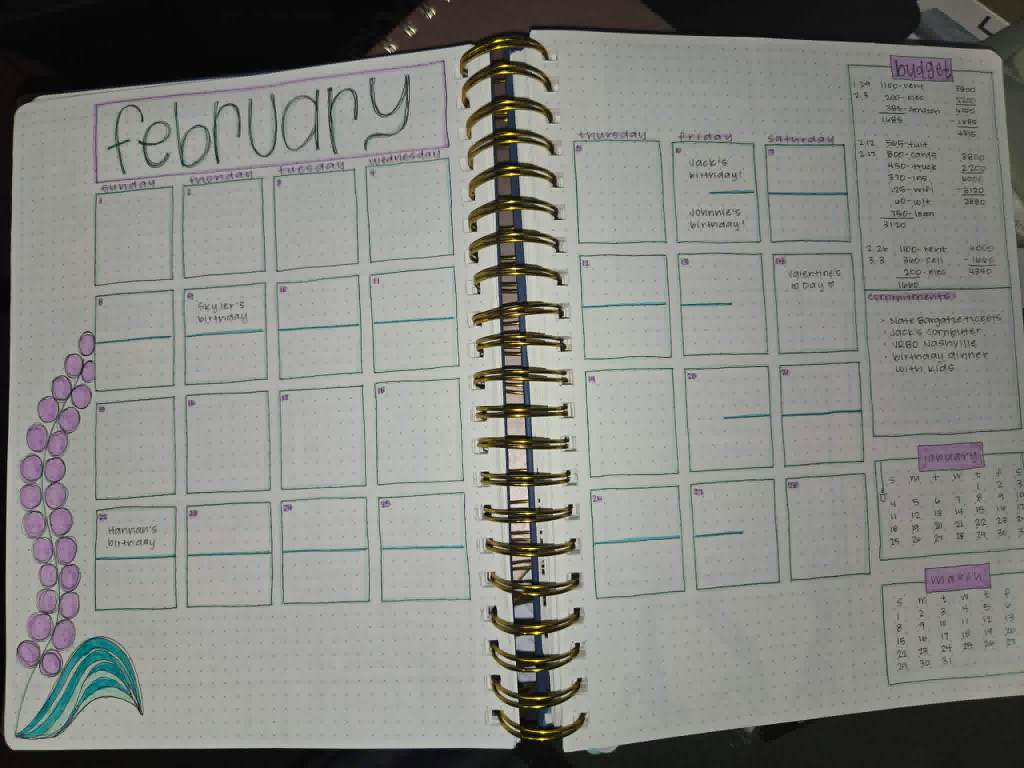
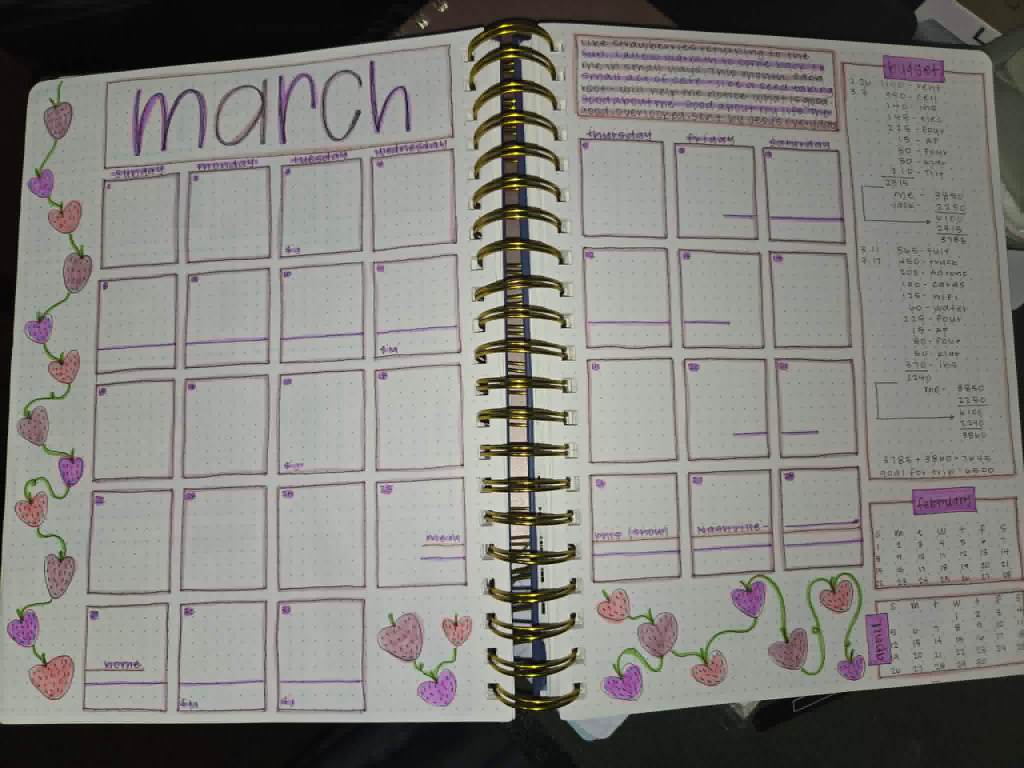
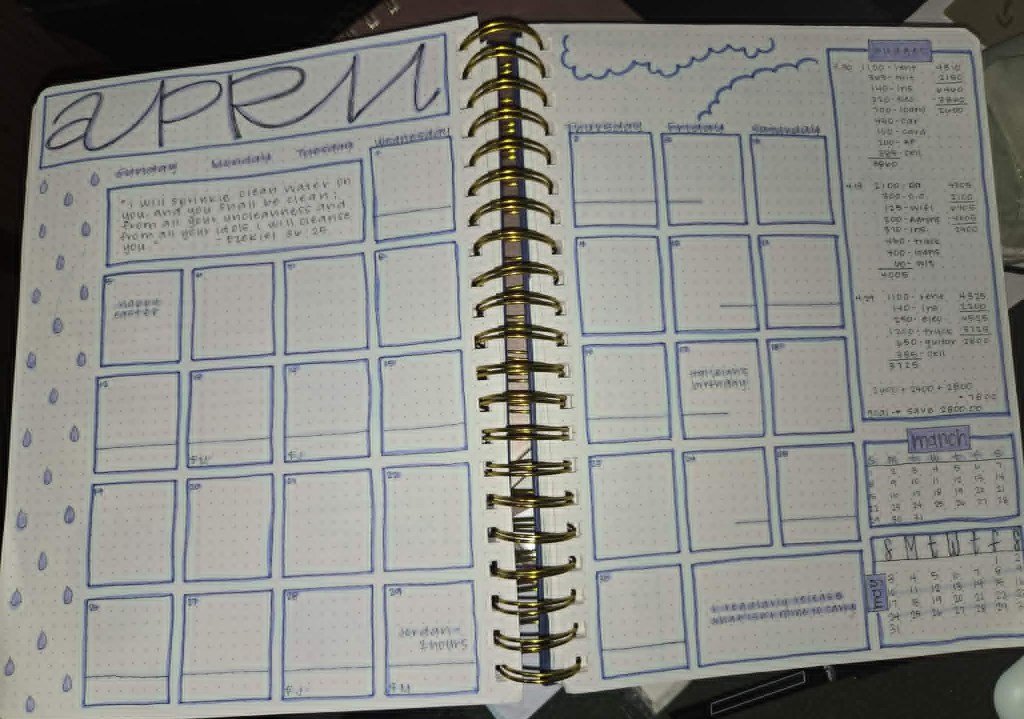
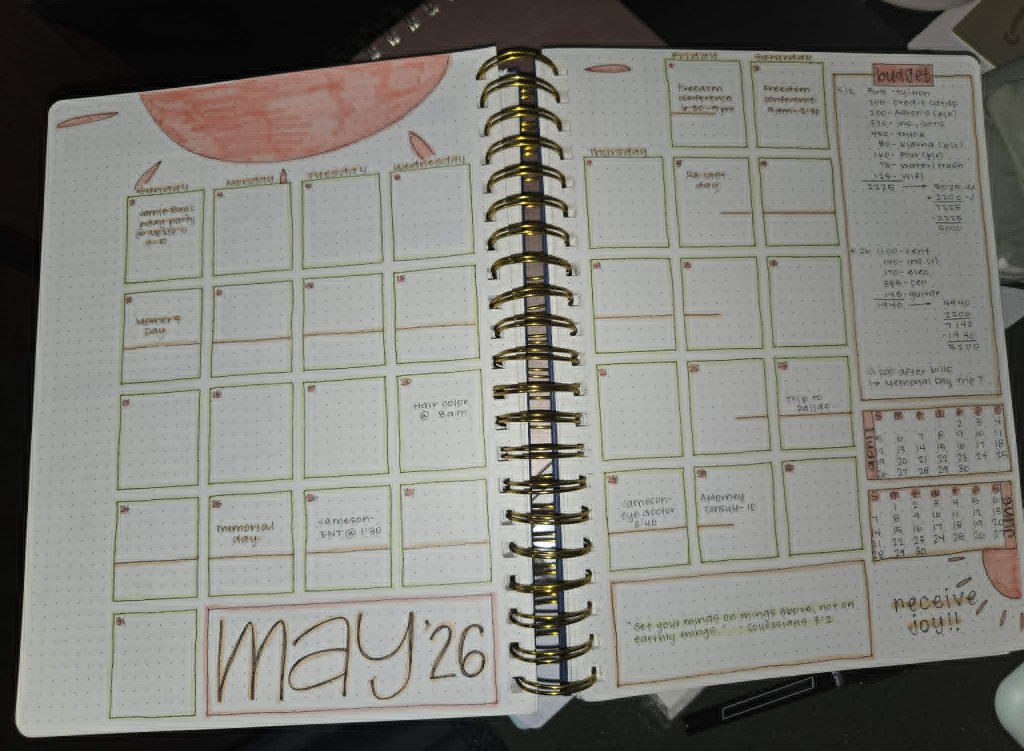
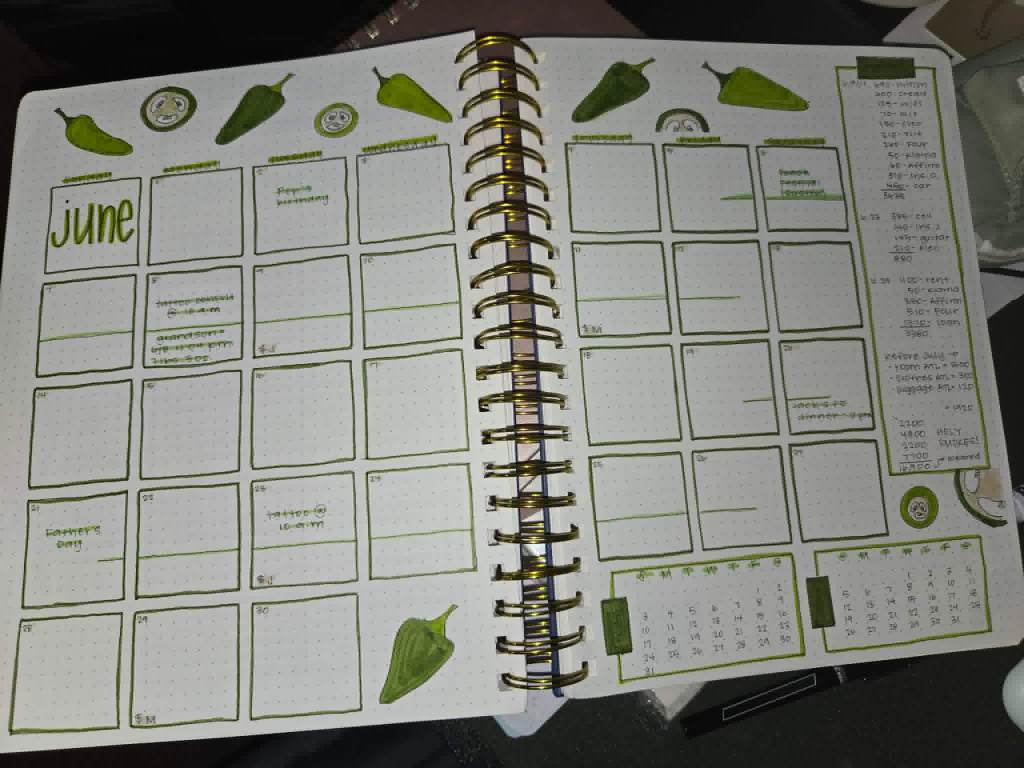
Each month, I chose (and will continue to choose) a different theme. Something in line with my goal for that particular month. I also made more detailed notes for appointments, and on the right side of each monthly page, I created a place to list our monthly bills so that I never lost track of what needed to be paid and when.
The cover page for January. I opted for light bulbs, as the focus was “inspiration.” It was the beginning of the implementation of new habits that I hope to carry with me as I continue to grow.February’s theme was lavender. Lavender symbolizes serenity and devotion. I practiced a spending freeze in February, as a way to show my devotion of this journey, and not a commitment to “stuff.”I doodled strawberries the entire month of March. Strawberries represent love. I realized at the beginning of the year that I didn’t love myself very much, and I used March to track daily acts of kindness I showed to myself. Something as simple as going to bed early or getting a hair cut.April was used to track the “release” of certain things that clouded my identity. Every day, I wrote down something I could stop holding. Someone’s opinion. Things that were not my responsibility. One thing. Every day in April.In May, I returned to the “Son.” I committed to reading Scripture and allowing the Lord to tell me who I was instead of other people. For those 31 days, I chose one Bible verse, each day, and wrote it down, as a way to challenge thoughts of fear and/or shame.June was set aside for spice. Having more energy. Being more productive. I chose 30 places in my home that needed to be decluttered.
Each of the above pictures are just the cover pages for their respective months. I also created a daily page. One page, per day, with time blocks, so that I could make lists of what needed to be done on a daily basis. This journal isn’t just a suggestion – I have used it every day – for something.
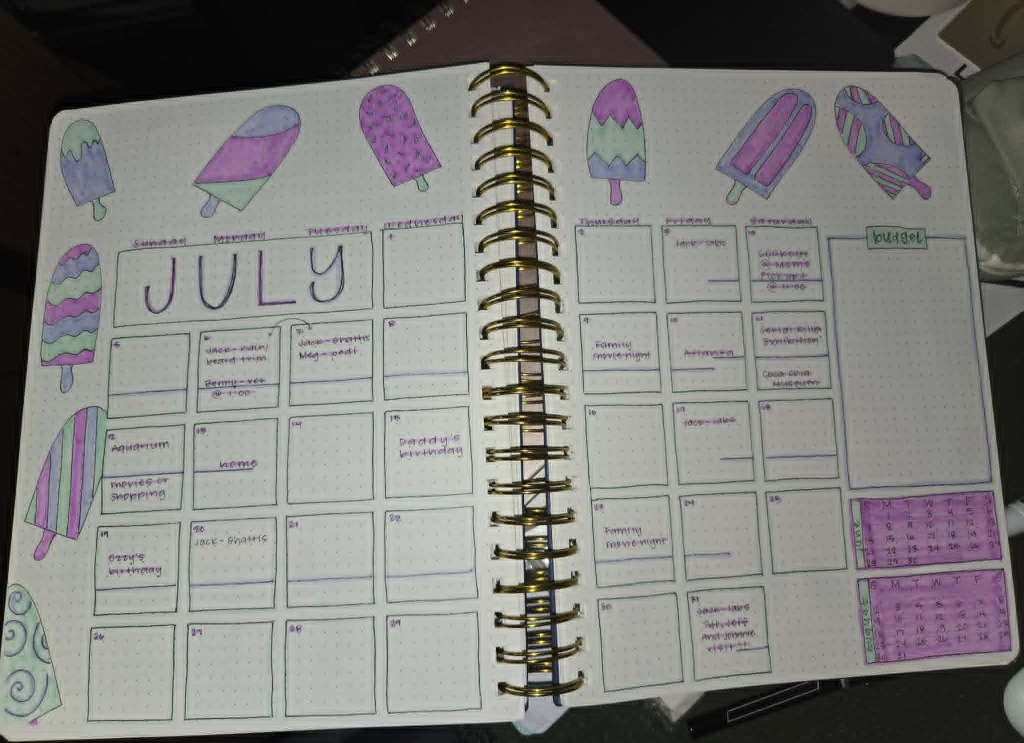
So I’ll spare you the volume of photos of my “daily” pages, but I will show you what July looks like so far, since the month just started.
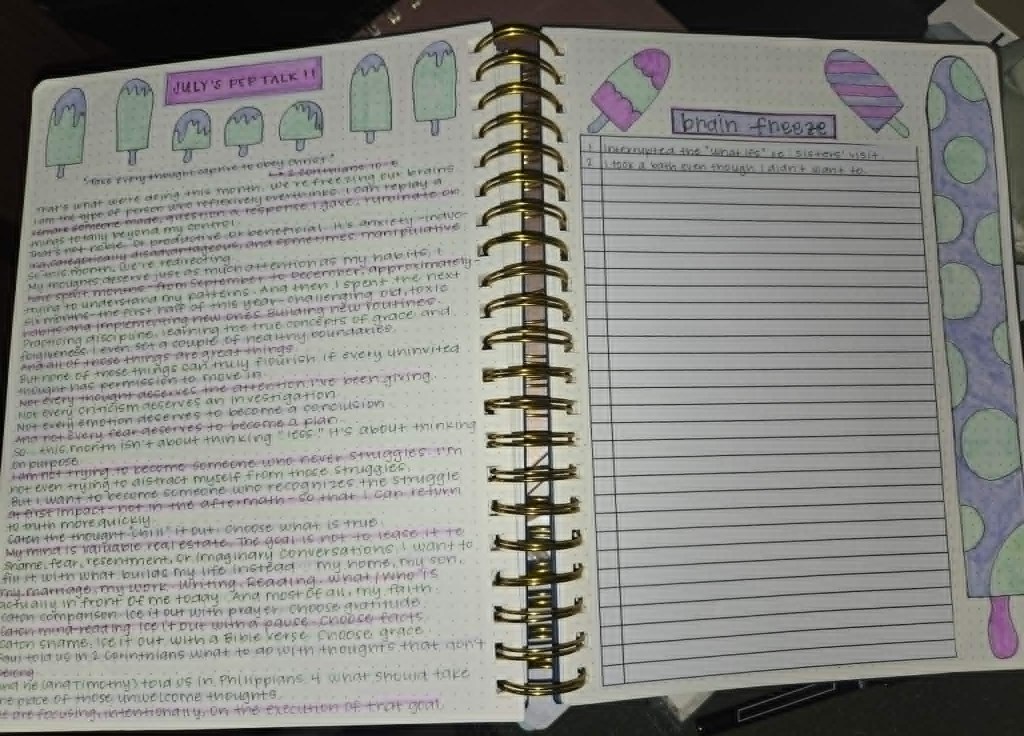
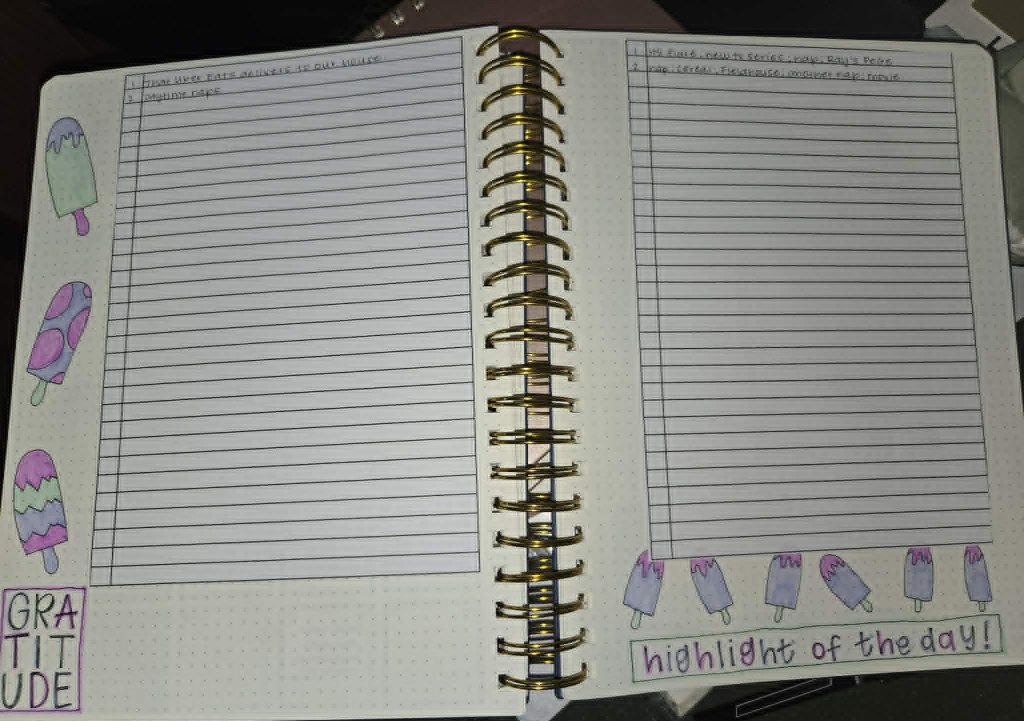
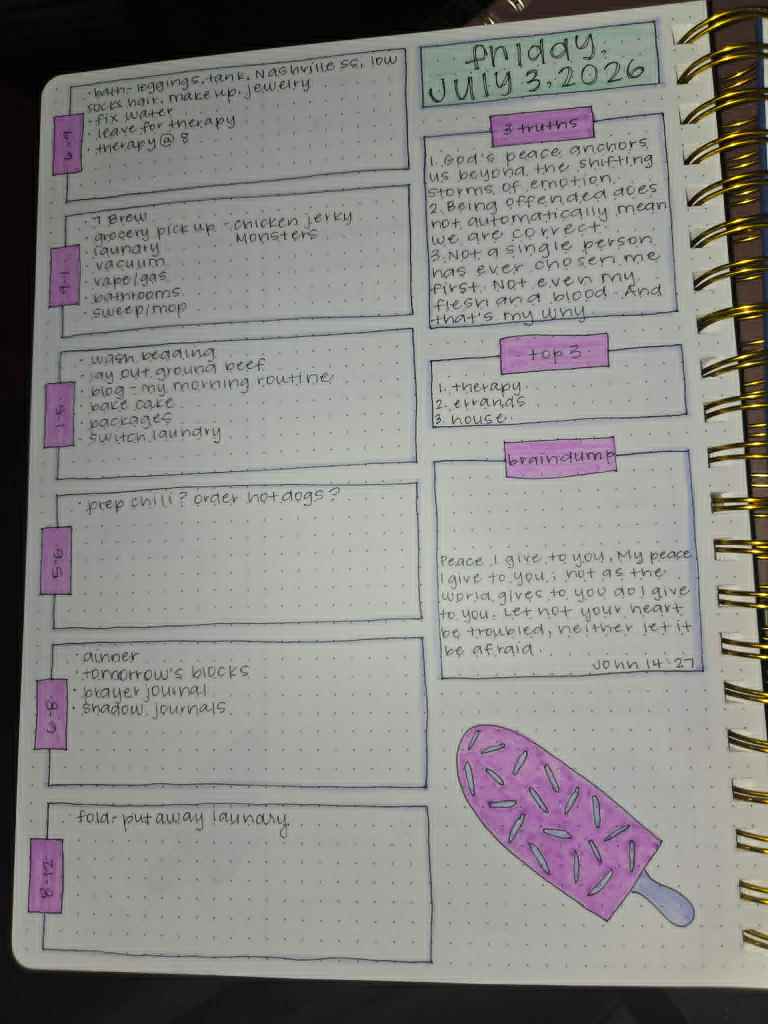
July’s theme is “chill out.” As I have continued with therapy, I am becoming more aware of the thoughts that tend to overtake my headspace, especially when I am stressed or upset. July is about chilling out – or pausing – when I notice a negative thought – and then choosing not to react just so the thought disappears.These pages were drafted/doodled following July’s cover page for the month. I wrote out a “pep” talk for myself, as a reminder of my “why.” I also created a trackable table so that I could write down what thought I “iced” that particular day. Yesterday, for example, I slept for most of the day. I had no energy, no drive, and I was pretty depressed. To combat that, and even though I didn’t really feel like doing anything except lay around, I took a bath anyway. I know that taking a bath shouldn’t be that big a deal or require that much intention, but some days…unfortunately…it does.Following those two pages are “gratitude” and “highlight of the day” pages. These pages exist in my journal every month. I list one blessing per day on the gratitude page, and on the highlight page, I essentially summarize my day.This is what my daily pages look like. They are all laid out the same, although they are colored and doodled to match the theme I picked for the month. On the left are my time blocks. I don’t possess enough discipline to write my day out by the hour, but I can usually follow my list if I give myself a few hours at a time to complete tasks. Tonight is the night I have to fold and put away a LOT of laundry that I have washed, so I have that written down to complete before I go to bed. On the right side, I write down three truths and make a list of my top three priorities for the day. In the “brain dump” block, I usually write down the Bible verse that is in my Bible app that day. The brain dump block is also there for listing things I want to research or random things I need to remember, like passwords or appointments I need to make.
So…there you have it. This journal is something I actually enjoy doing, and I haven’t missed a day yet. I even took it on vacation back in March because it has become such a big part of my routine that I become anxious if I’m not working on it by about 8 p.m.
I hope you guys don’t think this was stupid. I’ll be back tomorrow with my usual content.
If you are new here, you may have questions about my blog name.
Raspberry Iced M.
It’s a fair question.
To answer that question, I have to rewind time.
About 20 years ago, Sonic aired this commercial advertising raspberry iced tea:
For reasons I still cannot adequately explain…
I laugh every time I watch it.
And thus the birth of a two-decade inside joke: Raspberry Iced M (where the “M” coincides with the first letter of my name, Meg).
Truth be told, it was never meant to become anything significant. It was just funny.
But funny things have a way of becoming meaningful over time.
As years passed, I decided to start writing publicly, and I kept the name because it was familiar. Comfortable. A tiny piece of my history.
And I never really stopped to question why I’ve been so attached to it.
So I started researching raspberries, and what I found surprised me.
In some early Christian work, raspberry juice represented blood and became associated with kindness, generosity, and the compassion of Jesus. Whether or not that symbolism is universally accepted is of no consequence to me. I loved the picture it painted in my mind and the idea that a simple fruit is a reminder of sacrificial love.
More than that, raspberries are planted into the ground. They don’t get to choose their environment. But their survival is totally dependent upon growing roots and staying where they are, even if richer soil exists elsewhere. Having been a “runner” for most of my adult life, I found irony in the fact that I made a commitment to the Lord – and to myself – that this blog would reflect the staying power I want to possess.
Staying rooted. Sitting in discomfort when my reflexes want to run. Enduring the consequences of my poor choices while resisting the urge to dismiss the hurt I have caused others and myself. Holding my ground when my feelings try to convince me that I can’t. Planting myself firmly in prayer and in the Word and refusing to accept that I have no value, even if it looks like I am worthless on paper. Allowing pruning. Not chasing. Coping quietly – yet bravely – under the hardest of circumstances. Doing all of that without a need for recognition – because raspberries are not martyrs and are rarely praised for surviving – while also trusting that the Lord will bring fruit in His time, not mine.
And on a more personal level, upon observation, raspberries are incredibly delicate. Soft. Fragile. Easily squashed by the elements around them. And when I started writing, I was much the same way. Crushed by rejection, criticism, disappointment, and my own mistakes.
Life has a way of reminding us just how fragile we really are. How quickly everything can change. How little we actually control.
And yet…
Raspberries do not grow out in the open. They grow, protected, behind thorny canes. Sweetness…surrounded by thorns. I couldn’t ignore the metaphor. Because isn’t that the story of many beautiful things?
The rose has thorns. Jesus wore thorns on His head. And the sweetest fruits often grow in places that require careful hands to reach them.
My life has felt a little like that.
There have been thorns. Consequences. Heartbreak. Grief. Regret. Loneliness – so much loneliness.
Some of those thorns were placed by other people. And some I grew myself.
But somehow, by the grace of God, this raspberry has still grown. Not because my life has been easy. But because He has been faithful.
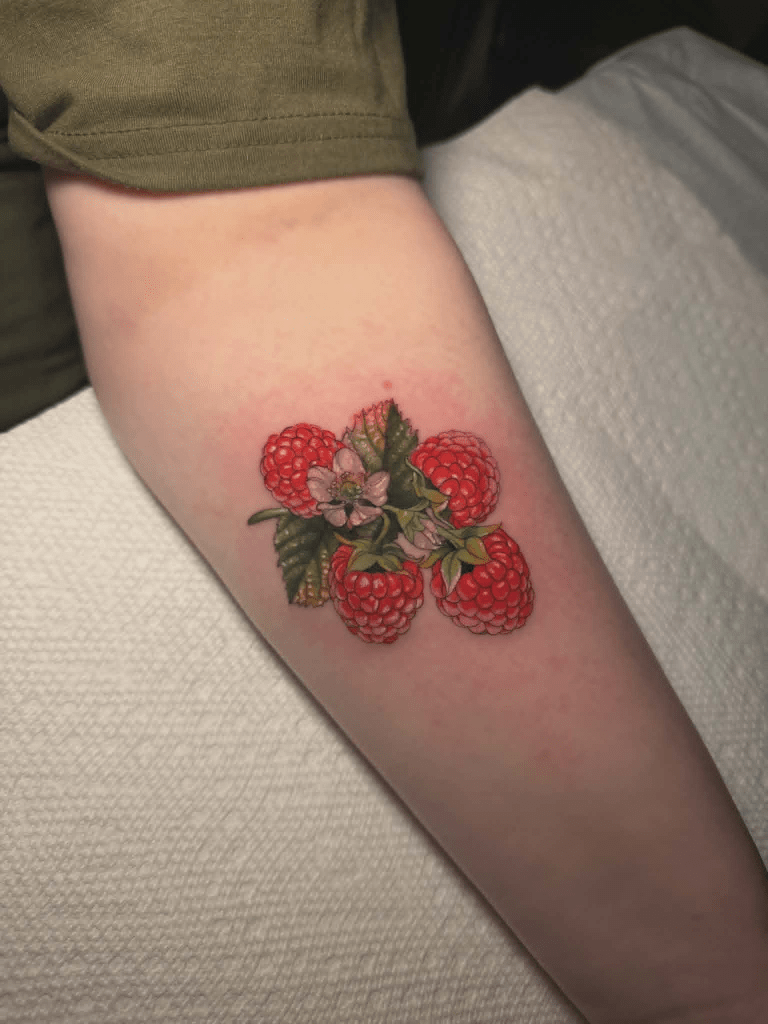
I married into an incredibly creative family. My daughter-in-law is a tattoo artist – a busy one – because she is a good one. Having already been inked – thrice – I began making plans for a fourth tattoo, and raspberries seemed like the only appropriate option. Not because they represent perfection. In fact, quite the opposite.
Raspberries remind me that delicate things are still valuable. That a sweet spirit can exist alongside suffering. That elegance can grow even in difficult places. That protection sometimes comes wrapped in thorns.
So while most people just see red fruit, I see a story. A silly commercial that became a username. A username that became a blog. A blog that became a place where I practice honesty and vulnerability. And now a tattoo that reminds me every day that God has a remarkable way of taking ordinary things and giving them extraordinary meaning.
What started as a joke has become a theme – that the smallest, strangest parts of our story can become threads that God quietly weaves into something magnificent.
And that’s how He works most often in my life – not by erasing my story – but by redeeming it.
“I chose you and appointed you so that you might go and bear fruit – fruit that will last.” – John 15:16
I’m taking a break from my usual content to share some completely useless facts that I know, in hopes that it will distract me from the grief I am currently processing.
In my home state, in the town of Sulphur, it is legitimately illegal to curse on the telephone.
You’re taller in the morning than at night. We can thank gravity for that.
Woolly mammoths were still alive when the Great Pyramid was being built.
A day on Venus is longer than its year (i.e. its trip around the sun).
The smell of rain has a name: petrichor. And humans that detect it at incredibly low concentrations. Some scientists believe this was developed by our early ancestors because water was so crucial for survival.
There are several cases noted throughout history where people who had been declared dead were very much alive. This prompted the creation of “safety coffins,” equipped with bells so that groundskeepers could hear those live people if they woke up underground.
The city of Nineveh, which Biblical Jonah preached against, was so large and wealthy that many people were considered unconquerable. But in 612 B.C., the city suddenly fell, with little explanation as to why – just as the prophets had foretold.
We have already met most of the people we will ever meet in our lives.
Most people don’t realize when they experience a “last time.” The last bedtime story we hear. The last time we drive a certain car or pet a certain dog.
In 1872, the merchant ship Mary Celeste was found drifting in the Atlantic Ocean. The cargo was intact. The crew’s belongings were largely untouched. The ship was seaworthy. The captain, his wife, his daughter, and the entire crew had vanished. To this day, no one knows what actually happened.
The Babylonian king in Daniel’s time, Nebuchadnezzar II, was a real historical figure whose building projects were so extensive that inscriptions bearing his name have been found by the thousands.
The last execution by guillotine in France occurred in 1977—the same year the first Star Wars movie was released.
Your stomach gets a brand-new lining every few days. If it didn’t, it would digest itself.
Cows often develop best friends and show measurable stress when separated from them.
In ancient Rome, wealthy people sometimes hired professional mourners to cry dramatically at funerals.
And on that note, I don’t want a funeral – but if I did – I’d probably have to hire people to show up and cry.
As I have mentioned, I go to therapy every Tuesday. Today was no different.
8 a.m. It’s the same routine. Drive in silence. Park the car. Enter the office. Grab Kleenex. Drop my keys and phone on the couch beside me so that I’m not tempted to fidget.
We talked about something today that I hadn’t mentioned to her before.
For most of my life, I swung between two extremes. Sometimes I stayed silent when I should have spoken. Other times, I spoke up when silence would have probably served me better.
And the older I get, the more I realize that wisdom isn’t found in always speaking up or always staying quiet.
It’s found in knowing the difference.
One of the hardest lessons I have learned is that not everything deserves a response.
When something hurts, my instinct is to address it. Clarify it. Understand it. Resolve it.
But my therapist challenged me today to consider that no every offense deserves my attention…that I get to decide how much weight to give every comment, every misunderstanding, every opinion.
Sometimes responding only gives more life to something that might die on its own.
Under the right circumstance, silence is wisdom. It’s not weakness – it’s maturity.
When someone is committed to misunderstanding me. When emotions are running high at all angles. When I’m speaking to my own side of a story, while the other person in the conversation is only listening for an opportunity to defend him/herself. When the conversation is producing more heat than light.
But silence isn’t always healthy. And that’s where I get tripped up. Because I spent years confusing peacekeeping with peace itself.
I stayed quiet to avoid conflict. I swallowed feelings. I minimized needs. I made myself smaller so that everyone else was comfortable.
That wasn’t wisdom. That was fear. And fear disguised as peace eventually becomes resentment.
After a prayerful ride home, and a few hours of reflection, I have figured out that I should be speaking up when:
A boundary is being crossed repeatedly. Not because I am trying to control someone, but because remaining silent teaches them that the behavior is acceptable. Daddy used to say, “If you don’t condemn it, you condone it,” and I think that motto fits here.
Resentment is building. That’s often a sign that something important has gone unspoken.
My integrity requires it. In moments when staying silent would violate my values – when truth should matter more than comfort – I need to speak up.
A relationship has the capacity for repair. I believe that healthy relationships can handle honest conversations…that if someone genuinely cares about me, they will usually at least be willing to hear it, even if they do not agree with me.
And – like I said – sometimes it’s better just to “let it ride.” I love that phrase because it’s practical.
When the issue is with my ego – not my values.
When I am seeking vindication instead of resolution.
When the other party has already made up his/her mind.
When talking won’t change the outcome.
When I feel myself reacting emotionally instead of responding thoughtfully.
Those types of battles – for me – don’t deserve enrollment.
This exercise of decision-making is tedious. It requires that I question my motives in a very honest, direct way.
What is my goal? Do I want peace? Do I want understanding? Do I want accountability? Do I want the last word? Do I want to be right?
And the answer tells me whether I need to say something or keep my mouth shut.
To back my theory, I offer that Jesus did both. He spoke boldly when truth required it. He confronted hypocrisy, He defended the vulnerable, He corrected error. But He also remained silent at times. He didn’t clarify every accusation. He didn’t chase every critic. And He did not present for every argument. He was wise enough to know what required His voice.
As I prayed on my way home from therapy, I told Him that I am not sure if what I am doing is working or not. These days, it seems like I do the same things, talk to the same people, think about the same scenarios. I am still triggered by the same things. I’m still tempted by the same things. I find that I am praying about the same things I prayed about 10 months ago.
But I asked Him to remind me – when I start to question my progress – that none of what I am doing may be for me…or my circumstances. Yes, I would love to “feel better,” but the Lord sees things on a scale bigger than ours.
What if someone needs to watch how I transform so that they know how to do it? What if someone reads one of my blog posts and realizes that they’re actually salvageable? What if someone sees what I’ve survived – not beautifully or perfectly, but meaningfully – and quietly decides that their life is worth living, too? What if someone feels comfortable enough to come specifically to me for a hug or for prayer or for a conversation because I have chosen not to hide the ugly part of flesh-breaking?
I told the Lord that’s a lot of pressure to put on someone who fails at most things. But there is something to be said for the effort He is helping me put into myself so that I can become a person I can tolerate. And it’s His grace, His mercy, His kindness, and His covenant love that have made all the difference. I take credit for none of this. More than self-discovery, more than self-acceptance, even more than self-forgiveness – He is teaching me that my life is not special because of the work I do. It is not measured by the number of epiphanies I have on any given day. And my life – and transformation therein – is not a reflection of how “sanctified” I’ve become. I am completely and wholly reliant on His sacrifice, His blood, His Word.
So it’s really important to me to do my best to handle conflict in ways that glorify Him.
Speaking up isn’t always courageous. And biting my tongue isn’t always wise. And I don’t have to make one, never-wavering choice between the two. Instead, it’s about asking, “What serves truth, peace, and integrity in this moment?” Because some situations need a voice. And others need patience. If I am being honest, I am still learning that lesson. But the process of learning it is where maturity lies. And I don’t think that effort goes unnoticed.
The kindest thing we can do for someone is listen.
Not fix.
Not advise.
Not correct.
Not compare.
Not explain why that person “shouldn’t” feel the way that they feel.
Not rationalize.
Just listen.
And for some reason, that is much harder than it sounds.
Most of us listen to respond.
I’ve caught myself doing it. Someone starts talking, and before they’re finished, my brain is already searching for solutions. Advice. Perspective. A Bible verse. A silver lining. A way to make them feel better.
And while those things can be helpful at times, I’ve realized something: People often don’t need answers first. They need understanding first.
Being heard is healing. There is something powerful about sitting across from someone and realizing they aren’t trying to fix you.
They’re not interrupting. They’re not waiting for their turn to talk. They’re not minimizing your experience.
They’re simply present. That kind of listening communicates something words often cannot:
“Your experience matters.”
“I see you.”
“You don’t have to carry this alone.”
Listening requires humility, and that might be why it is so hard to do. We have to temporarily set aside our own opinions, our own experiences, and the “What I would Do” mentality. It requires curiosity. Patience. Restraint. Sometimes it means resisting the urge to turn someone else’s pain into a problem we are determined to solve.
Not every problem needs a solution in the moment. Some sounds need witnessing before they need wisdom. Some grief needs space before it needs perspective. Some emotions need acknowledgement before they need analysis.
I know there have been moments in my life when I didn’t need someone to fix what I was feeling…
…because I always figure it out eventually. I just need to panic first. And I needed someone willing to sit beside me while I felt it.
Consider Job. One of the most interesting examples of this in Scripture is Job’s friends. When Job lost everything, they came and sat with him.
For seven days.
No speeches. No explanations. No lectures. Just presence.
Ironically, the problems began when they started talking.
Sometimes the ministry of presence is more powerful than the ministry of answers.
Listening is an act of love. No, it doesn’t change circumstances. But it communicates value. “You matter enough for me to slow down. I care enough to understand before I speak. I am here with you.“
That is such a gift.
I spend a lot of time helping other people. And I do that without expectation of returned favors. But I am learning to ask what I would want asked (rhetorically) when I’m upset about something: Do they need help or do they need to be heard?
Those aren’t the same thing. Sometimes advice is appropriate. Sometimes guidance is needed. But often the greatest kindness is simply creating a space for another person to be honest.
This lesson isn’t just for relationships. Sometimes we rush to fix ourselves, too. Correct every feeling, move past every hurt immediately. But sometimes what is needed most is to sit quietly and honestly and acknowledge our feelings without judgment or panic or distraction. Without immediately trying to make it disappear. I can testify that it hurts. But it works.
We don’t always have to rescue or explain. Sometimes we just need to listen. Feeling understood is one of the most healing experiences a human being can have. And in a world full of people who want to speak, there is something profoundly loving about being willing to simply hear another person’s heart.
Every misunderstanding. Every criticism. Every assumption. Every slight. Every opportunity to defend myself.
I thought that if I explained myself clearly enough, people would get it. Get me. If I corrected the record often eough, people would see the truth. If I responded to every offense, I could somehow prevent misinterpretation of my actions/choices.
I was wrong. Really, really wrong.
One of the things I am learning – right smack in the middle of sleepless nights and overthinking and sitting in anxiety – is that noticing something does not mean I have to engage.
And boy, oh boy – I notice.
Rude comments. Digs on social media. Judgment. Accusations. Insults.
And it takes a lot for me, now, not to follow my impulses – the ones that have been branded into me – to jump to my own defense.
Now, when I notice a rude comment, a keep walking. When I notice a judgment, I keep living intentionally. When it is clear that there has been a misunderstanding, I choose not to argue with it – at least not outwardly.
There are really two people in my life who listen to me sound off about the things I notice. I pay one of them. And the other vowed to love me 8 years ago…and most days, I don’t think he’s even paying attention.
But nobody else ever hears those monologues in real time. The ones where I spend three days arguing with someone in my head. The ones where I rationalize, out loud, the events before and after a conflict, trying to pinpoint what I could’ve done differently. The ones where I stubbornly stand on all ten toes in my point of view.
But others will never hear it. And that’s not avoidance. That’s discernment.
I have learned to outwardly ignore certain things with grace.
People’s need to understand me. Not everyone wants clarity. And I know that because people who want clarity typically ask direct questions. For those who don’t, I just assume they want confirmation. Confirmation – through my misinterpreted behavior or choice – that they are justified in seeing me through an old lens. And no amount of explaining will change their mind. I no longer volunteer for those trials.
Every invitation to defend myself. To be fair, there are not many of these anymore – because – like I said – most people have already decided who I am – and they’re not willing to take the lid off of that box. Some accusations deserve a response, yes. But some don’t. Constantly defending myself keeps me emotionally chained to things I am trying to move past. And I truly believe that my quiet, boring, isolated life speaks more clearly than my defenses ever will.
The opinions of people who don’t know me. This one sounds obvious, but it isn’t. It is surprisingly easy to give enormous emotional authority to people who do not know anything about my actual life. Like…people who see me in leggings and assume I’m a slob. People who have talked to one of my exes and brand said ex’s story at 100% truthful. People who look at my profile picture on social media and assume I’m high maintenance. People who see the weight I’m carrying in my tummy and assume I’m lazy. People who know that my daughter and I are estranged and decide, with no other information, that I was a horrible mother. I used to stew in that judgment and hate. From total strangers. But I try to remember now that not every opinion deserves equal weight.
Every negative thought my mind produces. I like to think I am a creative person. Exceptionally creative. Especially at 2 a.m. when my thoughts override my good sense, and I spend all night replaying the past. But not every fear is a warning. Not every thought is wisdom. And not every worst case scenario deserves investigation or preparation. Some of my thoughts are from a place of fear, just looking for attention. And I am still working on not giving those thoughts what they want.
The emotional simplicity and immaturity of society in general. I cannot regulate another adult. I cannot force insight or empathy or even growth. And I’ll admit – that frustrates me sometimes. But choosing not to address those things in real time allows me to reflect freely. I used to manipulate the way others interpreted me by doing favors for people, dressing a certain way, adopting a personality that suited various situations I was in. And I thought I was doing the right thing – because doing all of that kept people happy and approving. But I was wrong. It was just an unhealthy, deceitful coping mechanism to avoid being lonely. And now, I’m lonelier than ever, but at least I’m free from the chains of always having to accommodate others.
The need to be chosen. This one still messes me up. I used to constantly scan for evidence that I was wanted. And the moment I realized I wasn’t prioritized or valued, I’d – once again – change who I was…change my preferences, my looks, my attitude. I wanted to be important – and appreciated. But if the last 10 months has taught me anything, it’s that no amount of fake control will transform someone else’s priorities or selection process. And the reality is that I have actively chosen people who have walked away from me without looking back. I have prioritized others’ needs and propensities over my own, such that I have completely lost sight of the fact that I have the ability to choose myself, even when no one else will.
To be a fly on my wall, you probably wouldn’t even notice the things I ignore – and that’s the point, I think, because I ignore all of those things…with grace.
I will not allow the fact that I intentionally choose silence to make me cold or bitter or detached or indifferent. I don’t believe that’s who I am. I care deeply. And I feel deeply. And those are attributes, even though I have always thought of them as curses.
Anyone can ignore something out of resentment. But grace is different. Grace is, “I see this. I acknowledge this. And I am choosing not to let it govern me.”
That is so much harder.
I think often about how Jesus handled certain situations during His time on Earth. He didn’t answer every accusation. He didn’t chase every critic. He didn’t spend His ministry correcting every false narrative. Sometimes He answered. Other times He remained silent. The wisdom was knowing the difference.
And I also consider my own prayers today. Very rarely does God spell it all out for us. And most of the prayers He has answered for me were not answered directly – or in ways I expected. The Lord tells me what I need to know. And He requires trust for the rest.
So the people in my life (and people who are no longer part of my life) do not get all of the information. I remain silent. In my own corner. Making slow, steady changes that better me, even if those changes go unnoticed, and even if they do not benefit anyone else.
Not everything gets my attention anymore. Only the things I deserve – truth, character, peace, growth, faithfulness, people who actually love me, the life God has placed in front of me. That is where my energy belongs.
“This I ignore with grace.“
Not because I’m blind. Not because I’m weak. Not because I don’t care.
But because I have finally learned that attention is one of the most valuable things I possess. And I don’t want to assign that attention to proof or defense or a chase. I don’t want to burden myself with things that are not mine to carry in the first place.
Some battles require courage. But this particular battle requires restraint. And it feels powerful to finally know the difference.
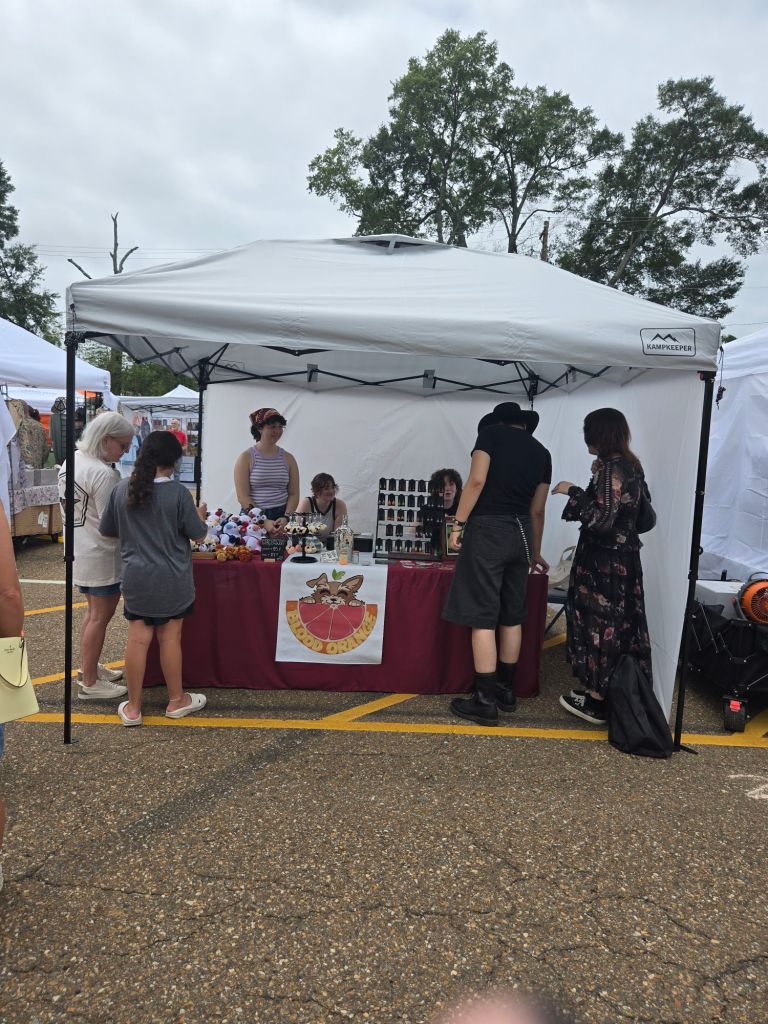
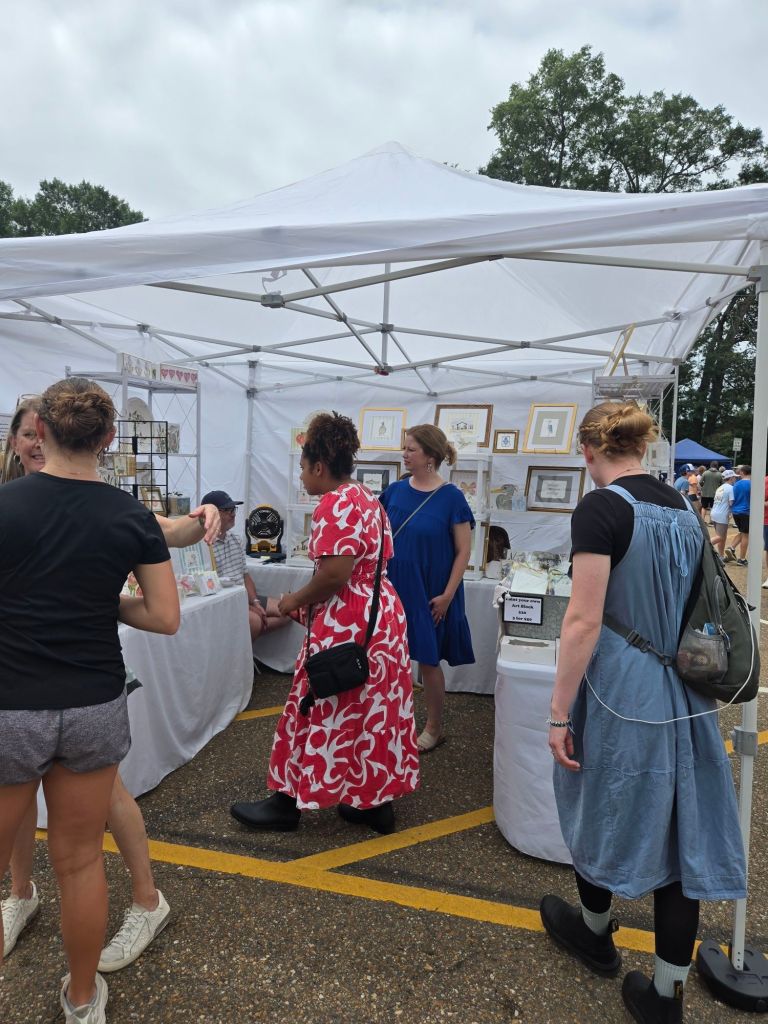
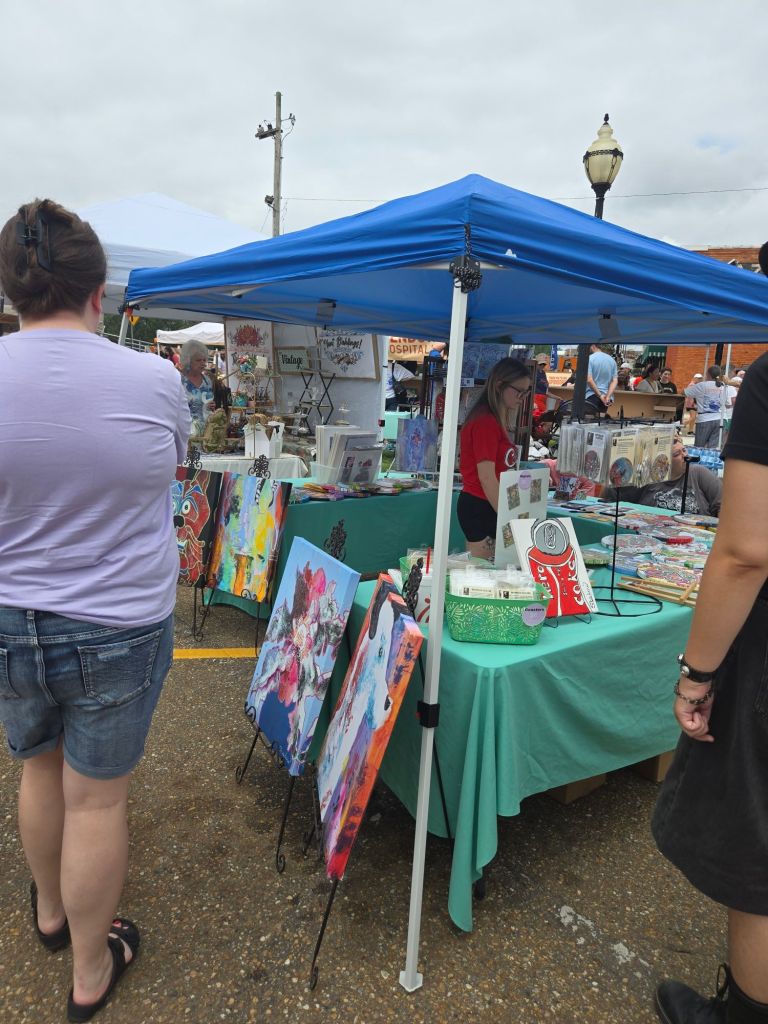
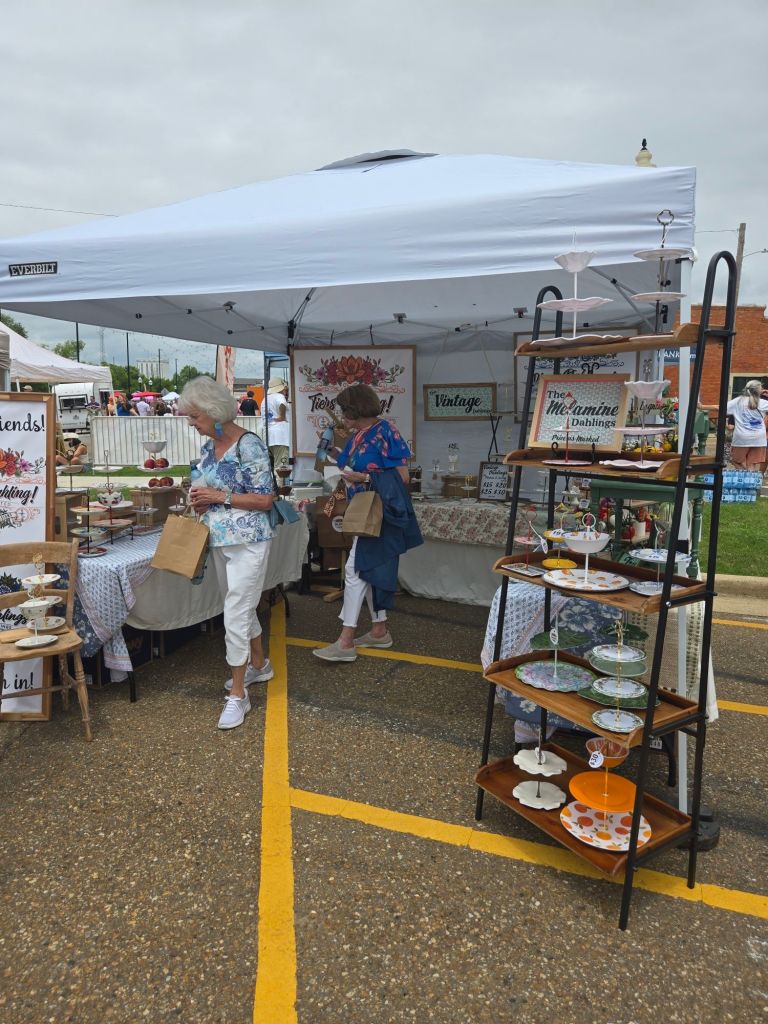
The South loves its “festivals.” There is one in almost every town from Shreveport to Vicksburg, on varying weekends throughout the Spring and Summer.
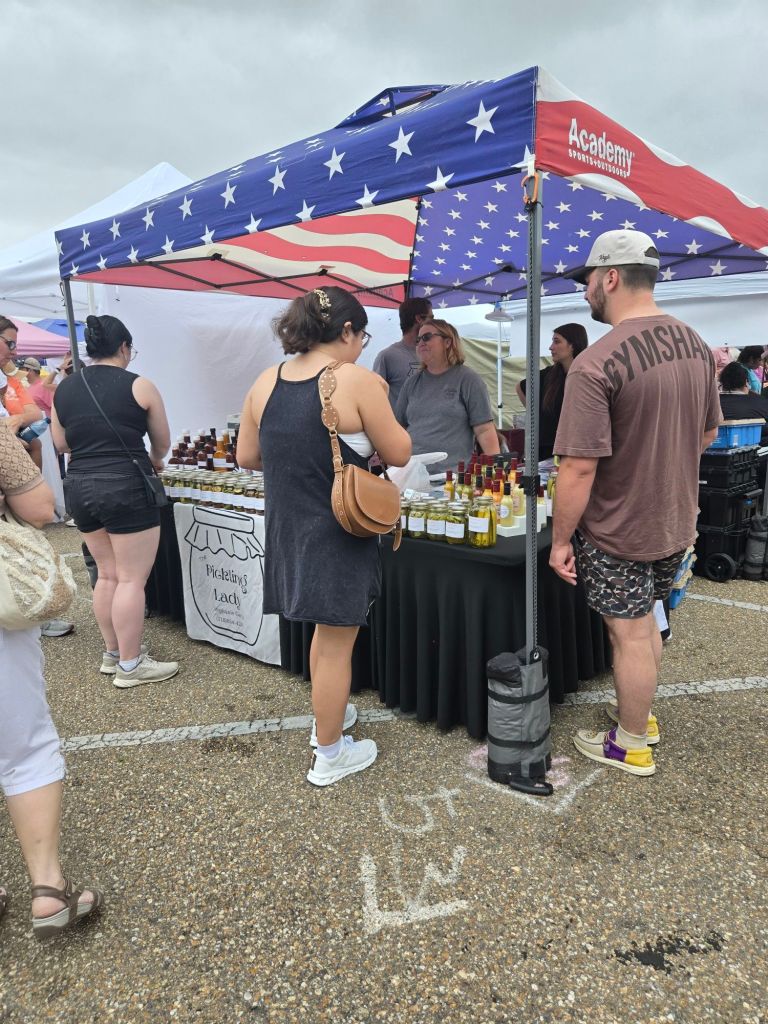
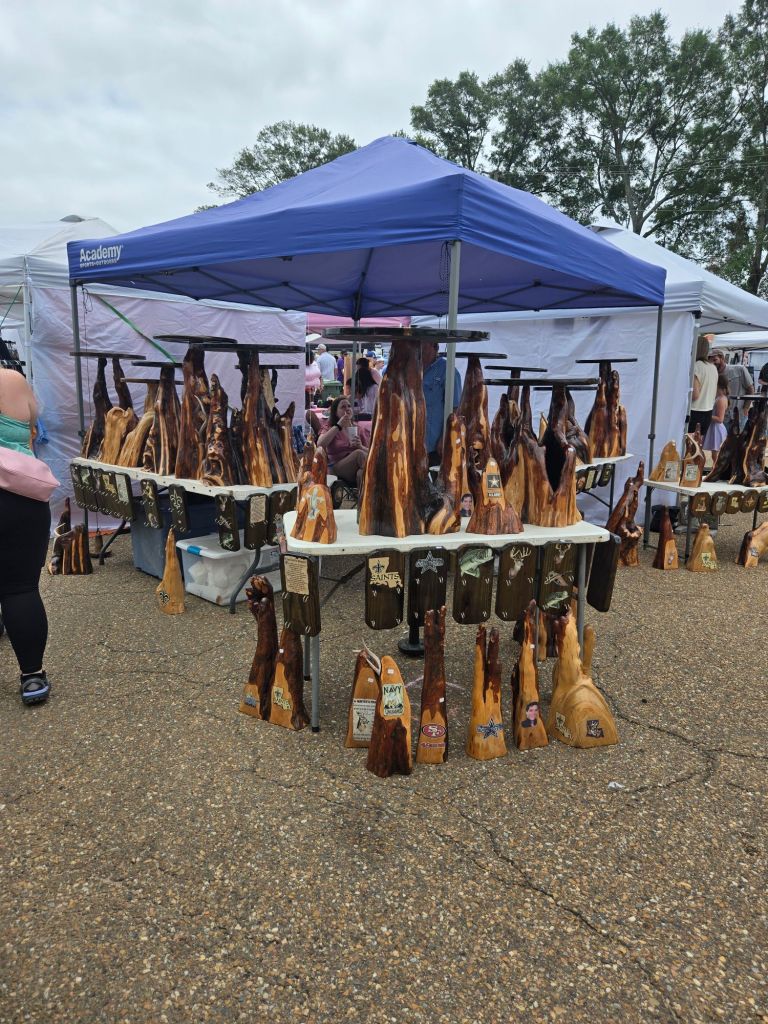
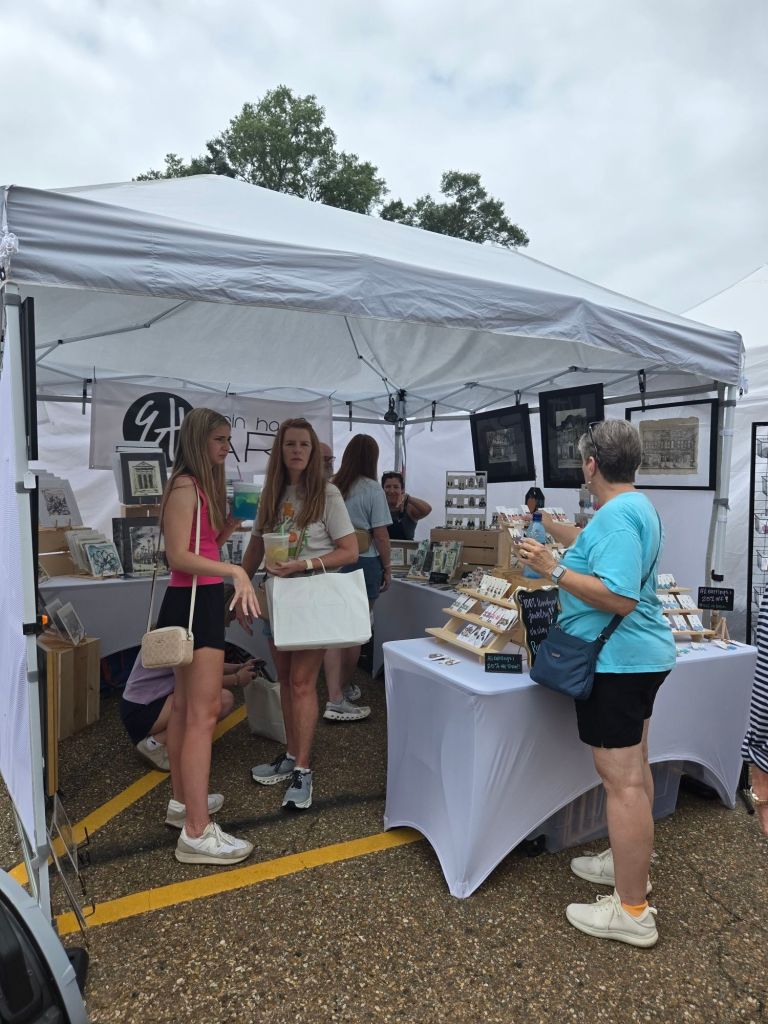
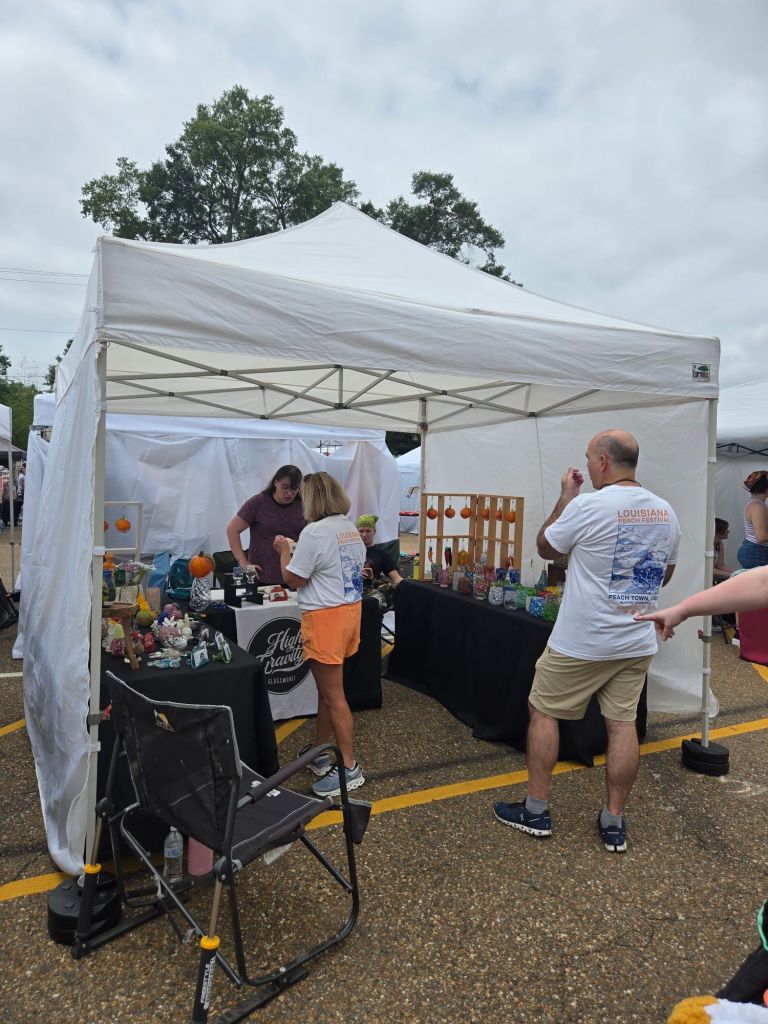
On Saturday, my family and I attended the 76th Annual Peach Festival in Ruston, Louisiana, which is about one hour away from where we live. We had never been to this particular festival, but in the spirit of breaking up the monotony of what is typical of our weekends, we decided to get up early, fight the traffic, and do some semi-local exploration.
There was music. There was food. There was merch. There was heat.
Below are some photographs taken by Yours Truly to commemorate the Saturday we did not spend bed-rotting.
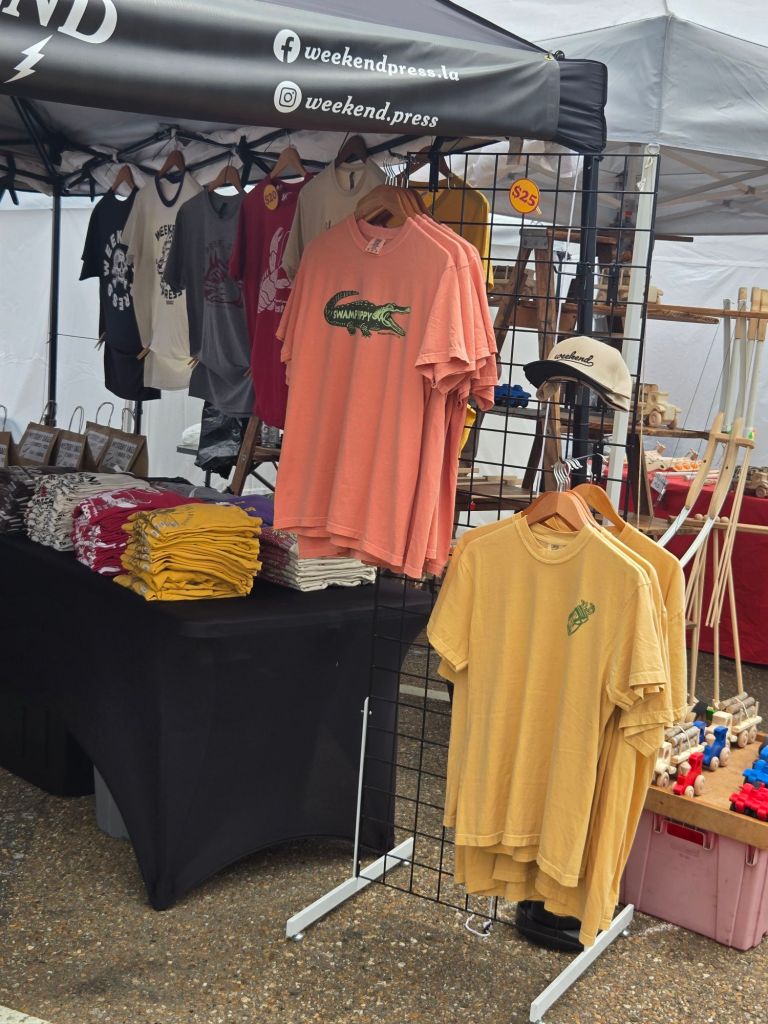
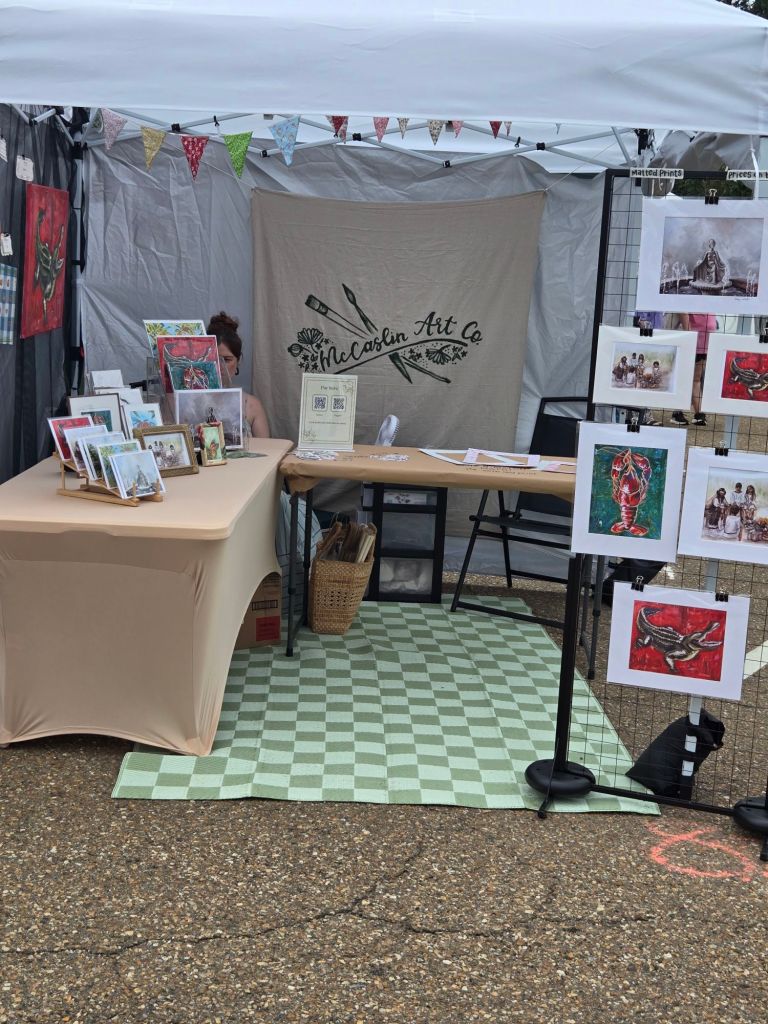
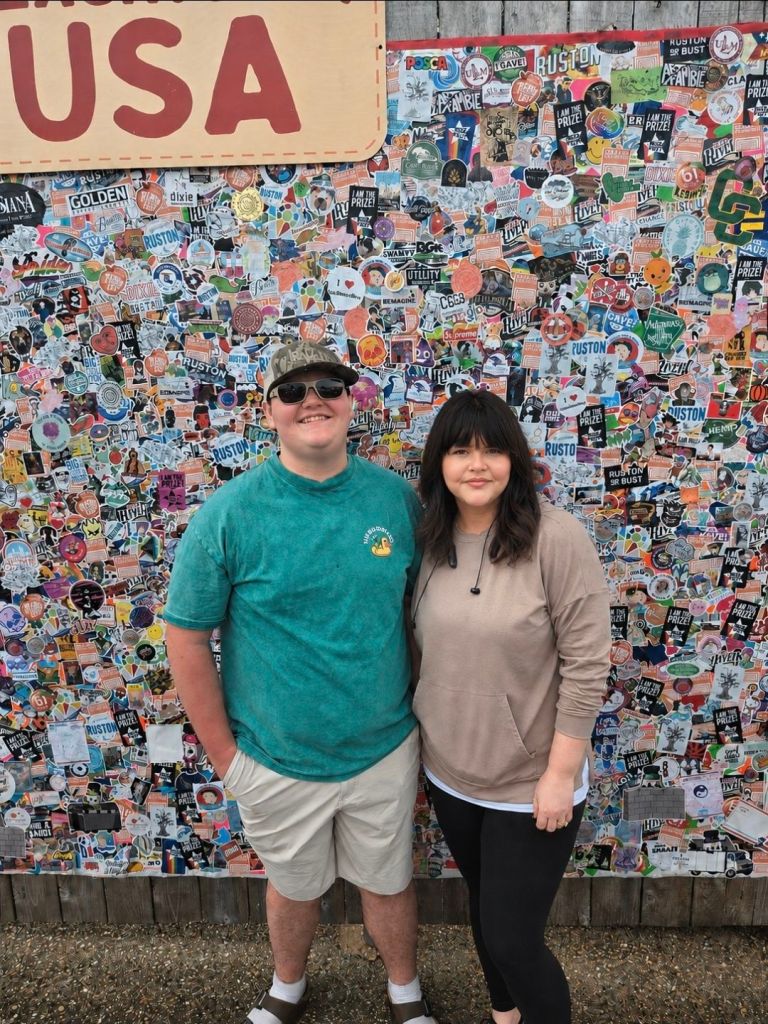
Homemade Pickle Stand!Handcrafted side tables and other decorum.There were lots of booths that sold custom artwork.Obviously, peaches were the theme.We ended up buying some of these crocheted stuffies. I got a possum…for my office.This art was so beautiful. Cottagey. Unique.More contemporary art. I particularly enjoyed the abstract Coke can.One of the first booths we visited. This lady hand designed and built platters. They were so cute!There were also lots of booths that sold t-shirts, sporting custom graphic designs. The orange shirt was awesome – a gator that said “Swamp Puppy.”More art. The cool thing is that these were all local businesses, so you could grab a business card.My boy and me.
This wasn’t really about shopping. Or supporting local businesses, though we did skirt away with some homemade/locally made blueberry jam and those stuffies.
But it was about keeping the commitments I make to myself. I spend most Saturdays parked on my couch, recovering from the week. I promised myself that, today, I would venture out. And I did. And I don’t regret it.
I am going to say something now that I wished someone had told me a long time ago: Peace looks a lot like boredom when chaos is the norm.
Granted, someone did tell me that once. I didn’t believe her anymore than I expect you to believe me now.
When we’re young and impressionable and long for spontaneity and excitement, the indirect consequence is usually drama.
Or at least that’s my perception.
I was never the type to want to jump out of airplanes or drag race or barhop. My definition of excitement was more like…getting butterflies. Arguing until someone conceded defeat. Spending money I didn’t have because stuff equaled satisfaction. Risking a sure thing on a hope and prayer that something – or someone – might prove to be better…
…and…enter drama.
So if you had asked me a few years ago what kind of life I wanted, I probably would have given you a list to include, in no particular order, the following: A passionate relationship. A nice house. A nice car. A successful career. Lots of friends. The ability to go where I want, when I want, and with whom.
And in that dream, my nails would be freshly manicured and I’d weigh about 50 pounds less. My preferred wardrobe would contain more pencil skirts. Some Saturdays would consist of day-drinking with girlfriends, shopping, and massages, while others would be reserved for hopping in a car with the love of my life to attend various concerts and comedy shows, trying all the new food and seeing the sites.
And the point was not to have a point. No agenda. No responsibilities. No routine. Just my people and me…and stuff…can’t forget the stuff.
But my life doesn’t look like that. And it’s not going to look like that.
My life is not bad. It is ordinary.
Most days look remarkably similar.
I wake up, get dressed, log in for work and shuffle emails around. I eat dinner, I fold laundry, I compare notes with my husband and son about our respective circumstances, moods, and schedules. And I turn on the t.v. for background noise while I write. And then I go to bed, read, and drift off to sleep with two tiny dogs, only to wake up the next day and do it all over again.
So if a fortune teller had said to me ten years ago that this is what my life would look like, I’d have called said life boring.
And it is.
But it is also beautiful.
See – boring doesn’t keep me up at night. The things that once made me feel alive I can now classify, respectfully, as unpredictable and chaotic. Chasing attention and connection and sometimes closure…and calling it excitement. That’s not fun. And it’s not realistic. Today, I sleep. Peacefully. And there is something glorious about laying my head on a pillow without needing to brace myself for what comes tomorrow.
Boring lets me trust myself. The old version of me invited chaos in destructive ways, and the consequence of that is that I also had to chase relief. Relief from loneliness, uncertainty, discomfort. And what I know now that I didn’t know then is that relief and peace are not the same thing. My days now are less exciting. But they are more aligned. And there is a quiet confidence that comes from consistently making decisions I can respect.
To live a boring life is to live predictably. And I used to think that was dull. But now I think predictability is underrated. The bills get paid. The dishes get washed. The kid gets to school. The Bible gets read. The dogs get snuggles. Routines continue, and the world doesn’t fall apart. There is comfort in knowing what comes next, especially when I’ve spent years emotionally preparing for disasters that inevitably arrived because I was too busy creating discord that I mistook for quirky whims.
And that discord consumed my attention. But boredom leaves room for growth. Drama demands energy. Survival mode leaves little room for reflection. But monotony creates space. Space to think and pray and notice patterns and become more intentional. Some of the deepest growth of the my life has happened during seasons that would look completely unremarkable from the outside.
What I understand now that I didn’t grasp before is that being unremarkable does not mean something is not special. Boredom doesn’t require performance. I don’t have to constantly reinvent myself. I don’t have to gamble on things that “might” be exciting. I don’t have to create intensity just to feel something. I can just be. And that is surprisingly healing.
And in that healing, I have found safety. For years, my nervous system associated intensity with importance. Dramatic equaled important. Uncertainty equaled vivacity. Safety isn’t boring. Safety is a gift. Steadiness is a gift. Consistency is a gift.
And I give myself those gifts every time I relinquish impulse for routine. Boredom is where character is built. Most growth does not happen during extraordinary moments. It happens on random Tuesdays when nobody is watching. It happens when I choose patience again. It happened last night when I finished the Book of Daniel, thanking the Lord that He understands, even when I don’t. It happened earlier this week when I chose to fold laundry instead of going to bed earlier, because that’s what I’d promised myself I would do.
None of those things are impressive. My life isn’t incredibly exciting. It’s actually really uneventful, and most days look the same.
But it’s peaceful. I have made so many mistakes in the last 38 years. And I’ll be paying for those for a long time it seems. But peace is the one thing for which I don’t have to apologize.
It’s hard to explain the beauty in boredom to people who still associate excitement with fulfillment. I don’t judge those people, because I used to do it, too.
But I’ve learned that not every season needs fireworks. Sometimes the most beautiful life is one that allows us to rest. Breathe. Heal. Tell the truth. Become steady.
And while boring may not make for the most exciting story, it has become the setting where some of the best parts of my life are finally growing.
As I continue to walk in integrity, there are certain old ways of thinking I have had to confront, challenge, and intentionally attempt to correct.
I said earlier this week that I took a break for a couple of weeks to rest.
And that really was true.
I had worn myself out during a two-week stent of overthinking and turning more to my feelings than the truth. I sat. For two weeks. In depression. In loneliness. In isolation. In offense.
I slept. I cried. A lot. I shut down.
But as the month of May came to a close, as a consequence for rotting, I recognized that the “break” I took might not have been a break at all. It might have been a coping mechanism used to avoid growth.
Avoidance.
That’s what makes this tricky. Both rest and avoidance can involve stepping back, being still, taking space, saying no, and pausing. From the outside, they appear identical. But internally, they’re different.
Real rest creates capacity. It steadies your mind. It resets your nervous system. It gives you what you need to return to your responsibilities with more clarity, presence, and stability.
Rest is intentional. It says, “I am stepping back so that I can return healthier.” It’s temporary and restorative.
Avoidance feels relieving in the moment.
But it doesn’t restore. It postpones. It says, “I am stepping back because I don’t want to face this.”
And usually, what we avoid doesn’t shrink while we’re gone. It waits. And often grows.
I can admit now that I have used avoidance more than rest.
Scrolling instead of reflecting. Sleeping excessively instead of processing. Distracting myself instead of dealing honestly with what was hurting me. Seeking comfort instead of pursuing healing.
And because avoidance is soothing in the moment, it can be easy to justify, even though it ultimately leaves us feeling more anxious, more behind, and more overwhelmed.
The easiest way for me to tell the difference now is the understanding that rest leaves me clearer. After true rest, I usually feel more grounded, more present, and more willing to engage with life.
Avoidance comes with resistance. Internal tension. A subtle dread. A knowing. A quiet awareness that I’m not actually resting – I’m just procrastinating.
Rest requires honesty, too. I used to think rest was simply about stopping, but now I think healthy rest requires discernment. I have to ask myself: Am I replenishing or hiding? Am I resetting so I can return stronger or am I hoping this problem disappears if I ignore it long enough?
The motives are different.
For me, now, rest looks practical. Sometimes it’s just going to bed earlier. Often it is praying or writing. Letting myself breathe without feeling guilty. Allowing my nervous system to settle.
And then returning to what needs my attention.
Rest is an act of responsibility. Avoidance is an attempt to shirk it. Rest strengthens. Avoidance delays growth.
Learning those contrasts has changed how I care for myself. Sometimes I need to stop, breathe, and recover. But sometimes what I call rest is really fear asking for permission to hide. And having the ability, now, to correctly define the two is its own kind of peace.



 Raspberry Iced M