
I am finishing up the Old Testament. I am currently wrapping up the Books of the prophets. Last night, I studied Zephaniah and Haggai.
Jeremiah – Why Judah fell.
Lamentations – The grief after the fall.
Ezekiel – Hope and restoration from exile.
Daniel – Faithfulness in exile.
Hosea – God’s pursuing love.
Joel – Return while there’s time.
Amos – Justice matters.
Obadiah – Pride and cruelty are judged.
Jonah – God’s mercy reaches enemies.
Micah – Walk justly, love mercy, walk humbly.
Nahum – Persistent evil will not last forever.
Habakkuk – Trust God even when you don’t understand.
Zephaniah – God ultimately delights in restoring His people.
Haggai – Consider your ways while rebuilding.
I have followed the stories of Israel and Judah, first asking “Who are these people?” and then following them from one united kingdom, through the split, the exile, and their return home.
I offer a brief overview of the Book of Haggai:
In earlier Books, and through preceding prophets, God destroys Israel and Judah, because these kingdoms had become corrupt. They worshipped idols, they lied, they ignored God – the One who rescued them from Egypt and saved them over and over and over. Israel and Judah had become too comfortable living life by their own standards, that they did not heed God’s instructions to return to truth. So Assyria overtakes Israel and Babylon overtakes Judah, and both kingdoms were exiled from their homes.
Destruction was the consequence. But God promises restoration. The “remnant,” or the few righteous Israelites and Judaeans left, were able to return back to their homes after a period of about 70 years – 70 years, in exile, that was meant to be spent re-committing to their God.
Haggai is the first prophet who speaks to the remnant after their return home.
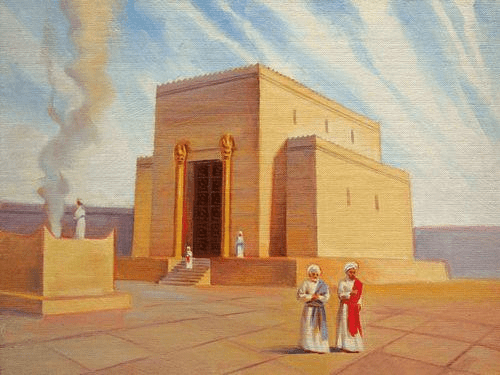
The exiles were excited. Relieved. Happy to be more than slaves and wanderers. And they laid the foundation of the new temple.
And then life happened.
They became occupied with building their own houses, farming, making money, and raising families. And the foundation they had laid for the temple sat unfinished for years. Not because they hated God, but because they had simply become distracted.
These people kept delaying the temple’s rebuild. But God challenges that. He doesn’t condemn His people for having homes. He just confronted misplaced priorities.
The prophet Haggai calls the returned exiles to stop delaying God’s work. To reorder their priorities, rebuild His temple, and trust that His presence and future plans are greater than what His people can see. God, through Haggai, repeatedly directs His people to “consider their ways.”
In other words…stop. Look honestly at your life. Are your priorities aligned with what you say matters?
Haggai points out that the Israelites are obviously working hard, and yet harvests disappoint, money disappears quickly, and satisfaction never lasts. It is as if Haggai is pointing out that the issue is not with their effort. The issue is with what comes first.
And almost immediately, the Israelites begin work on the temple. Immediate obedience.
As Chapter 1 becomes Chapter 2, the Israelites become discouraged because the new foundation for the temple looks small compared to the temple that Solomon built. God encourages them. “Be strong…I am with you.” And He promises that the future glory of the new temple will exceed the former. He encourages His people not to judge His work by what they see in the moment.
Quality over quantity.
Unlike other prophets, Haggai writes like a coach. Not a prosecutor. Not someone who is grieving. Not someone announcing doom. It’s as if he’s telling the Israelites, “Come on. Let’s finish what you have been called to do.”
I noticed that the hard part was over. The Israelites’ biggest problem was no longer Babylon or exile. It was…distraction.
Sometimes our biggest spiritual rival is not open rebellion. It’s when we slowly allow other good things to crowd out the most important thing.
The first 30 days of this journey I’m on were spent recommitting my life to Jesus. I had strayed so far and I was so far out of His will that I had to crawl back to Him. I remember praying back then, “Lord, what You gave me…I lost. And I don’t have a lot left. But You can have it.“
I prayed for deliverance. Wisdom. Forgiveness. Restored relationships with people who have left me. I asked Him then, and every day for the past year or so, to change my heart. I promised Him that I would put in the work, that I would obey, and that I would not run.
After my study session last night (well, really around 2:00 this morning), I felt so convicted.
I have spent the last year working so hard on my own growth and my own progress that, at times, I have forgotten why I’m doing it in the first place. And while I like to think I am constantly keeping my motives in check, I realized after reading Haggai that change doesn’t mean much if my desire to do so is rooted in the wrong place.
At times I have caught myself thinking…What if never “become?” What if all of this work is for nothing?
Or worse, what if I make progress…what if I heal…and no one ever notices? What if the people I most hoped would see the change never believe or embrace it?
And for those thoughts I had to repent.
I spend most nights alone. With a dry phone and a couple of dogs who have never offered feedback. And while I promised the Lord I would not run from discomfort anymore, the result of sitting, sometimes, is that my mind wanders, and I become anxious.
What if I never become the woman I am trying so hard to be?
What if I stay stuck?
What if this is as good as it gets?
What if all of this reading and praying and therapy and journaling and effort still isn’t enough?
They’re not thoughts I like to admit. But they’re honest ones.
“Becoming” is hard to measure, and the frustrating thing about growth is that is rarely announces itself. There’s no finish line. I won’t wake up one morning and think…there it is…I’ve officially become emotionally mature.
Instead, it happens in subtle moments during ordinary days. In responding differently. In pausing instead of reacting. In telling the truth when a lie would be easier. In walking away from situations that used to be all-consuming. And it’s such a slow process, that it’s easy to overlook those moments, especially when you’re the one living them.
So I have had to reevaluate the part of me that expects there to be one concrete moment where I realize I’ve “arrived.” Where I stop struggling, overthinking, and feeling afraid. Where I stop needing God’s grace so much. The journey I am on doesn’t work that way. There are no check points, and there is no ribbon at the end of the race. There is only the willingness and faithfulness to move in the first place.
So the question “Have I become?” has slowly shifted into, “Am I becoming?”
I am reminded of the Bible verse that says that the righteous person is like a tree planted by streams of water.
Trees don’t grow because they’re in a hurry. Every day looks almost the same for a tree.
Until one day, someone notices shade. Or fruit. Or the girth of the trunk. Because the tree was growing the whole time. It just wasn’t immediate. Or loud. Or obvious on any given ordinary day. Trees grow because they stay rooted.
So maybe “becoming” isn’t quite the dramatic makeover I once envisioned. Maybe it’s just apologizing sooner, judging less, listening more, sleeping better, keeping my word, paying the bills, folding the laundry. Maybe it’s praying before panicking, talking a walk instead of running away.
Like the phrase, “death by a thousand cuts,” maybe my expectations should not have been seeing one grand transformation overnight. Maybe true transformation is made up of hundreds upon hundreds of ordinary decisions that slowly reshape my life, and all the while being patient with myself, and patient with God when He doesn’t immediately remove obstacles.
The Israelites waited in exile for 70 years. And here I sit…discouraged because I am not who I thought I would be after one year of honest effort, as if there is something so evil or stubborn or broken inside me that this journey has really been a run in circles, giving me something to do but nothing to track.
I guess my (incorrect) assumption was that I could measure my growth by the way I was perceived/accepted/validated/noticed by other people. And not having that affirmation sometimes leaves me wondering if I am even capable of what I promised the Lord I would do.
And when I catch myself welcoming that discouragement, I feel so much conviction for misplacing my motives. I try to remind myself that I don’t chase like I used to, I don’t defend myself like I used to, I don’t panic like I used to. I don’t live for immediate relief anymore. The truth is that I still have a long way to go. But that doesn’t erase the ground I’ve already covered.
“Becoming” may not be a destination at which I will eventually arrive. Instead, it might just be a direction in which I am already walking. And tomorrow, if I choose kindness again, discipline again, honesty again, then I might not need to worry so much about whether or not I am doing enough, and I can simply trust that He is going to do what He has always promised to do. Because the reality is that none of this is about me – or for me.
“Being confident of this, that He who began a good work in you will carry it on to completion until the day of Christ Jesus.” – Philippians 1:6
He began the work. He will carry it on.
My responsibility is not to complete myself. It’s to keeping saying “yes” to what He is doing, even if that means no one else sees it.
“Lord, please forgive me for getting so busy building my house – working for the cause – that I forgot to build the temple – I forgot why I’m doing this.”

 Raspberry Iced M
Leave a comment