I started first with the goal to understand myself. My defense/coping mechanisms. My survival tactics. My interpretations of various events throughout my life. Basically…why am I the way that I am?
Overlapping that was a goal to change the parts of myself that were intolerable. Destructive patterns, unhealthy routines, bad habits.
So I’ve spent a lot of the last year thinking about growth. And there are still parts of myself that need refining.
I heard someone say today that we cannot call ourselves self-aware if we only consider our bad qualities and not the good. And that gave me pause, because I felt conviction around that statement.
For as much time as I’ve spent in the last year focusing on what pieces of myself need to be altered, I have taken very little time to appreciate the positive traits that I possess. So I take time to do that now, and I intend to revisit this post in the future, should I ever forget or lose sight of how complex I truly am…how complex any human being is.
I hope I never lose my sense of curiosity. I hope I never stop asking questions. About people. About God. About why the world works the way that it does. Curiosity has a way of keeping us humble. The moment I think I have it all figured out is probably the same moment I’ve stopped listening.
I hope I never stop believing that people can change. I have needed grace too many times to believe otherwise. While it is true that some people won’t change, that does not mean change is impossible. I don’t want to become so cynical that I stop leaving space for redemption.
I hope I never lose my sense of wonder. I want sunsets to continue to stop me. I hope thunder continues to make me sleepy. I hope I always make note of the first cool breeze every fall. I hope coffee always tastes like a small gift. Life is too beautiful to become numb to it.
I hope the ability to laugh at myself never disappears. I’m sure I’ll always say awkward things. I’ll forget why I walked into the kitchen. I’ll take too long to tell a joke. I’ll wave back at someone who wasn’t waving at me in the first place. I’ll say. “Excuse me,” to a mannequin (that has actually happened) or get into the wrong vehicle (also based on true events). But life is a little lighter when we don’t take ourselves too seriously, and I love to laugh.
I hope I never stop admitting when I’m wrong. I won’t lie – it bruises my pride. But it protects my character. And after so many prideful moments, I’d rather have an uncomfortable conversation than a comfortable lie at this point.
I hope I never lose compassion. Even when people make decisions I don’t understand. Even when someone hurts me. Even when it’s easier to judge. Compassion does not excuse behavior. But it does acknowledge the human complexity I mentioned earlier, and it remembers that every person is dealing with circumstances I cannot fully see.
I hope I never stop learning. I hope I’m still reading books, asking questions, and changing my mind when truth requires it. I want to always be willing to say, “I hadn’t thought about it that way.”
I hope I never stop loving my family in ordinary ways. Dinner. Good morning texts. Showing up. Listening. Laughing together during a movie. The older I get, the more convinced I am that – much like change – love is found more in ordinary moments than in grand gestures.
I hope I never stop choosing peace over proving a point. There was a time when I needed the last word, but now I’d rather have a good night’s sleep. Not every misunderstanding needs to be corrected or even addressed. Not every opinion deserves my attention. While I don’t subscribe to society’s definition of “protecting my peace,” I do believe that peace is too precious to spend it carelessly.
I hope I never stop depending on God. I do not claim to be wise, but I do know that not much good has come from my desire to have control over my life or anyone else’s. Every time I have convinced myself that I can do life on my own, I’ve discovered how much I need Him. Not just during the hard seasons. Not just on days when I’m sad or lonely or overwhelmed. I need Him every day.
I hope I keep growing. I hope I become wiser. Kinder. More patient. More disciplined. More like Jesus.
But I also hope I never outgrow the best parts of who God created me to be.
The ability to laugh. The willingness to learn. The courage to apologize. The desire to love well. The hope that people can change.
If those things are still true about me after this second wind of my life is complete, I think I’ll have lived a pretty good life.
Growing isn’t about becoming someone else. It’s about becoming – more fully – the person He intended me to be all along.
Matthew 7 and Luke 6 emphasize that a person’s actions – their “fruit” – reveal true character, just like a tree’s fruit identifies the tree.
And when we consider “fruit,” we typically think about tangible, seeable things.
A degree. A promotion. Weight loss. Debt paid off. A published book. A bigger house.
And those are wonderful things. But lately I’ve wondered if the most important fruit in my life is the kind no one else can measure.
No one can count the number of times I interrupted a destructive thought before it took root. Or how many conversations I chose not to have because they wouldn’t produce peace. No one sees the prayers whispered before my feet ever hit the floor in the morning. No one notices the moments I pause before responding instead of reacting.
Those types of victories do not come with trophies, and they don’t earn applause.
But I think He notices.
There are fruits that never make the highlight reel. The decision to tell the truth when a lie would’ve been easier. Choosing patience with someone who is having a hard day. Keeping my word when no one would even know if you didn’t. Admitting I’m wrong. Remaining faithful on a week that I don’t “feel” like it. Getting back up – recovering – after I’ve made a mistake. Forgiving someone who may never ask for it.
Those things aren’t impressive. But they quietly change us.
I used to think growth would feel dramatic. Like fireworks. Like reaching a finish line.
And instead, it has felt more like…taking root. Like something invisible is planted to first grow underground. It is slow. But it is steady.
And there are days that I don’t feel like I’m changing at all. My triggers are the same. My impulses are the same.
But then I look back to this time last year and I realize…
I don’t react the same way I used to. I don’t chase the same thing or panic as quickly. I don’t need everyone’s approval. I tell the truth faster. I’m quicker to apologize. Pray. Pause.
And I wouldn’t put any of those things on a resume, but they are fruit.
Jesus never promised that we’d be recognized by our achievements. He said we’d be recognized by our fruit. Not by how impressive we appeared or how successful we became…but by what our lives consistently produced, none of which fit neatly into a spreadsheet.
Peace cannot be weighed. Kindness can’t be set against a ruler. And we cannot calculate faithfulness on a graph. But those are the very things God calls fruit.
Sometimes I wonder how often I miss celebrating what He is actually growing because I am too busy measuring what the world notices. Maybe the greatest victory this year wasn’t something anyone else noticed.
Maybe it was the argument I didn’t start. The text I didn’t send. The temptation I resisted. The thought I wouldn’t entertain. The apology I offered. The promise I kept.
Maybe that’s the harvest
I’ve spent a lot of my life keeping track of things are not easy to count. This season, I’m trying to pay more attention to things that are not.
Am I becoming more patient? Honest? Dependable? Peaceful? Compassionate? More like Jesus?
Because if the answer is yes, then something beautiful is growing…even if no one else ever measures it.
The sweetest fruit often grows where no one is looking first – not because it is hidden from the Lord, but because He’s more interested in changing our hearts than impressing the crowd.
I think that’s been one of the biggest lessons of my last year. I have spent less time asking if everyone else sees said change and more time asking if I am actually becoming different. The latter is a quieter question – but it’s the one that bears lasting fruit.
I can’t escape my own mind, and that has been a big problem lately.
Not the overthinking itself, but the content.
In an effort to pull myself away from an abstract headspace, I offer the following, less profound, possibly rhetorical question:
“If you were an inanimate object, what would it be?“
My response(s)…
A junk drawer. Three good ideas. A dead battery. An expired coupon. An emotional support pen with teeth marks on the cap. And 17 other thoughts that don’t belong together but somehow exist peacefully.
A Crock Pot. It takes me approximately 9 hours, on low, to process a single emotion. And by the time I know how I actually feel, everybody else has given up and eaten cereal.
That calendar from your Granny’s house that was purchased in 1998 but never removed from the wall or replaced. I keep saying I’ll change it but it seems it has become permanently affixed to the wall.
The library book that was never returned. I appear put together. But if you open me, there are scribbles in the margins, coffee stains, dog hair, and several chapters that were clearly not edited before publishing.
That wobbly wheel of your grocery cart. Headed in the right direction. But hanging on for dear life and making a lot of noise on the journey.
A lava lamp. From the outside, nothing seems to be happening. Internally? An incredible amount of activity with no obvious purpose.
A sticky note. I exist solely to remind myself of things I absolutely should remember but definitely won’t.
A password with too many requirements. Must contain: One uppercase letter. One lowercase letter. One number. One special character. One emotional breakthrough. One therapy appointment. One prayer. Apparently.
The chapstick under the car seat. People remember that I’m there. I’m just not important enough to retrieve.
The light above the oven. I don’t offer much, and I’m often overlooked. But I’m appreciated the most when the rest of the house is pitch black. And my efforts are missed the most when I burn out and can’t do my job anymore.
You know what I would really like to be, maybe someday? A blanket fresh out the dryer.
Not exciting. Not dramatic.
Just comforting. Warm. Steady. A place where people I love feel safe.
Maybe that is what it means to grow older…
Realizing I’m not a sports car. I’m more like…a reliable coffee maker. I’m not fireworks. I’m the dependable, ever-ready flashlight on your phone. I’m not a brand new pair of Jordans. I’m the Crocs that sit by the door…overlooked during events but ready and waiting when the groceries need to be retrieved from the trunk.
And maybe there is something comforting about knowing that.
I am finishing up the Old Testament. I am currently wrapping up the Books of the prophets. Last night, I studied Zephaniah and Haggai.
Jeremiah – Why Judah fell. Lamentations – The grief after the fall. Ezekiel – Hope and restoration from exile. Daniel – Faithfulness in exile. Hosea – God’s pursuing love. Joel – Return while there’s time. Amos – Justice matters. Obadiah – Pride and cruelty are judged. Jonah – God’s mercy reaches enemies. Micah – Walk justly, love mercy, walk humbly. Nahum – Persistent evil will not last forever. Habakkuk – Trust God even when you don’t understand. Zephaniah – God ultimately delights in restoring His people. Haggai – Consider your ways while rebuilding.
I have followed the stories of Israel and Judah, first asking “Who are these people?” and then following them from one united kingdom, through the split, the exile, and their return home.
I offer a brief overview of the Book of Haggai:
In earlier Books, and through preceding prophets, God destroys Israel and Judah, because these kingdoms had become corrupt. They worshipped idols, they lied, they ignored God – the One who rescued them from Egypt and saved them over and over and over. Israel and Judah had become too comfortable living life by their own standards, that they did not heed God’s instructions to return to truth. So Assyria overtakes Israel and Babylon overtakes Judah, and both kingdoms were exiled from their homes.
Destruction was the consequence. But God promises restoration. The “remnant,” or the few righteous Israelites and Judaeans left, were able to return back to their homes after a period of about 70 years – 70 years, in exile, that was meant to be spent re-committing to their God.
Haggai is the first prophet who speaks to the remnant after their return home.
The exiles were excited. Relieved. Happy to be more than slaves and wanderers. And they laid the foundation of the new temple.
And then life happened.
They became occupied with building their own houses, farming, making money, and raising families. And the foundation they had laid for the temple sat unfinished for years. Not because they hated God, but because they had simply become distracted.
These people kept delaying the temple’s rebuild. But God challenges that. He doesn’t condemn His people for having homes. He just confronted misplaced priorities.
The prophet Haggai calls the returned exiles to stop delaying God’s work. To reorder their priorities, rebuild His temple, and trust that His presence and future plans are greater than what His people can see. God, through Haggai, repeatedly directs His people to “consider their ways.”
In other words…stop. Look honestly at your life. Are your priorities aligned with what you say matters?
Haggai points out that the Israelites are obviously working hard, and yet harvests disappoint, money disappears quickly, and satisfaction never lasts. It is as if Haggai is pointing out that the issue is not with their effort. The issue is with what comes first.
And almost immediately, the Israelites begin work on the temple. Immediate obedience.
As Chapter 1 becomes Chapter 2, the Israelites become discouraged because the new foundation for the temple looks small compared to the temple that Solomon built. God encourages them. “Be strong…I am with you.” And He promises that the future glory of the new temple will exceed the former. He encourages His people not to judge His work by what they see in the moment.
Quality over quantity.
Unlike other prophets, Haggai writes like a coach. Not a prosecutor. Not someone who is grieving. Not someone announcing doom. It’s as if he’s telling the Israelites, “Come on. Let’s finish what you have been called to do.”
I noticed that the hard part was over. The Israelites’ biggest problem was no longer Babylon or exile. It was…distraction.
Sometimes our biggest spiritual rival is not open rebellion. It’s when we slowly allow other good things to crowd out the most important thing.
The first 30 days of this journey I’m on were spent recommitting my life to Jesus. I had strayed so far and I was so far out of His will that I had to crawl back to Him. I remember praying back then, “Lord, what You gave me…I lost. And I don’t have a lot left. But You can have it.“
I prayed for deliverance. Wisdom. Forgiveness. Restored relationships with people who have left me. I asked Him then, and every day for the past year or so, to change my heart. I promised Him that I would put in the work, that I would obey, and that I would not run.
After my study session last night (well, really around 2:00 this morning), I felt so convicted.
I have spent the last year working so hard on my own growth and my own progress that, at times, I have forgotten why I’m doing it in the first place. And while I like to think I am constantly keeping my motives in check, I realized after reading Haggai that change doesn’t mean much if my desire to do so is rooted in the wrong place.
At times I have caught myself thinking…What if never “become?” What if all of this work is for nothing?
Or worse, what if I make progress…what if I heal…and no one ever notices? What if the people I most hoped would see the change never believe or embrace it?
And for those thoughts I had to repent.
I spend most nights alone. With a dry phone and a couple of dogs who have never offered feedback. And while I promised the Lord I would not run from discomfort anymore, the result of sitting, sometimes, is that my mind wanders, and I become anxious.
What if I never become the woman I am trying so hard to be? What if I stay stuck? What if this is as good as it gets? What if all of this reading and praying and therapy and journaling and effort still isn’t enough?
They’re not thoughts I like to admit. But they’re honest ones.
“Becoming” is hard to measure, and the frustrating thing about growth is that is rarely announces itself. There’s no finish line. I won’t wake up one morning and think…there it is…I’ve officially become emotionally mature.
Instead, it happens in subtle moments during ordinary days. In responding differently. In pausing instead of reacting. In telling the truth when a lie would be easier. In walking away from situations that used to be all-consuming. And it’s such a slow process, that it’s easy to overlook those moments, especially when you’re the one living them.
So I have had to reevaluate the part of me that expects there to be one concrete moment where I realize I’ve “arrived.” Where I stop struggling, overthinking, and feeling afraid. Where I stop needing God’s grace so much. The journey I am on doesn’t work that way. There are no check points, and there is no ribbon at the end of the race. There is only the willingness and faithfulness to move in the first place.
So the question “Have I become?” has slowly shifted into, “Am I becoming?”
I am reminded of the Bible verse that says that the righteous person is like a tree planted by streams of water.
Trees don’t grow because they’re in a hurry. Every day looks almost the same for a tree.
Until one day, someone notices shade. Or fruit. Or the girth of the trunk. Because the tree was growing the whole time. It just wasn’t immediate. Or loud. Or obvious on any given ordinary day. Trees grow because they stay rooted.
So maybe “becoming” isn’t quite the dramatic makeover I once envisioned. Maybe it’s just apologizing sooner, judging less, listening more, sleeping better, keeping my word, paying the bills, folding the laundry. Maybe it’s praying before panicking, talking a walk instead of running away.
Like the phrase, “death by a thousand cuts,” maybe my expectations should not have been seeing one grand transformation overnight. Maybe true transformation is made up of hundreds upon hundreds of ordinary decisions that slowly reshape my life, and all the while being patient with myself, and patient with God when He doesn’t immediately remove obstacles.
The Israelites waited in exile for 70 years. And here I sit…discouraged because I am not who I thought I would be after one year of honest effort, as if there is something so evil or stubborn or broken inside me that this journey has really been a run in circles, giving me something to do but nothing to track.
I guess my (incorrect) assumption was that I could measure my growth by the way I was perceived/accepted/validated/noticed by other people. And not having that affirmation sometimes leaves me wondering if I am even capable of what I promised the Lord I would do.
And when I catch myself welcoming that discouragement, I feel so much conviction for misplacing my motives. I try to remind myself that I don’t chase like I used to, I don’t defend myself like I used to, I don’t panic like I used to. I don’t live for immediate relief anymore. The truth is that I still have a long way to go. But that doesn’t erase the ground I’ve already covered.
“Becoming” may not be a destination at which I will eventually arrive. Instead, it might just be a direction in which I am already walking. And tomorrow, if I choose kindness again, discipline again, honesty again, then I might not need to worry so much about whether or not I am doing enough, and I can simply trust that He is going to do what He has always promised to do. Because the reality is that none of this is about me – or for me.
“Being confident of this, that He who began a good work in you will carry it on to completion until the day of Christ Jesus.” – Philippians 1:6
He began the work. He will carry it on.
My responsibility is not to complete myself. It’s to keeping saying “yes” to what He is doing, even if that means no one else sees it.
“Lord, please forgive me for getting so busy building my house – working for the cause – that I forgot to build the temple – I forgot why I’m doing this.”
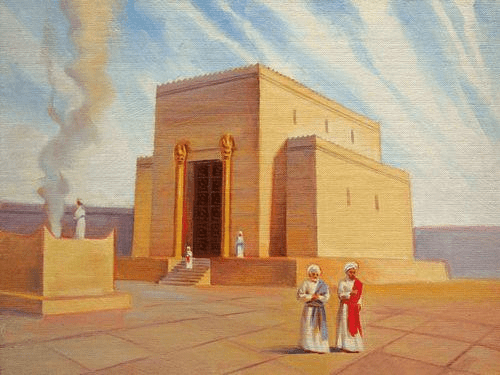
A depiction of what the new temple may have looked like, as described in Ezra.
Since this month’s posts have centered around the “ordinary” that has become my life, I offer a breakdown of my normal weekday routine and explain where I can be found at any given moment during the day.
7:30 a.m. – I am usually awake, even if I can’t bring myself to climb out of bed yet. If the dogs are moving, I get up and give them belly rubs and good morning kisses before I pick both of them up and carry them to their kennel so that they can go potty. My one complaint about this is that sometimes I have to pee, too, but am forced to hold it so that my carpet remains clean and unsoiled by these rotten puppies.
8 a.m. – I log in for my work day, remotely. I check emails and make sure there are no emergencies. I live in Louisiana (central time zone), but I work for a law firm based on the west coast. So when I log in at 8:00, it is only 6:00 in California. I like it, though, because I am not a morning person, and I don’t enjoy logging in to a billion emails. 8:00 to 10:00 is just a warm up.
8 a.m. – It is also around this time that my husband arrives. He’s a nurse, and he works nights. Sometimes he arrives a little earlier and comes into the bedroom to retrieve the dogs so that I don’t have to. But he always waits for me to get up and moving, and we talk about his night at work insofar as my tired, does-not-function-at-full-capacity-in-the-mornings brain allows. He starts my coffee for me, too, because he knows me better than anyone.
8 -9 a.m. – After we talk and I’ve put out any work fires of my own, I grab a shower and get ready for the day. If I have plans in the afternoon, this “get ready” block includes hair, make up, and jewelry. If not, I usually throw my hair in a low ponytail and put moisturizer on my face and chapstick on my lips. My work attire consists of leggings, sports bras, sweatshirts, and that darn chapstick. I am so addicted to chapstick that I literally reached for the tube at my desk just because I typed the word.
9 a.m. – I am usually dressed for the day. Before I go back to my computer, I start a load of laundry. My husband and I continue to chat – sometimes about how the dogs behaved after he left for work the night before, sometimes about an epiphany I had in my sleep. Sometimes I tell him what I read most recently in the Bible. Sometimes we talk about things we need to get done. Sometimes he has a tale from his shift the night before. The contents vary, but a discussion is always had.
10 a.m. – I am about two cups of coffee in by now, and my husband retreats to our bedroom around this time. Around this time, you’ll find me at my desk, plugging away, committed to completing my task list. I love working from home. Not only can I wear what I want, but I also don’t deal with office drama. I work for one attorney, technically, who just became Partner. No news is good news, and he is really great about not micromanaging.
11 a.m. – 4 p.m. – I will switch over the laundry I started earlier, but this block is used to prioritize work. I might grab a snack around 1 p.m., but that’s about it.
4 p.m. – My husband is usually awake by this time. He comes out of the bedroom and gives me and the dogs kisses and asks how my day is so far. Once I provide an answer, he hops onto his own computer for an hour or two while I finish up.
5 p.m. – By this time, my brain is fried and my fingers are tired of typing. I log out of my remote desktop. Sometimes I sit for another half hour browsing the web or shopping online. I’ll draft a blog or research a topic that’s popped into my head. This block is also used to decide on dinner.
6 p.m. – It’s dinner time. I’ll admit right now that I really hate to cook. I will if it’s needed. If not, I’m probably Doordashing something or sending my husband out to pick something up. When he returns, we eat together.
7 p.m. to 9 p.m. – Dinner has been eaten and the t.v. has been turned on. My husband grabs his shower and gets ready for work and then settles back into his recliner, where he grabs a nap, while I watch t.v. and love on the dogs. I use this block to work on the house or other project. At around 8:30 p.m., I start working on my various journals.
9:15 p.m. – My husband’s alarm goes off and he wakes up, grabs his energy drink and yogurt and/or leftovers that he’s taking to work, kisses the dogs and me, and takes off. We usually exchange TikToks on his way to work, and he’ll text when he arrives at his job, especially if something weird is happening. Two nights ago, he pulled into the parking lot alongside 4 Sheriff’s deputies. Last night, he was notified that there were 4 new patients that needed to be triaged. His stories vary, but his consistency in texting me does not. Meanwhile, I’m at home, continuing to journal while my Shih-poos chase each other and pull each other’s ears.
11 p.m. – It is around this time that my dogs start looking in my direction to try to gauge bedtime. Sometimes I can eek out another hour of t.v. before they really get restless.
12 midnight – By this time, I’m being pressured to go to bed. I make my way to the bathroom where I change, wash my face, and apply more chapstick. Then I have to catch my little guy, Benny, who thinks it is funny to hide under the bed so that I cannot pick him up to actually put him in bed. Our older baby, Ozzy, is much more obedient. He lays on his back and silently requests belly rubs before I pick him up, give him lots of kisses, and place him at the foot of the bed before I climb in myself.
12:15 a.m. – Once the dogs settle, I use the next half hour or 45 minutes to read my Bible. The dogs makes their nests and are down for the count by this time.
1 a.m. – I wrap up my reading, turn off the lamp on my nightstand, and turn on a YouTube video, and I usually don’t finish ten minutes of it before I am also asleep.
I’ve typed all of this, and it is only further confirmation of how boring I am.
Routine has a weight to it.
Not an exciting weight. Not a glamorous one. It’s the kind you barely notice until one day you realize what you’ve been carrying for months.
Like I’ve already described. Wake up. Go to work. Wash the dishes. Fold the laundry. Pay the bills. Pray. Read. Go to bed.
Most days it feels like my life is made up entirely of repetition. And if I’m honest, I wonder, sometimes, if I’m making progress at all. I guess that is because routine doesn’t usually feel rewarding.
No one applauds you for making your bed. No one throws a party because you loaded the dishwasher. No one notices that I chose patience over irritation. Or honesty over convenience. Or discipline over distraction.
Routine doesn’t feel important in the moment.
But chaos has a weight too. And I’ve carried it. It’s heavy. Always wondering what’s next. Always putting out fires and reacting instead of responding. Living from one emotional emergency to another.
That kind of life feels more important, in a sense, because chaos requires our nervous systems to be on high alert. It’s exhausting.
Routine is heavy. But chaos…it’s heavier.
The funny thing about routine is that it doesn’t usually change your life overnight. It changes it almost invisibly. One tiny, committed, respectable decision at a time – decisions that aren’t noticed from one day to the next.
But six months later…you’re not the same person.
There are mornings I’d rather stay in bed. Days I don’t feel like writing. Evenings when the laundry can wait. Moments when the easiest thing to do would be to run out of sheer fear of turning into someone monotonous.
But feelings make terrible foremen. If I only build my life on days that feel exciting, or even on days when I feel motivated, I’ll spend most of my life waiting. Routine is teaching me to keep going when inspiration calls in sick.
In the way the Israelites gathered manna every morning… In the way priests offered daily sacrifices… In the way Jesus withdrew to pray…
Nothing flashy. But always faithful. And if He is comfortable with ordinary rhythms, maybe I should be, too.
There was a time when I lived for milestones. The finish line. The breakthrough. The answered prayer.
Now I’m trying to appreciate the middle – because that’s where most of life is lived – when I recognize that making my bed isn’t just “making my bed.” It’s stewardship. Or when I choose to see “going to work” as providing for my family and not just a daily chore. Or when I perceive reading by Bible as feeding my soul and not just checking a box. Yes, the tasks are ordinary. The purposes for those tasks are not.
There’s a weight to keeping a routine. But it’s a weight that builds strength instead of breaking it. The weight of keeping your word, of choosing integrity again, of showing up when no one is watching.
Maybe that’s why I am embracing it. I don’t think the life I want can be built in extraordinary or dramatic or glamorous moments. I think it will be built under the steady, faithful weight of doing the next right thing…over and over again…until one day, I’ll look behind me and see that all of those not-so-interesting decisions add up to a life inside which I can function, and not just survive.
Routine is heavy, but so is regret. I’d rather carry the weight that builds something.
This last birthday has prompted me, subconsciously, to consider my 40th birthday. It is only when we become adults that we realize our parents were right…time really does fly. And I don’t want 39 to come and go without tracking certain goals that will improve the life I have now.
Some are practical. Some are silly. Some will challenge me. Some will probably make me laugh. And a few have been dreams for a very long time.
Here’s to 365 ordinary days…and 40 intentional choices.
Read the entire Bible.
Memorize 40 Bible verses.
Spend one full day alone with the Lord – no distractions. Just prayer, reading, and quiet.
Write 100 answered prayers in a journal.
Go an entire week without buying anything.
Complete my first bullet journal (one year).
Write 100 blog posts.
Read 24 books.
Take an online class out of sheer curiosity.
Write a letter to my 50 year old self.
Move my body 20 minutes per day.
Increase the time I spend in the sun.
Take 1,000 pictures of my ordinary life.
Write and illustrate a children’s story.
Learn and try 12 new recipes.
Donate my time, money, or stuff at least 100 times.
Organize every closet and cabinet in my home.
Learn to make homemade bread.
Create wall galleries in every bedroom in my home.
Complete one home project I’ve always relied on someone else to do – and this may be the building of a fire pit.
Go on 12 planned dates with my husband.
Have one unplugged day with my son.
Mail 5 handwritten letters.
Say “I love you” more often.
Practice listening more than talking.
Visit 5 towns I have never seen before.
Watch 10 sunrises.
Watch 10 sunsets.
Take myself on a solo coffee date (accomplished only by actually sitting in a building, not by hitting a drive through).
Try 20 new restaurants.
Experiment until I discover what will be my “signature” dessert – something to bring to every family get together.
Go one whole day without checking my phone unnecessarily.
Plan/Design and decorate a possum themed Christmas tree.
Grow out my hair. Trims only…for a year.
Visit a Buccee’s. I’ve never been to one.
Make sushi at home.
Say “no” without guilt.
Say “yes” to something scary.
Pay off one major debt – I’m thinking my SUV.
Write, compose, and sing an original song with my son.
Checking these 40 boxes won’t make me a better person. But I’m making this list anyway, because life has taught me something I wish I’d understood years ago…that the life I want won’t happen by accident. It will be built. One habit. One prayer. One conversation. One ordinary Tuesday at a time.
Here’s to the last year of my third decade. May it be less about rushing toward the fourth, and more about cultivating my inner self into someone I can tolerate when I get there.
Also known as a Friday. The day my son goes to his dad’s. The last day of my work week. The last day I spend alone before my husband finishes his own work week.
I was born on a Friday, too. On a full moon. And since this birthday is the last one of my 30s, it feels like an interesting closing of a circle.
In my 39 years, I have learned plenty of things…the hard way.
Some through joy. Some through consequences. Some through prayer. Some through grief.
I am sure I’ll spend the rest of my life learning.
But these are 39 lessons I don’t want to forget:
Healing is slower than I anticipated, but faster than it feels.
Feelings are real, but they are not always true.
Being chosen is not the same as being loved.
Peace is worth more than being right.
The hardest person I will ever forgive is myself.
In order for integrity to mean something, it has to – by default – cost something.
People don’t always see your growth. Grow anyway.
Apologies matter. Changed behavior matters more.
Boundaries are not punishments. They’re directions.
Sometimes “no” is God’s protection.
You are capable of surviving things you once thought would destroy you.
Your nervous system deserves kindness too.
An argument is only an argument if you show up for it.
Not everyone who misunderstands you deserves convincing or proof contrary to their beliefs.
Loneliness is painful. Isolation is a choice.
Rest and avoidance are not the same thing.
Consistency changes a life more than motivation ever will.
Ordinary days are extraordinary when you stop overlooking them.
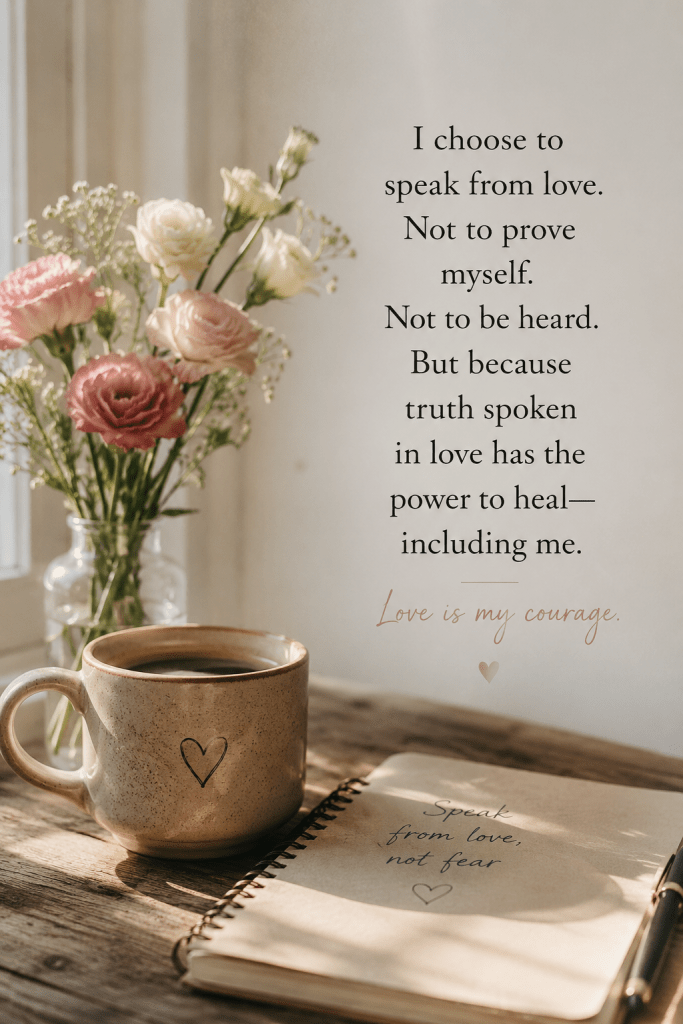
Truth spoken with love is almost always better than silence motivated by fear.
You don’t have to match someone else’s energy in order to protect your own.
Prayer changes me even when it doesn’t change my circumstances.
God is the God of the middle, not just the beginning and end.
Character is built in repetition.
You can be honest without being harsh.
Growth usually feels boring while it is happening.
Sometimes staying is braver than leaving.
Consequences are the most effective teachers.
Hope is a discipline, not just an emotion.
God wastes nothing, including our sins, including our pain, including what we have lost.
The people who truly know you – because they want to – require less explaining.
There is freedom in saying, “I don’t know.”
Your worth is not determined by your worst decision, and it is not up for debate, nor should it be defined by the opinions of others.
Small, kept promises become self-respect.
Listening is one of the purest forms of love.
The woman I am becoming is worth the uncomfortable process.
There is strength in asking for help.
The fruit God grows is usually underground before it’s visible.
Actually changing takes longer than appearing changed.
God has been more faithful than I’ve recognized.
I’m not an expert.
I’m a student.
I’ve learned that life asks better questions than it gives answers, that grace and accountability belong together, that peace is cultivated, that faith is practiced, and that healing isn’t measured by the absence of scars, but by what those scars no longer control.
If there’s one lesson I hope I carry into my 40th year, it’s that I don’t have to become someone extraordinary. I just want to become someone who loves God well, loves people well, tells the truth, keeps her word, and leaves every place a little kinder than she found it.
If I can do that, 39 will have been a very good teacher.
Every birthday requires “one to grow on,” and if I could carry one more lesson into year #40, it would be: I spent years trying to be enough for everyone else. I’m finally learning to become someone I can respect.
A year ago, the question with which I became preoccupied was, “How do I get people to choose me?” And now, I’m asking, “How do I become a woman of integrity?” That doesn’t guarantee easier circumstances, but it does place my focus on something I can actually control – one, ordinary day at a time.
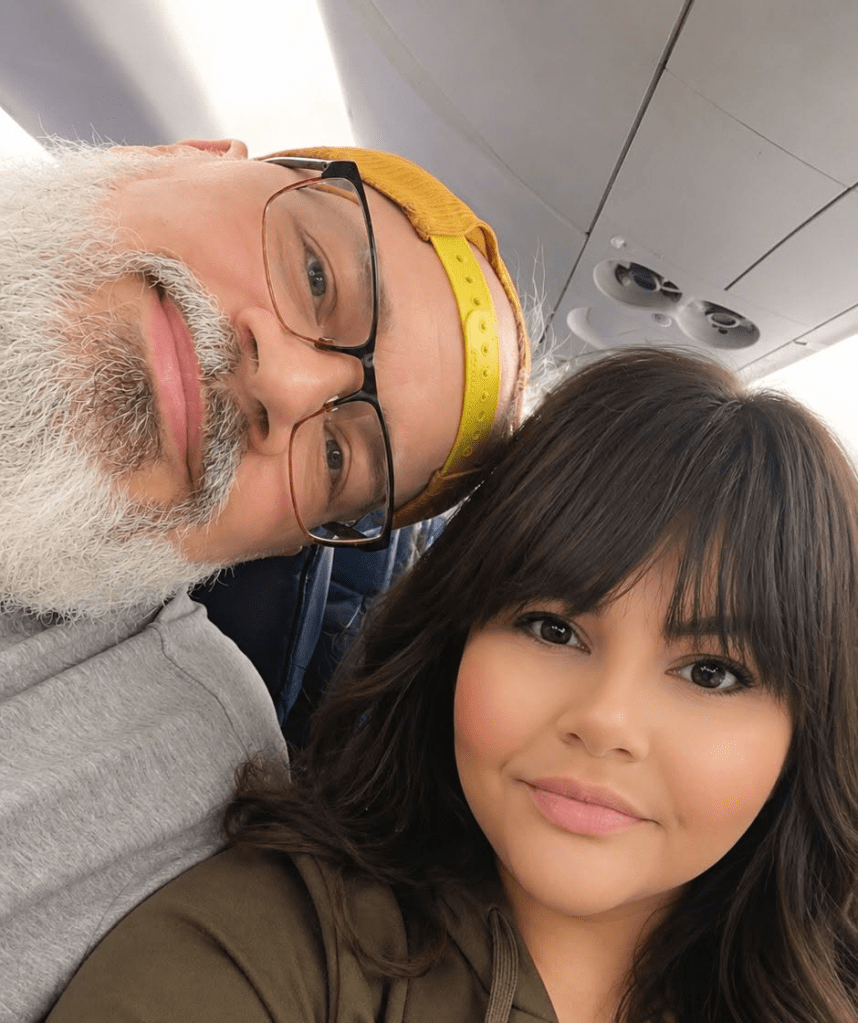
The obligatory birthday selfie, taken as our plane took off to Atlanta.
Birthdays aren’t really the same anymore. It’s less about getting older and more about taking inventory.
Not just of what I’ve “accomplished,” but what I’ve been given.
This year wasn’t easy. There are prayers I’ve prayed that still have not been answered. Relationships that still ache. Questions that remain unanswered.
And yet…
…when I stop looking only at what I’ve lost – or only what I don’t have – I realize I’ve been surrounded by blessings all along.
Some obvious. Some quiet. Some I almost missed.
38 Blessings in Honor of the last 38 Years
A husband who still chooses me every day – the one person who has seen every part of me, and stayed anyway.
My son, who reminds me that motherhood is still one of my greatest gifts.
A job that allows me to work from home.
A paycheck that pays our bills.
A home that has become my safe place.
Two dogs who genuinely think I am the most interesting human alive.
Coffee, because yes, it deserves its own number.
A therapist who asks hard questions instead of offering easy answers.
A church where I can continue to grow.
A Bible that says something new every time I open it.
The courage to tell the truth.
The humility to admit when I am wrong.
The discipline to keep showing up.
Peaceful mornings.
Quiet evenings.
The ability to laugh at myself.
My journals, which have become a reflection of conversations I have with God and with myself.
Words, because writing has helped me survive seasons I cannot explain out loud.
The freedom to begin again.
The realization that healing isn’t linear.
Learning that my worth isn’t up for a vote.
A slower, steadier nervous system than the one I had even as recently as last year.
The ability to pause before reacting.
Boundaries that no longer feel selfish.
The phrase, “I don’t receive that,” which is used sparingly, but is necessary when accusations and criticisms from others are misplaced by people who actively choose not to be a part of my life.
Sleep onset by a clear conscience.
The fact that I am no longer running from myself.
The ordinary rhythm of work, dinner, laundry, prayer, and bed – what I used to call boring but now know as peace.
Books that challenge me.
Music that met me where words couldn’t.
My health – even though I often take it for granted.
The few people who stayed.
The people who left, thereby forcing me to learn who I am without their approval.
Consequences – not because they are enjoyable, but because they are some of my greatest teachers.
God’s patience with me, which amazes me to this day.
Hope, even on days when it seemed out of reach.
The woman I am becoming – not finished, not perfect – but unmistakably different than she was even at 37 years old.
Another year – not everyone gets one. And I don’t want to waste time.
If you’d asked me at 37 to list my blessings, I’d have probably focused on the big things. Today, I think the smaller, more subtle things have become my favorite.
And empty laundry basket. A quiet house. A prayer answered with peace instead of explanation. A giggle. A page filled in my journal. An ordinary Tuesday.
Maybe the gift of getting older isn’t a bigger life. It’s better eyes. Eyes that are slowly learning to recognize that He has been generous all along – even in seasons when I couldn’t immediately see it.
38 wasn’t the year I got everything I wanted. It was the year I began wanting different things. Restoration instead of reconciliation. Steadiness over certainty. Peace over intensity. And a closeness with the Lord, which matters more than the acceptance I once desired from others.
These are not just a different list of blessings. They’re proof of a changing heart, and not by my doing, but His.
There was a time in my life – a couple of decades, really – when every difficult conversation felt like a fight for survival.
If I didn’t explain myself perfectly, I’d be misunderstood. If I didn’t defend myself, people would assume the worst. If I didn’t speak up, my feelings wouldn’t matter.
Looking back, I realize that I hardly ever spoke from a place of confidence. I was speaking from fear.
Fear has a loud voice. It rushes. Interrupts. Overexplains. It believes every disagreement is a threat and wants immediate resolution. And I’ve spoken from that place. Not because I wanted to argue, but because I desperately wanted to be understood.
Love is different. It’s still honest. It still set boundaries. It still says, “That hurt me.” But it doesn’t need to raise its voice to prove its point. Love doesn’t try to win. It simply tries to communicate.
I once thought I only ever had two choices: Stay silent or become defensive.
Now I know that there is a third option: Speaking calmly, clearly, and respectfully, without apologizing for existing and without trying to control the outcome.
I can stand up for myself but not stand against other people. I thought that advocating for myself automatically meant creating conflict. But healthy self-advocacy isn’t about making someone else “lose.” It’s about refusing to disappear.
It’s about saying:
This is my perspective. This is my boundary. This is what I need.
And not demanding agreement.
When I speak from fear, I need the other person to understand me right now. To apologize right now. To reassure me right now. Fear wants immediate validation.
But love is willing to wait. I can release the outcome. If I’ve done my part by telling the truth, what someone else does with it belongs to them.
I back this belief up with Scripture. Jesus wasn’t passive. He spoke when truth needed to be spoken. He confronted injustice. He corrected error. He defended the vulnerable. But He was never driven by panic or insecurity or the need to prove Himself. His words flowed from a place of love, even when those words were difficult for other people to hear.
That is the kind of courage I want.
Standing up for myself looks less dramatic than it once did.
I don’t agree. That hurt me. I am not comfortable with that. I need some space. I won’t be participating in that.
No speeches. No emotional explosions. No desperate attempts to win others to my cause. Just honesty.
I probably will always feel nervous before difficult conversations. I will probably still overthink the things I say.
But something that has changed in the last year or so is that I no longer speak because I’m afraid of disappearing. I speak now because I believe I was given a voice, and using it with humility is one way I honor that blessing.
Standing up for yourself doesn’t have to be rooted in anger, pride, or fear. It can come from love. Love for the truth. Love for the relationship. Love for the other person. Or in my case…love for myself. Because using my voice isn’t about convincing everyone that I’m right. It’s about communicating honestly enough that I can walk away from an interaction knowing I was faithful to my values. And if the conversation doesn’t go the way I’d hoped, I can still leave it with peace…because I spoke from love and not fear.
When I made a commitment to become someone I could tolerate, I sincerely thought the changes I would make would be dramatic.
Huge breakthroughs. Personality makeover.
As if something would click in my brain and I’d think, “Yep, never doing that bad habit again for the rest of my life…”
But the biggest changes in me over the last six months (since we are officially halfway through 2026) have been subtle. I’ve noticed them in ordinary conversations. Ordinary Tuesdays. Ordinary decisions.
Subtle growth is easy to overlook. So I take time, now, to acknowledge it – not because I am finished – but because six months ago, I was so broken and ashamed and torn in two that none of these things were true of me.
Today, they are.
I don’t chase like I used to. There was a time when rejection sent me running. Toward explanations, reassurance, solutions, proof. Toward being chosen. Now? I am allowing doors to stay closed. People can’t be convinced. Relationships can’t be repaired by one-sided effort alone. And that doesn’t mean I don’t care. It means I have stopped believing that my value depends on someone else’s decision to stay. I hate being rejected. Abandoned. Excluded. But running exhausts me. And it rarely got me what I wanted.
I have stopped trying to control other people’s opinions. This one is still a work in progress, but I have made strides. I used to spend so much of my energy wondering if people understood me, if they noticed I’d changed, if I should explain myself one more time. Now, there is one question on my mind: Am I living with integrity? Because that is the only part I can control.
I pause more than I react. I used to confuse every emotion with an emergency. Now I breathe. I pray. I sleep on it. I journal. A lot of regret I am still processing from my past exists because I acted on emotion and not in alignment with my core values. And today, I might feel something and cry or get angry or be disappointed. But I don’t make decisions with the sole purpose of relieving those emotions.
I live life in the delightfully ordinary. Old Me would be terrified to learn that I have a routine now. Predictability. Quiet evenings. Laundry. Work. Dinner. Prayer. Writing, reading, and repeating. Old Me thought that was really boring. The woman I am becoming thinks its peaceful. Stability is not the absence of life. Sometimes it is evidence that healing is taking root.
I take responsibility for my inner world. My emotions. My triggers. My healing. My productivity. Those belong to me. Other people can certainly hurt me. But they cannot do my emotional work for me. And that responsibility used to feel so heavy that I shirked it every chance I could. But knowing what I can control – myself – is true freedom.
I am becoming someone I respect. Not because I am perfect. I’m far from that. I still have fears. I still overthink. I still get hurt. And I still make mistakes. But when I look in the mirror each morning, I see someone who is trying. Someone telling the truth. Someone keeping her promises more often. Someone consistently choosing her faith/values over temporary relief. Someone who’s stayed. And that’s a woman I can respect.
Growth doesn’t always feel like growth. Sometimes it feels like saying no. Keeping quiet. Sometimes it looks like folding laundry instead of collapsing on my bedroom floor in a pile of depression. Sometimes it’s going to therapy. Reading my Bible. Paying my bills. Keeping my word.
None of those make dramatic stories. None of those come with awards.
But if you’d asked me six months ago where I’d be today, I probably would’ve listed external goals. Relationships repaired, problems solved, circumstances changed.
And instead, God is changing me…one ordinary day at a time.
And that’s the miracle I almost missed. My life hasn’t become perfect. But in the middle of an imperfect life, I am finding more peace. And perhaps that’s all the last six months needed to do.

 Raspberry Iced M