
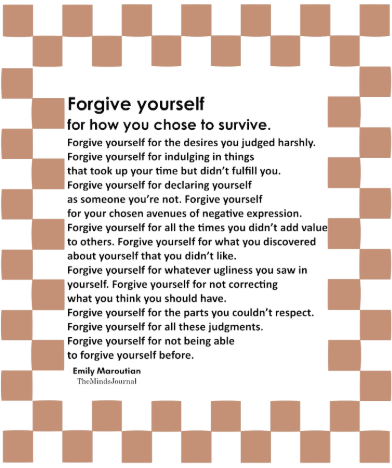
I am quicker to forgive other people than I am to forgive myself.
If someone makes a mistake, I find myself wondering what he/she has been through, what he/she is carrying, what placed that person in his/her position.
But when it’s me, the verbiage is different. How could you? You knew better. You ruined everything.
And that’s the PG rated version. I’ll spare you the more intense, heavier thoughts and accusations. But there have been times that I have looked at myself in the mirror and talked to myself in ways that…well…let’s just say I’d never say some of those things to anyone else, no matter what they’ve done.
It’s amazing how much grace I can extend outwardly while refusing to receive any myself.
I know my motives. And I think part of the reason forgiving myself is so hard is because I know more than anyone else does. I know the thoughts I had before I made the decision, the warning signs I ignored. I know the moments I could’ve turned around, the opportunities I wasted. So while other people see my actions, I know the circumstances leading up to them. And that makes self-forgiveness feel complicated.
It has taken a year of therapy to recognize that guilt serves a purpose. I’ve learned not to hate it. And I’ve forced myself to sit in it and process it. Healthy guilt is a gift. It tells us that something in our lives is out of alignment. It leads to confession. Toward repentance. It prompts us to make things right when and where we can. Without guilt, I might never recognize what in my life needs to change.
But guilt is also meant to be a doorway, not an address.
Shame – on the other hand – is different. It whispers something guilt never does. Instead of, “I did something wrong,” it says, “You are something wrong.” Guilt points to a behavior but shame attacks identity. On good days, I know the difference. On bad days, my vision becomes clouded with the tally marks that I’ve created in my brain – summing up how many times I have messed up.
And on those bad days, I convince myself that shame is synonymous with accountability. I think that if I keep punishing myself – if I keep spouting vicious insults to myself in the bathroom mirror – if I refused to let go of any failure – it somehow proved that I was truly sorry. I thought that if I stopped replaying my mistakes, that would mean I wasn’t truly sorry…that if I stopped condemning myself, I was minimizing what I’d done. So shame became a card I still carry in my back pocket like it is evidence of repentance.
My mistakes have cost me relationships with people I still cry for. Almost daily, I grieve someone who has left me because I could not meet their expectations at one point or another. And it is really hard for me to forgive myself because I’ve lost those people. My brain doesn’t know how to release my failures because those failures have hurt people I love. It’s almost like I can’t be okay until they are okay…like I have to grin and bear this until they come back, as if restoration of past relationships is somehow the only thing that will prove I’m worthy of acceptance.
My therapist says that I can acknowledge that my choices hurt people. And I can grieve what cannot be undone. And I can accept consequences…while still believing that God is not asking me to spend the rest of my life hating myself.
I know my therapist is right.
But I don’t know how to do that.
I can open my Bible and read stories of redemption over and over again. The prodigal son. Peter after he denied Jesus. Paul after literally murdering Christians. The adulterous woman.
Those stories make me smile and feel warm inside. I celebrate God’s grace for them.
But then I close the Book and bury my head into a pillow without ever considering that that same grace applies to me…as if His mercy has an exception clause with my name on it.
Forgiving myself requires a certain level of trust, and the reality is I don’t trust myself. I can’t pretend nothing happened. I can’t pretend the consequences I’m currently living in will disappear overnight.
I told the Lord last night, “My faith hasn’t altered. But my willpower isn’t reliable.”
I have asked Him so many times to deliver me from myself. I have asked Him to soften the hearts of people I’ve lost. I’ve asked Him to remove from me whatever parts cause so much hurt and chaos in the lives of others. Sometimes I ask Him to forgive me, even though I know He already has.
Sometimes I’m fine. Sometimes I can make it through the day without dwelling on my Scarlet Letter. There is no rhyme or reason or pattern in my life that helps me recognize when shame is going to rear its ugly head. And the truth is that I’ll never forget the lessons or try to rewrite history.
But I don’t want my past to always be the only thing I see when I look at that mirror, and I don’t want to stunt my growth with daily ruminations that confirm I’ll never be more than my worst choices. So I am challenging myself to believe that He died for me as much as He died for everyone else. I want to believe He is changing my heart – little by little – because that is what I have asked Him to do.
The word “repentance” is a noun. Its literal meaning is, “the act of changing one’s mind.” Which I have done. The verdicts I hand myself…the rejection I’ve confronted…the shame I fist fight…none of those things are more righteous than His forgiveness. If I can learn to sit in self-forgiveness instead of my failures, then said failures no longer get to write the last chapter of my story. So that’s the goal.
Fingers crossed.


Leave a Reply